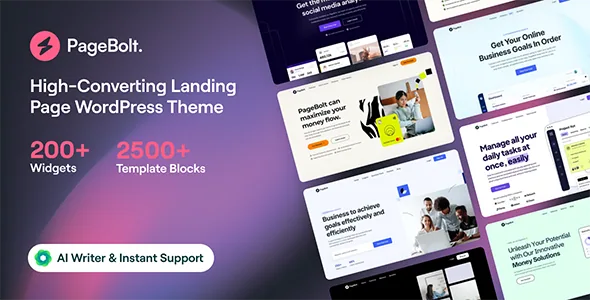
The campaign page is a separate case, and PageBolt treats it as one
A sales page and a blog archive need different chrome, and most themes make you solve that with duplicate templates or a child theme. PageBolt's page options panel overrides theme settings on a single page without custom code. The listed controls are the ones that matter for a campaign: page title on or off, title background and overlay, title colour, breadcrumbs, boxed or full-width layout, body background, header on or off, transparent header, header height change on scroll, top banner, footer, copyright, plus per-page custom CSS and JS.
In practice that means a launch page can carry a transparent header over a full-bleed hero with no footer, while the contact and blog pages keep the standard site frame. You are not maintaining two template sets to get both.
The panel is described by the vendor as sitting on top of the theme options, not replacing the Elementor workflow. If you work in Elementor, you still build the page in Elementor; the options panel decides what the theme wraps around it.
Global colours and fonts are wired into Elementor's design system
According to the marketplace description, PageBolt exposes seven global colours that link to every colour setting in Theme Options and are fully integrated with Elementor's design system. Global fonts work the same way: choose a Google font or a system font, apply it theme-wide, and it links to typography settings in Theme Options, again described as integrated with Elementor. A separate 990+ Google Fonts collection is listed for picking individual faces.
For a client site the payoff is that the brand palette and type scale are entered once and then reused as named options in the editor. When a client asks for the accent colour to shift, it does not become a search through every widget.
Two smaller theme options help manage that settings surface: a Live Settings Search that jumps straight to a named setting, and a Preset Manager that saves and loads option groups per category, including ready-made presets drawn from the demos. Read the Elementor integration as a vendor claim about wiring rather than proof that Elementor's own site settings become redundant; if you rely on those, expect to keep using them.
Two libraries, not one
PageBolt's Elementor assets come in two kinds. The vendor lists 200+ design elements available inside the Elementor editor, and separately a UiCore Template Library of 500+ pre-designed sections and pages to pick from and combine.
A widget is a single block you place into a layout. A pre-designed section is an arrangement already composed \u2014 spacing, columns, typography and all \u2014 that you drop in and adjust. When a draft has to exist by Friday, the sections are where the time saving shows up, because the first pass of a page arrives mostly assembled.
The listing does not break the 500+ figure down by category, so how much of the library is landing-page shaped and how much is blog or portfolio shaped is not stated. Browse it before you quote a build around it.
The wide element list buys a shorter plugin stack
The 200+ element inventory is unusually broad for a corporate and marketing theme, and the unusual entries are what make it worth reading. It includes a 360\u00b0 Product Viewer, crypto currency card and table, trailer box, weather, QR code, timeline, document viewer, image compare, and a charity cluster covering Give and Charitable donation forms, donor walls and goals. Event elements, Easy Digital Downloads modules, Tutor LMS course grids, a cookie consent bar, table of contents, countdown and pricing table appear too.
That list is the vendor's own count, and no page needs anything close to 200 elements. The useful reading is narrower: the small blocks a marketing site usually installs a separate plugin for \u2014 countdown, pricing table, logo carousel, testimonial slider, cookie bar, table of contents \u2014 are listed as native widgets here. If keeping the plugin count low matters on your builds, that inventory is the reason to choose PageBolt. If you rebuild the same handful of sections on every project, the extra elements cost you nothing and add nothing either.
Selective demo import, and what it does not settle
The importer is described as a two-step choice: pick a demo, then pick which content types to bring in \u2014 pages, posts, widgets, navigation menu items, media and theme options. Required plugins are installed automatically, and failures are reported, with an Error Log in theme options for imports that fail or finish only partially. A Server Status check reports whether the hosting configuration meets the theme's minimum requirements.
Selective import is the detail that matters for a rebuild: you can take theme options and navigation structure from a demo without dragging in its posts. What the description does not cover is imagery licensing or how much placeholder media the demos ship with, so budget for your own photography whichever starting point you choose.
Publishing tools beyond the landing page
PageBolt is titled a landing page theme, but the description covers editorial work properly. Blogs get four base layouts, grid controls for columns, item spacing, hover effect, image ratio, border radius and typography, on/off toggles for author, date, category and excerpt, sidebars assignable per archive and per post with normal or sticky behaviour, a narrower post container, a reading progress bar below the header, and separate typography settings for post content. A UiCore Post Grid widget places a blog grid anywhere on a page.
Portfolio items get their own grid controls, sidebars for both the portfolio page and single item, and Elementor-based editing.
The declared plugin environment, observed 4 November 2026
The compatibility attribute lists Contact Form 7, Elementor, Elementor Pro, Events Calendar, Events Calendar Pro, Gravity Forms, WPML, and WooCommerce 6.x and 7.x, with WordPress 6.7.x as the declared software version. Browsers are listed as Firefox, Safari, Opera, Chrome and Edge, and files included as PHP, CSS and JS.
These are vendor declarations, not tested pairings. Check them against the versions you actually run, especially WooCommerce if the shop matters to the project. Gutenberg Optimized is marked No, which describes the editing route the vendor supports; it does not mean the block editor is switched off.
The marketplace listing carries a live preview of the theme's own pages, which is the place to check layouts before you commit.
Questions & answers
Do I need Elementor Pro to use PageBolt?
The compatibility attribute lists both Elementor and Elementor Pro, and the vendor describes the theme's elements as available inside the Elementor page builder. That points to Elementor as the base requirement rather than Pro, but the listing does not say which elements depend on Pro features. Check the specific widgets you plan to use against the vendor's knowledge base.
Can I import only part of a demo?
Yes, according to the vendor. The importer asks you to choose the content types to bring in — pages, posts, widgets, navigation menu items, media and theme options — so theme options and menus can be imported without the demo's posts. If an import fails or stops partway, an Error Log in theme options records it.
Does the block editor still work?
The listing marks Gutenberg Optimized as No, which reflects the Elementor workflow the vendor builds around. It does not state that posts cannot be written in the block editor, and the blog controls are described in terms of layouts, sidebars and typography rather than an editor.