Three reservation routes, and the one you should choose first
Before you look at layout, decide how a table request should arrive. The Elementor edition's version 2.0.0 changelog entry from 18 April 2025 lists the booking form options the vendor moved between: Contact Form 7 updated, Five Star Restaurant Reservations updated, and OpenTable added. Three named integrations means three different operating models.
A Contact Form 7 route keeps everything inside WordPress: submissions land in your site and notifications go to whichever address you configure, but you own the reply, the confirmation and any calendar entry. Five Star Restaurant Reservations is a booking plugin with its own availability handling, which is a different level of machinery than an email form. An OpenTable form hands the reservation to OpenTable's system, so the booking lives in an account you do not host.
Which is right depends on where your bookings are currently managed, not on which one sounds most advanced. A small cafe taking phone calls and a handful of emails each day may only need the form. A restaurant already listed on OpenTable gains little from duplicating its book in WordPress. Pick this before customising anything else; the booking block is the part visitors actually use.
A menu builder, events and a shop are separate jobs
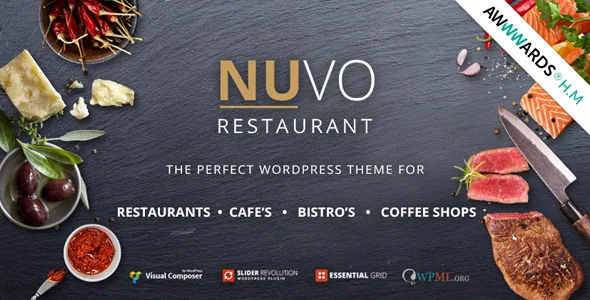
The vendor description groups four capabilities in one sentence: a menu builder, reservation booking, events management and an online shop. Read that as four content surfaces rather than one feature.
A menu builder is the surface that gets edited most often. Menus change with seasons and prices, so what you want is a structure where a dish is an item with a price and a section, not a line of text inside a page layout. The changelog history supports the interpretation that menu items are structured content: an early entry adds an option to place the price before or after an item, and another adds the ability to turn the menu link on or off.
Events are tied to third-party ground. The vendor's credit list names Events Manager at wp-events-plugin.com, and older changelog entries record compatibility fixes for Events Manager versions as far as 5.7.x. If your calendar needs recurring schedules, ticket capacity or venue data, check what the events plugin provides in its own right rather than assuming it lives in the theme.
The shop side is WooCommerce, which the vendor lists as compatible across 5.x.x through 9.x.x. Selling retail items, gift cards or a takeaway menu through a shop is a WooCommerce configuration task; the theme's role is styling and templates, not commerce logic.
Two builder editions with different version numbers
The changelog is split into a Change Log Elementor and a Change Log WPBakery, and the two lines carry separate version numbers on the same date: 2.0.2 for the Elementor edition and 6.1.3 for the WPBakery edition, both dated 6 August 2025. The marketplace's listed latest version of 2.0.2 corresponds to the Elementor line.
That is a practical detail, not a trivia item. When you report a bug, ask for support or compare release notes, the version number alone is ambiguous unless you say which edition you run. The two lines also diverge in detail: the WPBakery 6.1.2 entry records updating WPBakery Page Builder to 8.4.1, a plugin update that does not apply to the Elementor edition.
The vendor's compatibility list names Elementor and WPBakery Page Builder, so both are declared. Nothing in the supplied material ranks them for quality or for parity of features. Pick one at the start and treat the other as unused weight; switching builders after a site is built is a rebuild, not a setting. If you have existing pages in one builder, choose that edition and accept whatever gaps appear when you compare against the other's changelog.
Full-width or boxed — with a narrowing history
The vendor describes a layout choice: full-width or boxed, switchable globally or per page. It is a reasonable option for a restaurant brand that wants a framed, printed-menu feel on some pages and open photography on others.
Check that expectation against the changelog before you build around it. A WPBakery entry from 2 February 2017 states removal of boxed layout and fixed header from Page Options, and removal of the fixed header from Theme Options. The direction of travel was toward a single global control rather than per-page overrides. Later entries describe adding custom row styles with overlay and cover effects, which is a different way of achieving a framed look.
The accurate expectation is therefore a layout setting you can apply, with the newest release notes as the authority on how granular it is. Confirm whether per-page switching still exists in the edition you install before you promise a client that some pages will be boxed.
What the package contains, and what the demo does not give you
The marketplace lists the included files as PHP, CSS, SCSS and JavaScript, and the theme is marked widget ready, high resolution and well documented, with demo content and video tutorials mentioned in the vendor description. Child theme files appear in older changelog entries, so a child theme has been part of the package in the past, though it is not among the file types the listing enumerates.
One exclusion matters more than any inclusion: the vendor states that images and videos taken from Shutterstock, iStock and Unsplash are for display purposes only and are not supplied with the final packages. A demo import gives you a layout with placeholders or references, not a licensed photo library. For a restaurant, food photography is the site's main asset, so budget the shoot as part of the project rather than as a later upgrade.
The description also credits bundled plugins with notional savings — Slider Revolution, Visual Composer and Essential Grid are each named with a figure. Treat those as the vendor's marketing, and treat plugin licensing and update entitlements as something to confirm for the edition and version you actually install, particularly on the WPBakery line whose notes reference its own page builder version.
Declared compatibility, as recorded in November 2026
Marketplace attributes observed on 4 November 2026 list WordPress 5.4.x through 6.8.x, WooCommerce 5.x.x through 9.x.x, Elementor, WPBakery Page Builder, Contact Form 7, WPML and Bootstrap 4.x and 5.x. Layout is responsive with four-plus columns, and browsers named are Chrome, Firefox, Safari, Opera and Edge, plus IE10 and IE11, which tells you the browser list spans the theme's long life rather than describing a current testing matrix.
These are declarations from a listing, not results from running NUVO on a particular install. The top of the WordPress range — 6.8.x — is where the vendor's own April 2025 compatibility note sits; anything newer is untested territory according to the evidence available. Gutenberg Optimized is marked yes, but that attribute says nothing about how the restaurant modules behave inside the block editor, and the theme's layout work is described through Elementor or WPBakery rather than blocks.
If your stack sits at the edge of those ranges — a recent WooCommerce, a newer WordPress minor — confirm on staging before launch. Attribute lists describe intent, and the only proof is your own install.
Questions & answers
Can I use NUVO as a cafe site without taking reservations at all?
Yes in principle — the booking form is a feature the vendor describes, not a requirement, and the menu builder, events and shop sit alongside it. The supplied material does not describe a demo built specifically to omit reservations, so treat that as a page-level decision rather than a documented preset.
Does the theme handle OpenTable bookings inside WordPress?
The April 2025 Elementor changelog lists OpenTable as an added booking form option. That places the booking entry point in OpenTable's system rather than making WordPress the booking database. Availability rules, table assignment and diner records would live in OpenTable, and the supplied material does not describe a two-way sync.
Which version number should I quote when asking for support?
Say which edition you run. Elementor and WPBakery have separate changelog streams with different numbering — 2.0.2 and 6.1.3 respectively as of 6 August 2025 — so a bare version number can point to either release.