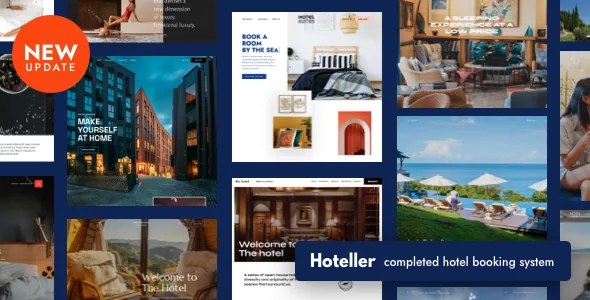
Rates are the product here, not the layout
Most hotel themes give you a room page and a form. ThemeGoods describes Hoteller differently: the booking system is part of the package without an extra plugin purchase, and the feature list spends its length on how a price is calculated.
That is the part to evaluate first. A rate in Hoteller can shift on several axes at once — the season or specific days you set, what the room includes, how many guests are searching, and how many nights they stay. If your property quotes rates by more than one of those, the theme's pricing model is doing real work rather than decorating a form.
Behind it sits a flow the vendor describes end to end: search availability by adults and children, a single accommodation page with room detail, price, gallery and booking form, a checkout for personal details and payment, and a guest account with booking history.
Seasonal, benefit-based and per-guest pricing
Seasonal pricing lets you set prices for a season or for specific days and dates. The vendor treats "season" as a label you rename to suit your own rate changes, so it does not have to mean high and low summer.
Flexible rates attach different prices to what a stay includes, with breakfast versus no breakfast as the vendor's example. The guest sees the options and picks one during booking, which means the rate comparison happens on your page instead of over the phone.
Variable pricing changes the price from the search parameters themselves; the vendor describes customising accommodation rates with price variables based on guest count. Weekly, monthly and other custom rates add price points tied to length of stay.
Packages and services can be sold alongside the reservation, free or paid, charged per room or per person. An airport transfer or a breakfast-inclusive package sits in the same checkout as the room.
Rules can be set for the property, one unit, or a season
Booking rules are scoped three ways: the whole establishment, an individual accommodation, or a season. Within that scope you set minimum and maximum nights and available check-in and check-out dates, and you can switch booking off for a period either everywhere or for one unit.
That granularity is worth mapping against your calendar before you build. A minimum-stay rule for the whole property is a broad instrument; applying one to a single unit in a single season is what lets you protect a peak weekend without restricting the rest of the year.
Hoteller also handles parties that need more than one unit. The vendor says the search recommends suitable combinations and that the guest can skip the recommendation and choose their own rooms. How that recommendation behaves with your actual inventory is not something the description settles.
Taxes, fees and the total the guest agrees to
Mandatory fees, accommodation taxes, service taxes and fee taxes can all be attached to a charge, and the guest sees a summary before confirming. The vendor says the same figures are stored with each booking in the admin dashboard.
That storage matters more than it sounds. A total that exists only on the checkout page cannot answer a question about a bill weeks later; a total recorded with the booking can.
Payment runs through four gateways the vendor names as built in: PayPal, 2Checkout, Stripe and Beanstream/Bambora. You can charge the full amount, take a deposit to confirm, or let the guest pay after arrival. The description does not tie these gateways to particular account types, countries or currencies, so check the one you intend to use against current vendor documentation rather than assuming a listed name still works unchanged.
Where iCal ends and a channel manager would begin
The vendor describes iCal support as automatic synchronisation of bookings made on your WordPress site with those from online travel agents such as Airbnb or Booking.com, with avoiding overbooking as the stated purpose.
Keep that boundary in view. Calendar-level availability sync is not the same as a two-way channel manager that pushes rates and inventory per channel, applies per-channel markups or handles reservation messaging. If a channel manager already runs your distribution, the question is whether iCal supplements it or is meant to replace it — and the description answers only the first half.
The admin screen a front-desk team would actually use
Received bookings and booking requests, in their current statuses, are described as stored in one place: sortable, and shown in a calendar view. For daily operations that is the useful shape — arrivals, pending requests and cancellations read together rather than arriving as separate email threads.
Coupons are built from conditions rather than a single code field. The vendor lists a discount amount, an expiry date, selected accommodation types, check-in and check-out dates, and minimum and maximum stay lengths. Those constraints let a promotion attach to the nights you want filled rather than to every booking that finds the code.
Consent is a checkbox below each booking form for opting in to your terms, which the vendor presents as GDPR compliance. The checkbox exists; how your own retention and privacy policy maps onto it is your decision to make.
Elementor handles pages, the Customizer handles the rest
Pages are assembled in Elementor with drag-and-drop modules including gallery, blog and map, a responsive preview inside the builder, and saving a page as a template for reuse. The marketplace attributes also list Elementor Pro, though the vendor text describes the free builder's workflow rather than what Pro adds.
Typography and colour are managed separately in the WordPress Customizer: heading, menu, submenu and widget-title typography, more than 500 Google Fonts, Typekit and self-hosted fonts, colour pickers across content, forms, navigation, sidebar and footer, boxed or wide layout, and an optional frame. Responsive mode can be switched off from the Customizer with one click — an unusual control, and one to keep away from anyone browsing settings casually.
The listing marks Gutenberg Optimized as No. That tells you the theme was not designed around the block editor; it does not mean the block editor is unavailable, and Elementor is plainly the intended editing path.
Five starting sites, and two different multilingual records
One-click import is offered for five ready-made sites: Luxury Hotel, City Hotel, Beach Hotel, Mountain Hotel and Apartment. They are starting points for layout and booking configuration, and the vendor says more will follow in future updates.
On a second language the records disagree in a way that affects setup. The vendor's feature text walks through a multilingual site built with the free Polylang plugin, while the compatibility attributes list WPML and do not mention Polylang. Treat them as two routes with separate configuration and decide before you build, because translating room names, rate labels and booking-form strings is not work you want to redo.
The attributes also list bbPress and WooCommerce alongside the multi-version WordPress range; those are declarations from the listing rather than results from running Hoteller on a particular server.
What the description leaves you to verify
Hoteller is aimed at a property that wants reservations to happen on its own site, with its own rate structure, without licensing booking software separately. The seasonal, benefit-based and party-size pricing controls are the substance behind that pitch.
What stays open is how deep the channel integration goes, whether every named gateway is current for your region, and how the multi-room recommendation handles your actual room mix. Those are answers you get from the vendor's current documentation and a test build with your own rates, not from a feature list — and they matter more than the length of the list.
Questions & answers
Do I need a separate booking plugin for Hoteller?
ThemeGoods says the booking system is included without an additional plugin purchase, and describes availability search, checkout, guest accounts and booking history as part of it. That is the vendor's claim; confirm current package contents and update terms with them before relying on it.
Can Hoteller take a deposit instead of the full stay?
According to the vendor, yes: you can charge the full amount or a deposit to confirm a booking, or allow guests to pay after arrival. Payment goes through PayPal, 2Checkout, Stripe or Beanstream/Bambora, and taxes and mandatory fees appear in the guest's charge summary before confirming.
Does iCal sync replace a channel manager?
The vendor describes iCal as synchronising bookings from sites like Airbnb or Booking.com to avoid overbooking. That is calendar-level availability sync, not two-way rate and inventory management. If you rely on a channel manager, check whether iCal supplements it.
Is Hoteller set up for WPML or Polylang?
The record is split. The compatibility attributes list WPML, while the vendor's feature text describes a multilingual site built with free Polylang. Pick one route and confirm current support with the vendor before building the second language.