A header that can change from page to page
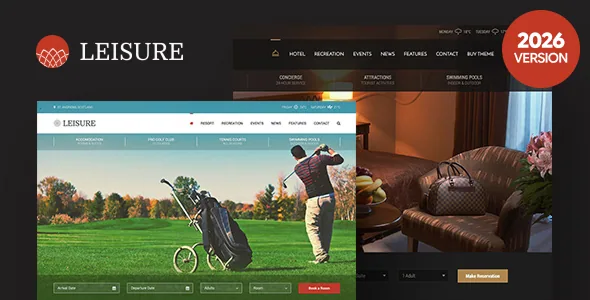
The vendor description for Leisure does not present one global header and a logo slot. It says the header options are flexible enough to get the right display for each individual page, and it names the levers directly: a slider, a custom image, added elements, colour and size changes.
That is a different working model from a theme where the masthead is fixed once in the Customizer. A hotel homepage can open on a full-width slider of rooms, a spa treatment page can carry a still image of the pool area, and a club page can use something plainer, without building three separate designs. The cost of that freedom is the maintenance: each page you create carries a header decision of its own, so a site with dozens of pages means dozens of header settings to keep coherent.
Everything here comes from the marketplace description rather than from using the theme, so treat it as a description of intent. The demo is the place to see how varied the headers actually look in practice.
Backgrounds set per section, per page, or globally
The second half of the same idea is the background system. The vendor says you can use a different background for each section or page, or configure it globally instead.
Section-level backgrounds matter most for image-heavy hospitality sites, where a homepage is a sequence of bands: an arrival shot, a rooms preview, a restaurant strip, an offers panel. If each section can take its own image, you can pace those bands instead of repeating one hero image down the page.
The three-tier arrangement (global default, page override, section override) is also the practical test of whether a theme like this suits your workflow. If you plan to hand a finished site to a client who edits pages themselves, more per-section control means more settings that can drift out of alignment over time. If you are the one who builds and maintains it, the control is the point.
Turning a page into a one-page site
Leisure's description states that any page can be turned into a one-page website using the theme's customization tools. For a restaurant, spa or small resort with a handful of messages — welcome, rooms, treatments, find us — a single scrolling page is often a faster read than five subpages.
The vendor does not describe how the anchor navigation for that one-page layout is wired, so the honest answer about whether it fits your structure comes from the demo rather than the feature list.
Navigation depth is stated more concretely. The theme supports sub-menus up to three levels deep, and the vendor says those are built by drag and drop. Three levels suits a hospitality menu that separates accommodation, dining and facilities, each with its own children. A leisure club with classes, courts and memberships can fit the same shape. Beyond three levels the description offers nothing, so a directory-style site with deeper nesting would be working against the theme's stated limit.
How pages are actually built
The vendor frames the build around Visual Composer, calling it an enhanced version of the drag-and-drop builder, with content management described as drag and drop throughout. The compatibility attributes separately list WPBakery Page Builder, which is the same plugin under its later name, and Gutenberg Optimized is recorded as Yes.
Those two facts sit side by side rather than cancelling each other out. The theme's demo pages and its shortcodes belong to the WPBakery world, while the Gutenberg attribute means the block editor is declared as supported for content. The description explains which builder produces the theme's own layouts and says nothing about how Gutenberg blocks are styled inside them, so a block-based editing workflow is not something the vendor text sets out.
If your team already works in WPBakery, the arrangement is ordinary. If you were hoping to avoid a page builder entirely, this theme's described workflow points the other way.
The bundled slider and form pieces
Two companion plugins are described as part of the Leisure setup. Slider Revolution is listed as included, and the vendor describes the slider as supporting custom effects, video embedding and user interaction. Ninja Forms is described as free and supported, with the theme extending it through a drag-and-drop field organization so forms can be assembled without code.
What matters for planning is the demo content. The vendor says the download package includes demo content for Ninja Forms and for the slider, alongside the theme's own demo pages. That means a ready-made enquiry form and slider layout can be loaded rather than built from scratch — a useful head start for a hotel contact form or a room gallery slider.
The description stops before saying what those demo forms collect. Whether they amount to a booking request, a reservation enquiry or a general contact message is not specified.
Compatibility claims and what they do not mean
The marketplace attributes list WooCommerce 8.x, 9.x and 10.x, WPML, Gravity Forms and Bootstrap 4.x as compatible, and the vendor text describes the theme as adapted for WooCommerce so the site can work as an online shop.
A compatibility entry is a declaration, not a description of templates. The vendor does not explain how shop pages are styled, whether product layouts are customised, or whether any demo includes a shop. For a hotel selling gift vouchers or a spa selling products, that gap is worth closing in the demo before committing.
WPML is treated more fully in the description: the vendor points to WPML for a multilingual site and also names Poedit or the Codestyling Localization plugin as alternatives for translating the theme's own strings. Browsers listed include Internet Explorer 11, Firefox, Safari, Opera, Chrome and Edge, which says little about how the layout behaves on a phone beyond the stated responsive, fluid framework. Layout is listed as responsive with 4+ columns.
What ships, and the one exclusion to read twice
The declared package includes PHP, CSS, SCSS and JavaScript files. The SCSS sources are the practical inclusion if a designer needs to adjust the styling at source rather than through theme options; the description also mentions unlimited colour options and custom typography settings, but does not say how those interact with the stylesheets.
The vendor description carries an explicit note that pictures and videos are not included. For a theme whose main selling point in the same text is large, beautiful imagery, that is the fact to plan around: every hero image, gallery shot and section background in the demo has to be replaced with your own licensed photography.
The marketplace listing records version 2.3.2 as the latest, observed on 4 November 2026, with a vendor update date of 29 October 2026. Those are listing figures. They are not a claim that any particular package you obtain is that build, and the description itself does not enumerate what changed between releases.
Questions & answers
Does Leisure include a booking or reservation system?
The vendor description does not describe one. It lists Ninja Forms as the form tool, including demo form content, but does not say those forms handle availability, rates or reservations. Rooms, availability and calendar behaviour are not covered in the description, so confirm the booking approach you need before relying on the theme for it.
Can I use the photos and videos from the Leisure demo?
No, according to the vendor's own note: pictures and videos are not included in the package. Budget for licensed photography, which matters more than usual here because the theme is designed around large images and per-section background pictures.
Is the theme built on Gutenberg or on a page builder?
The described build is Visual Composer (WPBakery), which the vendor calls an enhanced version of the drag-and-drop builder, and the demo pages follow that system. Gutenberg Optimized is recorded as Yes in the marketplace attributes, but the description does not explain how block content is styled within the theme's layouts. If your team edits in blocks, check how a test page renders in the demo.