Headers and footers are layouts, not fixed zones
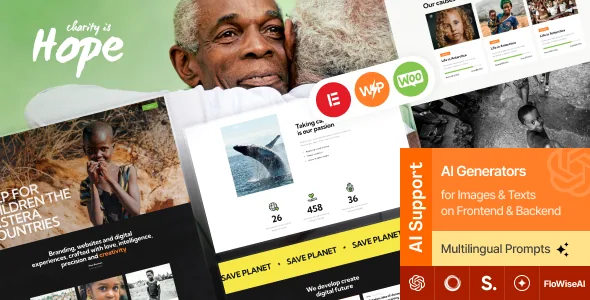
Plenty of themes let you edit page bodies in a builder and leave the header and footer to the Customizer. The vendor description for Hope takes the wider route: it says header and footer layouts are customised in Elementor Page Builder, and it lists Elementor and Elementor Pro among compatible plugins.
That changes the shape of a recurring job on a non-profit site. A header usually has to carry a donate button, a way into the events or campaign area, and a logo that survives a seasonal appeal. Built as a layout, it can be composed from the same widgets you use lower down the page instead of being constrained to whatever slots the theme fixes. Footers on charity sites tend to hold registration numbers, contact details and donation disclaimers that need to stay identical across pages, and editing them as a layout keeps that text in one place.
The theme ships its own addon layer, ThemeREX Addons, which the vendor lists alongside the theme and updater. It is where custom widgets come from, so the Elementor workflow reaches beyond stock elements.
The vendor also marks the theme Gutenberg Optimized as Yes, and one documented release adds a setting for how styles load into the block editor. That means the block editor is accommodated; the demos are described as an Elementor build.
How the override system is meant to work
The theme's own framework list opens with a Setting Inheritance and Override System, followed by 750+ Customizer options, custom post types, custom widget sets and custom shortcodes.
Read together, that is a base configuration with the ability to set individual parameters for different sections of the site and for supported plugins, which is how the vendor's own theme description frames it. For a charity site the appeal is uneven requirements: a campaign page may need louder colour and a different header treatment than the volunteer or press section, and those differences can live as overrides rather than as a rebuild of shared settings.
A later release points in the same direction, adding the ability to save and load custom style presets for Elementor widgets, sections, columns and containers. Presets and overrides are not the same mechanism, but both assume the theme is configured by stored settings that can be reapplied.
None of this tells you how your own page set will behave. The marketplace descriptions are the vendor's account of the framework, not a record of the theme running against your content.
Give runs fundraising, and the templates stay out of the way
The vendor names Give – Donation Plugin as the tool for fundraising campaigns, donations and charitable trusts, and the marketplace lists it as a compatible plugin. That is a claim about integration, not a statement that every demo depends on it.
If your donation structure is already built in Give, the question worth asking is whether the theme's page templates let the plugin's forms, progress bars and campaign pages keep their own styling. The vendor lists custom shortcodes and widget sets next to the plugin list, which is where conflicts usually appear. A campaign page, a single donation form and a recurring giving option are the three things to look at on the demo, since they exercise different parts of the plugin's output.
The theme does not present an alternative donation mechanism in the description, so a site already committed to a different donations plugin has no documented path here.
Events and the shop are separate jobs
The Events Calendar appears in the same compatibility list, and the changelog records specific maintenance on that integration: event times added to a widget's classic layout, and styling fixes in later releases. Those entries suggest the integration is kept working, not that it covers every pattern a charity calendar will need — recurring volunteer sessions, one-off fundraisers and multi-day appeals each test something different.
WooCommerce is described as full store compatibility for selling goods, with declared support from 5.x through 9.x, and TI WooCommerce Wishlist is listed for saving products. Merchandise, event tickets sold as products and branded items for a drive fit there. Recurring gifts and campaign totals do not; those belong to Give.
Two changelog entries show where shop work has landed: a product filter search field for long attribute lists, and a cart widget option to hide a zero counter. Useful for a catalogue, less relevant for a single campaign landing page.
One package note from the vendor: images used in the live preview are not included, and copyright stays with their owners.
RTL: what the label covers, and what it doesn't
The product name carries “+ RTL”, and the vendor markets the theme for non-profit organisations with RTL layout. For an NGO publishing in Arabic or Hebrew, that is a requirement rather than a bonus, so it is worth being precise about the evidence.
The changelog shows RTL work at the component level: a release adds basic RTL support to the navigation menu widget at the style level. A style-level fix addresses direction and spacing in that menu; it is not a blanket statement that every widget, form and interactive element mirrors correctly.
WPML is listed separately for translation. Multilingual content and right-to-left presentation are different problems, and the vendor's declarations cover both without describing how they interact. Because custom widgets come from the addon layer, the RTL quality of a given page depends on which widgets were used to build it.
Blog feeds and the layout set
The vendor lists 7 layout styles, multiple blog styles, 20+ post animations, boxed and fullwidth page layouts, and a blog feed you can draw from chosen post types or categories. Slider Revolution and a swipe-gesture slider are described as included.
The feed setting is the one with day-to-day consequences. Charity sites publish in distinct registers — campaign reports, volunteer stories, press notes, event recaps — and a homepage block filtered by category or post type can show one of those without removing the rest from the archive.
The marketplace attributes, observed on 3 November 2026, declare WordPress 4.9.x through 7.0.x, browsers including Firefox, Safari, Opera, Chrome and Edge, and PHP, CSS and JS files in the ThemeForest package. Treat all of that as vendor declaration about support rather than a result on your PHP build, caching layer or plugin combination.
Where Hope's setup pays off, and where to look harder
The theme suits a non-profit whose site is genuinely built out page by page — campaigns, events, a small shop, a news section — and whose team is comfortable doing design work inside Elementor, including the header and footer. The override layer is the reason to prefer it over a theme that offers a Customizer panel alone: sections and supported plugins can carry their own settings instead of one global style.
Two things need checking before you commit. If your fundraising already runs on a plugin other than Give, there is no documented alternative here. And if the site publishes in Arabic or Hebrew, evaluate the RTL claim on the demo's navigation, forms and cart with real right-to-left content, because the recorded work is component-level rather than a theme-wide guarantee.
Questions & answers
Do I need Elementor Pro to build the header and footer?
The marketplace lists both Elementor and Elementor Pro as compatible, and the vendor says header and footer layouts are customised in Elementor Page Builder. It does not state that Pro is required for the theme to work, so treat Pro as an option; check on the demo which features lean on it if your build depends on them.
Can the shop take donations instead of Give?
WooCommerce is described as store compatibility for selling goods, with declared support from 5.x through 9.x. Give – Donation Plugin is the fundraising tool the vendor names for campaigns and charitable trusts. The description does not present WooCommerce as a donation route.
Does the theme ship the images shown in the demo?
No. The vendor states that images used in the live preview are not included in the template and that copyright stays with their respective owners, so plan to supply your own photography.