Five travel post types are the real editing surface
Hemma's distinctive move is not a page canvas; it is content structure. The vendor says the theme ships with three bundle plugins that add five custom post types: Rooms, Events, Foods, Deals and Guest Posts, along with Instagram feed output and some extra shortcodes.
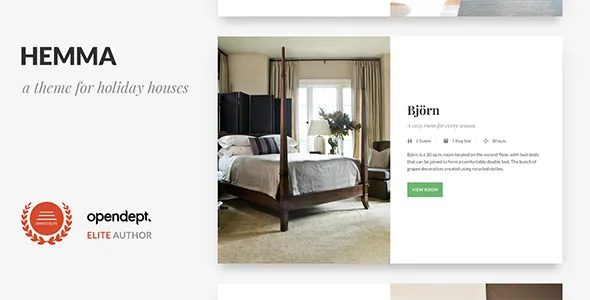
Those five names map onto what a guesthouse publishes. Rooms turns each accommodation into its own entry, so a room list and the room's detail page draw on one piece of content instead of duplicated pages. Foods holds a menu or the breakfast offering. Events covers what happens locally or on site. Deals collects packages and offers. Guest Posts sits apart from the ordinary blog, so visitor stories do not mix with your own posts.
One caveat: the vendor describes these as bundle plugins. The listing does not say which of them sit inside the theme archive, so check the plugin situation before you build a content plan around those types.
Pages come from templates and widgets, not a builder
The vendor is explicit that Hemma does not support page builder plugins such as Elementor, Beaver Builder or WPBakery, and warns those may not work as expected. That is a statement recorded on the marketplace listing, observed on 4 November 2026, not the result of an install test here.
Treat it as scope rather than a defect. If you plan to design pages from a blank canvas or hand a client a drag-and-drop interface, this is the wrong theme and no customisation will change that. If your pages should follow the theme's own templates with content coming from post types and widget areas, the missing builder simply removes a layer of decisions. The marketplace attributes mark the theme widget ready, with a responsive layout of 4+ columns, so supporting blocks belong in widgetised areas.
The vendor pitches Hemma to people who do not need a multipurpose theme but want a slim, Airbnb-like site for promoting their own holiday house. That is the same scope said in marketing language.
Menu depth is a limit you should settle before you buy
The vendor states that Hemma does not support submenus. Navigation stays one level deep. For a single property that is usually fine: home, rooms, dining, offers, events and contact all fit in one row.
It becomes a genuine constraint the moment you want Rooms grouped into Suites, Doubles and Apartments, or an accommodations menu split by property type. Because this is structural rather than a styling preference, decide menu depth before committing — a one-level menu is not something you can override later with CSS.
Where maps and translation belong
Two recurring jobs for a holiday house are showing people where it is and addressing them in the language they booked in. The vendor says Hemma supports the Google Maps API with two map styles that can be placed anywhere on your pages. That is partly a design claim: the two styles exist so a map sits inside a page instead of looking like a pasted embed.
The multilingual side is compatibility, not a built-in feature. The vendor names WPML and Polylang explicitly, and both are plugins you install and configure; the theme works with them rather than translating anything itself. Language switching and translation management stay under those plugins' control.
Instagram runs on a third party as well. The vendor says the theme uses the free Social Feed Gallery plugin to retrieve the feed, so feed behaviour follows that plugin's terms rather than the theme's.
Booking is outside the theme, by the vendor's own note
The listing states plainly that Hemma has no built-in booking system — no availability calendar, no rate management, no reservation flow. That belongs to whatever service or plugin you add, which is normal for a theme but worth stating because a holiday-house site's commercial function depends on it.
The only pointer the vendor gives is informal: some customers have reportedly used the HBook Hotel Booking plugin with minor CSS tweaks. That is a report about other people's setups, not a tested or supported integration. Expect to invest real time matching a booking tool to the theme's styling, and to confirm how enquiries reach you before launch.
Theme size, typography and the files you receive
Hemma is built on Underscores with semantic HTML5, and the vendor cites a file size of just over 300kb as part of a performance and SEO rationale. Typography is described as central to the design, and you can substitute any Google Font through the theme rather than by editing templates.
The marketplace file list names PHP, CSS and JS files, which indicates a compiled stylesheet rather than SCSS sources you can rework. The Gutenberg optimisation attribute reads No; take that as a statement about block-editor optimisation only.
The demo photographs are not included. The vendor's copyright note says images belong to their owners and appear for demonstration, so every photo on your finished site is one you supply or license — for a property site, a real budget line. The declared WordPress range spans 4.9.x to 6.5.x, with the marketplace version at 1.4.16 and the listing last updated in July 2024. Those are declared versions, not proof of testing against your PHP version or plugins, so verify on your own staging install. Documentation is described as detailed with video tutorials, and the vendor points to a support forum for questions.
Questions & answers
Can I use Elementor or WPBakery with Hemma?
The vendor says Hemma does not support page builders including Elementor, Beaver Builder and WPBakery, and warns they may not work as expected. Page structure comes from the theme's templates and widget areas, so plan around that rather than around a builder.
Does Hemma handle bookings itself?
No. The listing states there is no built-in booking system. Some customers have reportedly used the HBook Hotel Booking plugin with minor CSS changes, but that is an informal report rather than a supported integration, so you will need to choose and style a booking tool yourself.
Can the navigation use dropdown menus?
Submenus are not supported, so menus stay at a single level. That suits a small property site with a handful of top-level pages, but rules out nested structures such as rooms grouped by type.