Styling one section at a time
Most finance themes describe their look in adjectives and leave the styling story at "easy to customize." Fionca's vendor description makes a narrower, more useful claim: colour options and typography can be set for every section separately. That is a different working method from a single global palette.
If the control works as described, a page does not have to carry one scheme from top to bottom. You could keep an introduction block in restrained corporate tones, give a services grid a stronger accent, and let a call-to-action band run darker, without starting a second stylesheet. The same applies to type: heading treatment on a testimonial strip can differ from the one on a pricing block.
That is the kind of control that matters when a finance or consulting site mixes promotional sections with dense informational ones on the same page. It is also the first thing to verify in the demo before you commit, because "separately per section" can mean either a per-widget setting or a per-row one, and the wording does not settle which.
What you start with: two homepages and 10+ inner pages
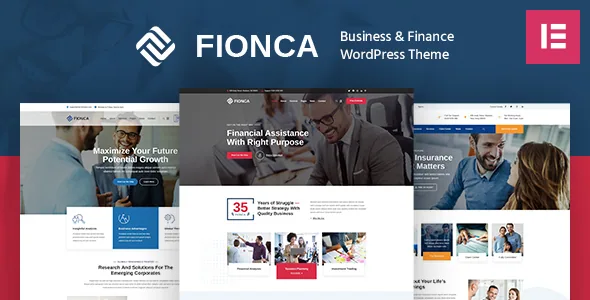
Fionca is not a theme that ships fifteen homepage variants. The vendor description lists two variant homepages and a collection of 10+ inner pages, and names what those layouts are built to present: services, portfolio projects, clients and team members.
For a consulting or advisory business, that is close to the actual content model. A homepage has to carry credibility signals (client logos, team faces), a services summary and evidence of past work, and the inner pages have to hold longer descriptions of each service and each person. Portfolio pages cover the case-study side of advisory work; client sections handle the trust part.
The honest way to read the count is as a starting frame, not a library. Ten-odd inner pages will not cover every page type a financial firm eventually wants, so plan on extending rather than choosing from a menu. The vendor also markets the theme across a wide spread of finance businesses — accountant, advisor, law firm, insurance, brokerage, wealth advisory — which suggests one structural approach is reused across those verticals rather than a dedicated demo for each.
Where site-wide settings and section settings split
Two administration surfaces are described. Theme-wide control sits in the Redux framework, which the vendor calls out as making theme control "more accessible and faster." Section-level design sits in Elementor, where the per-section colour and typography settings live.
That split is worth knowing before you plan the build. Global decisions — the base brand palette, the general type stack, header and footer behaviour — belong in the theme options. Local decisions — the treatment of one section on one page — belong in Elementor. Knowing which layer you are in prevents the common outcome where the same colour is set in three places and later changes miss one of them.
The vendor also refers to "custom Elementor addons of this theme" alongside the pre-defined layouts. In practice that means some of what you see in the demo is built from widgets the theme supplies, not from stock Elementor elements. The demo content is importable from the admin panel after activation, which gives you a working page to edit rather than a blank canvas — but it also ties the imported pages to those addons. Keep the theme's Elementor extensions active, or sections you import may not rebuild as shown.
Reading the package and attribute facts honestly
The marketplace file list for Fionca names Layered PNG, PHP files and CSS files. There is no JavaScript entry and no layered PSD or design source. High Resolution is marked No in the attributes.
The Layered PNG inclusion is the unusual part. It gives you editable layered image assets for whatever the vendor prepared them for — commonly a logo treatment or a hero composition — rather than a full design file. It does not replace a Figma or Photoshop source for the whole layout, so visual decisions you make about layout, spacing and imagery will be made in Elementor and CSS, not handed over as a source document.
The High Resolution marking applies to the seller's declared media handling; if sharp imagery on large displays matters to your site, treat it as a detail to confirm against your own imagery rather than an assumption in either direction.
A pricing note: the marketplace listed a Regular License at $50 when the listing was observed in November 2026. That is the marketplace's price, not a figure that describes any other source.
Platform claims, and the gaps in them
The vendor attributes observed in November 2026 declare WordPress compatibility from 5.0.x up to 6.8.x, compatibility with Elementor, and support across Firefox, Safari, Opera, Chrome and Edge. Widget Ready is marked Yes; Gutenberg Optimized is marked No.
Those are declarations from the listing, not results from running the theme on a particular host. The WordPress range is wide but should be read as a statement of support rather than a record that every entry in it was tested. The Gutenberg marking is a grading of how deeply the theme is built for the block editor; it does not mean the block editor is unavailable, and Elementor is clearly the intended editing surface. Likewise, the browser list is a claim, not evidence about how a specific layout behaves on a specific device.
The vendor description also names compatibility with Contact Form 7, which is a useful pairing for a consulting site: the enquiry form is the conversion point on most service pages, and using a widely known forms plugin means you configure the form in a tool with its own documentation rather than a theme-specific form builder.
Questions & answers
Does Fionca work with the block editor?
The listing marks Gutenberg Optimized as No, which grades how deeply the theme is built for the block editor rather than removing it. The described editing workflow is Elementor, and the demo layouts rely on the theme's custom Elementor addons, so plan your pages there.
Can I change colours on one section without affecting the rest of the page?
The vendor description states that colour options and typography can be modified for every section separately. The wording does not specify whether that control sits at row or widget level, so check the relevant setting in the demo or on a staging install before building a colour system around it.
What design source files come with the theme?
The marketplace file list names Layered PNG, PHP files and CSS files. There is no layered PSD or equivalent full-layout design source, so layout and styling changes are made in Elementor, the Redux theme options or custom CSS.