The header, footer and menu are Elementor documents too
In most Elementor themes the builder owns the page body and a separate options panel owns the frame around it. Key-Design's description for FinPath puts the frame inside Elementor as well: headers, footers and mega menus are designed on the front end with drag-and-drop, and the vendor supplies pre-designed templates for each of those three parts to import and adjust.
The assignment rule is the part worth planning around. The vendor says you can use different headers for every page and assign any footer template to any page. For a practice with a retail-facing homepage and a separate adviser or corporate section, that means the navigation can change with the audience without a second theme or a plugin. How granular the assignment gets — per page, per post type or per template condition — is not detailed in the listing, so confirm it on a staged install before you build around it.
A mega menu that can carry shop widgets, forms and a map
The mega menu builder is described as the same front-end Elementor workflow, and the vendor gives it content types beyond links: WooCommerce shop widgets, contact forms, and Google Maps can sit inside the navigation. On a finance site that is a plausible alternative to a long list of text links — a services column, a short enquiry form and an office location can live in one dropdown.
The vendor also states the menu is tuned for desktop, tablet and mobile layouts, and that pre-designed mega menu templates can be imported. Treat those as the vendor's claims rather than verified behaviour; menus are the first thing to test on a narrow screen because a multi-column layout has to collapse into something usable.
70+ widgets and 600+ blocks, with light and dark variants
The description puts the library at over 70 custom widgets and more than 600 template blocks. Two details make that count more useful than the raw number. Blocks are said to be built without hard-coded styles so they follow the theme's global fonts and colours, which keeps imported sections on brand instead of forcing a restyle. And the blocks are described as available in both light and dark versions, so a page built from a light block can be matched to a dark one rather than rebuilt.
Background options are listed as solid colours, images, video and gradients, with spacing, alignment, colour and font controls on the blocks themselves. The listing does not show a block catalogue, and the marketplace file list contains PHP, CSS and JS files with no layered design source, so any visual change beyond the Elementor controls happens in code or a child theme rather than in a design file.
Popups and off-canvas panels as the enquiry path
Lead capture for advisers and consultants usually means a consultation request rather than a checkout, and FinPath's popup and off-canvas tools are aimed at that. The vendor describes templates you can import, form integration for both simple subscribe forms and longer lead-generation forms, and the ability to put images, video, text and interactive widgets inside the panel.
Useful cases are concrete ones: a downloadable fee guide behind a short form, a callback request that slides in from the side, or a newsletter prompt on a blog post. The vendor lists Contact Form 7 among compatible plugins, so the form side of these layouts can run on a plugin you may already use. The listing does not say which popup conditions exist — exit intent, page targeting, scheduling — so check that before designing a campaign around them.
Starter sites scope the finance niche
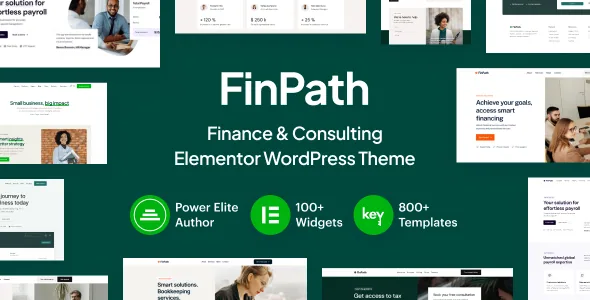
The starter sites are described as built around real business cases for financial, fintech, consulting, insurance, advising, bookkeeping and accounting work, each importing in one click with pre-built inner pages ready to replace with your own text and images. Read that as a description of the content's subject matter rather than a promise that a demo matches your firm.
What the import gives you is a working structure — service pages, team bios, testimonials or case studies — that you then edit in Elementor. The marketplace description also names investment firms and financial advisors specifically, which suggests service-led layouts rather than shop-first ones. Whether your specific offering fits is a question to settle by looking at the live demo before importing.
Blog, portfolio and WooCommerce controls an editor can change
The vendor's feature list is specific about the switches rather than vague about flexibility. The blog is offered in classic, horizontal and grid layouts with control over sidebar position and behaviour. The portfolio offers filterable grids and masonry layouts, related items below a project, and the choice of starting from a blank page or a pre-designed inner page template. WooCommerce gets product box designs, control over sidebar and product info position, and floating social sharing buttons.
These are layout choices applied through the theme rather than bespoke page builds, which suits a practice that wants its case studies and product listings consistent without redoing each one. The WooCommerce description stays on presentation — it does not describe checkout customisation or payment options.
Declared compatibility and the practical caveats
The marketplace attributes, observed on 4 November 2026, list WordPress 6.0.x through 7.0.x, WooCommerce 6.x.x through 10.x.x, and Contact Form 7, Elementor, Elementor Pro, Events Calendar and WPML as compatible. Gutenberg Optimized and Widget Ready are both marked Yes, and Chrome, Edge, Firefox, Opera and Safari are the listed browsers. These are vendor and marketplace declarations, not results from running the theme against a particular PHP version or plugin stack.
Two things are worth knowing before you commit. The description mentions one-click updates delivered from the vendor's servers, which depends on the vendor's update service remaining available to your licence. And a large block library is only as fast as the rest of the setup, so the vendor's claim of optimised asset and CSS loading and per-feature toggles should be measured on your own content rather than assumed.
Questions & answers
Do I have to use Elementor Pro to edit the header and footer?
The vendor describes header, footer and mega menu editing as happening in Elementor on the front end, and lists Elementor Pro as compatible. The listing does not break down which of those builders require the free or the Pro version, so check that alongside the demo before you buy if Pro is not already part of your stack.
Can different pages use different headers and footers?
The vendor states that you can use different headers for every page and assign any footer template to any page, working from a supplied set of header and footer templates. The exact assignment conditions are not described in the listing.
Does FinPath work for a shop as well as a service site?
WooCommerce compatibility is declared for versions 6.x.x through 10.x.x, and the theme adds product box designs, sidebar and product info positioning, and social sharing on products. The mega menu can also hold shop widgets. The description covers presentation rather than checkout behaviour.
Are the demo images included with the theme?
The listing does not say. The marketplace file list contains PHP, CSS and JS files, and the description refers to replacing placeholder images in starter sites with your own. Plan to licence or supply the photography yourself unless you find clearer guidance in the documentation.