The homepage is a stack of widgets, not a layout you draw
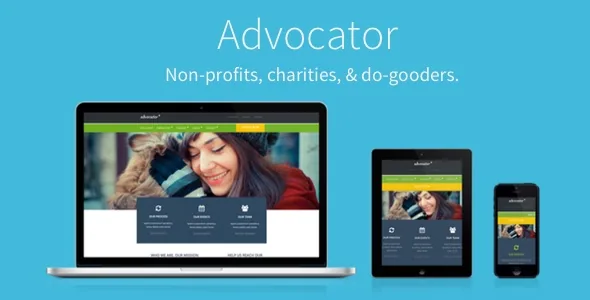
The vendor description for Advocator lists widgetized areas on the home page, sidebar and footer, and a changelog entry from March 2015 records individual widget classes being added to those areas. Taken together, that means the front page is composed by placing and ordering widgets in fixed regions rather than by dragging sections onto a canvas.
For a small organisation this changes who does the work and what it looks like. Adding a campaign appeal, an events list, a newsletter signup box or a short mission statement becomes a matter of moving a widget, not rebuilding a template. The trade-off is equally concrete: the page structure comes from the theme, so a design that needs sections in an unusual sequence will run into the regions the theme provides. Individual widget classes give you a styling hook per widget, which matters if you plan custom CSS.
If you were expecting to compose page bodies in Elementor or WPBakery, this is not that theme. Nothing in the description presents a page builder as its editing surface; Visual Composer appears only in the compatibility list.
Live Customizer colour and animation controls
The vendor leads its feature list with "See customizations live with the WordPress Customizer" and "Unlimited primary color scheme choices." Two changelog entries fill in the history: version 2.0 in November 2014 removed the old theme customization panel and added WordPress live customizer options, and version 2.3 from June 2015 added a header font colour option.
What that gives you is a colour layer you can adjust without editing stylesheets: primary colour choices, separate colours for links and buttons, button hover states, a footer background colour, and the background colour of the home top widget section. Animation options were added in December 2014 and fixed in December 2016, so motion on the page is configurable rather than hard-coded.
One caution about "unlimited": it describes the breadth of colour choice, not a design system. A team that needs per-page palettes or global typography scales should check the specific controls above rather than trust the adjective. Settings nested in the Customizer are also where a donation button's link target and hover colour live, which makes the Customizer the practical centre of this theme's configuration.
Giving is a button and a plugin, not a payment system
The description says "Accept Donations seamlessly," but the changelog shows what that has meant over time: version 2.0.8 in March 2015 added Donately as a recommended donation system and dropped Seamless Donations; version 2.3.5 in November 2015 added support for the Give donation plugin. The theme's own contribution is the presentation layer — a header donation button with configurable link target and hover colour, plus event buttons matched to the sitewide button colour.
So the decision is not whether Advocator can take money. It is which donation platform you run and whether the button takes visitors where they need to go. If your giving already sits with a hosted platform, an on-site form plugin or a fundraising service, the theme's job is largely a link. If you expected checkout logic inside the theme, nothing in the supplied evidence supports that.
Worth noting for mixed sites: WooCommerce appears in the vendor compatibility list at versions 3.5.x and 3.6.x, added in April 2016. That is a shop integration for goods, separate from donation handling.
Events, galleries, email and translation are separate jobs
Each of the remaining items on the feature list answers a different question, and they don't depend on each other.
Events run through The Events Calendar, which appears in the compatibility list alongside Events Calendar Pro. The changelog tracks that relationship closely from 2014 onward — compatibility updates for 3.6, 3.9.3, 3.10, 3.12.6 and version 4.5.10 in November 2017 — plus fixes for event list widget images, event title alignment, square versus standard event images, and single-event price display. Those entries describe a maintained integration, not a promise that every calendar pattern a nonprofit needs is covered.
Galleries and portfolios use a separate filterable gallery, with the Rescue Themes portfolio plugin referenced in the changelog. Email collection points to Mailchimp, and the theme is localised with .mo and .po files and a .pot file updated across releases. Post formats cover Standard, Asides, Images, Quotes and Links, and templates are listed for home, full width, 404 and archive.
Foundation 5, Underscores and a Sass build on request
The theme's base is Underscores, Automattic's starter theme, with Zurb Foundation 5 as the declared framework in the compatibility list. The November 2014 release converted development to a Sass environment on Foundation 5.4.7, and version 2.3.4 in September 2015 removed the SCSS folder from the download, asking buyers to contact the vendor directly for the Sass version.
The description still carries the line "Sass version available on request!" If you plan to change Foundation's grid variables or compile your own stylesheet, settle that before starting, because the compiled CSS is what the package contains by default. If you only need to adjust colours and fonts, the Customizer is the shorter route.
For child-theme work, the changelog offers small reassurances: an early release improved child theme compatibility, and later entries mention updates to the child theme stylesheet enqueue function and the parent theme name. A bundled demo XML file with media and a fully layered PSD are also listed, the PSD being design artwork for reference rather than something that maps onto a WordPress page.
The compatibility record is the thing to verify first
The vendor's declared WordPress software versions top out at 5.3.x, with a long tail back through 5.0.x, 4.9.x and further. The changelog's last entry is version 3.0 on 10 December 2019, which added support for WordPress 5.4 and new block editor styles; the marketplace listing's latest version reads 2.6. Those two numbers don't line up, so treat any version figure as something to confirm against the theme files in front of you rather than a settled fact.
The compatibility list pairs specific plugin branches: WooCommerce 3.5.x and 3.6.x, Gravity Forms 1.9.x, BuddyPress 4.1.x, Visual Composer 5.1.x. Those are vendor declarations recorded on 3 November 2026, not runtime tests, and several of those branches are old. Nothing here proves a current plugin fails — it means the pairing has not been declared.
Gutenberg Optimized is marked Yes, which is consistent with the block editor style work in the 2019 releases. Whether the demos themselves are block-built is a separate question the attribute doesn't answer. Browsers listed run from IE9 through Chrome, Firefox, Safari, Opera and Edge, and the marketplace files are described as PHP, CSS and JS.
Where the widget-and-Customizer setup earns its place
Advocator suits an organisation that wants a recognisable charity layout without a builder learning curve: assemble the front page from widgets, set primary and button colours in the Customizer, point the header donation button at an existing giving platform, and let The Events Calendar handle programming.
The friction points are specific. Editing is constrained to the regions the theme defines, so an unusual page composition needs template work. When you want custom styling beyond the Customizer, the Sass source has to be requested rather than found in the package. And the compatibility record stops at WordPress 5.3.x with a 2019 changelog tail, so a site running current WordPress and current plugin branches should be validated on a staging copy before committing.
Questions & answers
Does Advocator process donations itself?
No. The description presents donation acceptance as a styled button and layout, and the changelog shows the recommended donation plugins changing over time — Donately in 2015, with Give support added later that year. Your donation platform, hosted form service or plugin handles the transaction; the theme provides the call-to-action and styling.
Is the Sass source included in the package?
The description says a Sass version is available on request, and version 2.3.4 in September 2015 removed the SCSS folder from the download with an instruction to contact the vendor directly. Assume compiled CSS is what you receive unless the vendor supplies the source.
Can I edit page bodies in a page builder?
Nothing in the description names a page builder as the editing surface. Composition centres on widget areas for the homepage, sidebar and footer, plus Customizer settings, with templates for home, full width, 404 and archive. Visual Composer 5.1.x appears only in the compatibility list.
Do plans for events and a shop depend on each other?
They are separate integrations. Events belong to The Events Calendar and Events Calendar Pro; commerce belongs to WooCommerce, declared at 3.5.x and 3.6.x. You can run one without the other.