Donations come from GiveWP, not from the theme
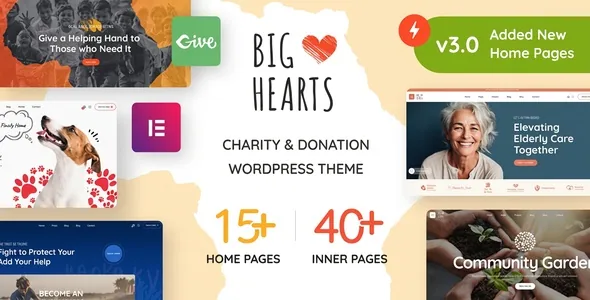
The vendor's description pairs BigHearts with the GiveWP Donation Plugin and recommends it as the donation engine for a charity site. That sentence sets the division of labour clearly: campaign creation, donation forms, payment handling and receipts live in GiveWP, and the theme styles the pages that carry them.
So when you evaluate BigHearts, the question is not whether it can take a payment on its own. It is whether you are willing to run GiveWP and build the donation flow in that plugin, then let the theme handle the campaign pages around it.
The changelog shows the connection is maintained rather than nominal. Version 1.2.6 records a fix for "the donation form view", which points at how donation forms render inside the theme's templates. Repeated bundled-plugin update entries in later releases suggest the author keeps the shipped plugin versions current, though the changelog does not say which plugins are bundled.
Global theme options, with a per-page override
Two settings layers sit behind a BigHearts page. The vendor lists "over 100 options at the theme options" for site-wide settings, and separately a way to "set local options at the page with metaboxes".
The practical value of that pair shows up on a campaign page. You might keep the site's header style, colour handling and typography uniform across a homepage, an About page and a news feed, then change the same parameters on a single urgent appeal page because you want it to read differently from the rest of the site. The per-page metaboxes mean that change does not require a separate template file or custom CSS scoped by page ID.
The trade-off is that settings live in two places. When something looks wrong on one page, the cause may be the page-level override rather than the global option, so it helps to know which layer you are editing before you start changing values.
Headers are built by dragging, and the demo import starts you off
BigHearts ships its own WGL Framework, and the vendor's feature list describes its header component as a "Flexible, Drag&Drop Header Builder with Presets". The presets matter as much as the drag-and-drop: they give you a working header to modify rather than an empty canvas.
Site content is assembled in Elementor, which the marketplace attributes also list under Compatible With. The theme adds more than 30 modules with their own settings, plus row animations through the WGL layer. One-click demo content import is listed as well, which is how the pre-built home page layouts and the inner pages (About Us, Our Team, Portfolio and similar) arrive in your install.
On the editor question: the marketplace marks Gutenberg Optimized as "No" for this theme. Read that as a statement about where the tuning effort went. It does not mean the block editor is unavailable, but the layouts and modules you see in the demo were built for Elementor and the WGL framework, so expect to work there.
Projects and people: portfolio grids and a team module
A charity site usually needs somewhere to put the work that is not a donation form: completed projects, ongoing programmes, the people running them. The vendor's list covers both with "Flexible Portfolio Modules" and a "Powerful Module of Team Members", and the description names Team and Portfolio among the pre-made inner pages.
The portfolio grid offers two loading behaviours, "infinite scroll" and a "Load More Button". These behave differently for a visitor. Infinite scroll keeps feeding items as they reach the end of the grid, which suits a long archive where the next project is likely to be relevant. A Load More button hands control back, which is easier when someone is hunting for one specific project and wants to reach the footer without scrolling through everything.
Gallery and portfolio modules have had their own fixes in the changelog (version 3.0.9 addresses layouts in the WGL Gallery module), and later releases added new home pages and a new module. That history is a rough indication of where the author has spent maintenance time.
The shop side sits alongside the charity content
The marketplace attributes list WooCommerce compatibility across versions 6.x through 9.x. The vendor's feature list adds an "Extended Module for Present Your Products at the Pages" and describes the theme as WooCommerce Ready.
That is enough to say BigHearts can present products, but not enough to promise a particular storefront shape. Many nonprofits run a small shop for merchandise or event tickets alongside donations, and this is the layer that would cover it. Whether the product pages match your catalogue depends on the demo closest to what you sell, so check that on the author's live demo before committing.
What the listing declares, as observed in November 2026
The version attributes recorded from the marketplace listing on 3 November 2026 cover WordPress 6.3.x through 7.0.x, WooCommerce 6.x through 9.x, and Elementor. Browsers listed are Firefox, Safari, Opera, Chrome and Edge. The package file types named are PHP, CSS and JS files, the theme supports RTL and translation, and a child theme is included.
Two labels deserve attention. Documentation is described as "Some Help" rather than a stronger claim, so plan on working through the demo content and the header builder without assuming deep written guidance. And the listed marketplace version is not a statement about any specific archive you might install; check version numbers against what you actually have.
Everything above is a vendor or marketplace declaration, not the result of running BigHearts on a test install. The changelog's most recent entry mentioning a security fix, alongside bundled plugin updates, also makes patch currency worth confirming on whatever copy you run.
Questions & answers
Do I need GiveWP to use BigHearts for a charity site?
The vendor builds the description around GiveWP as the donation plugin for this theme, and the changelog includes donation-form rendering fixes. Campaigns, forms and payments are GiveWP's job; the theme presents them. If you plan to use a different donation plugin, treat the theme's donation-related styling as unverified for your setup.
Can I build BigHearts pages in the block editor instead of Elementor?
The marketplace marks the theme as not Gutenberg optimized, and the demo layouts and WGL modules are built for Elementor. You can write posts and pages in the block editor, but the designed page layouts described in the sales material assume Elementor.
What decides whether a portfolio grid scrolls or shows a button?
The vendor lists both infinite scroll and a Load More button for the portfolio grid. Which one you use is a per-grid choice, and the meaningful difference is whether visitors get an endless feed or an explicit request for more items.