Settings that cascade, then get overridden
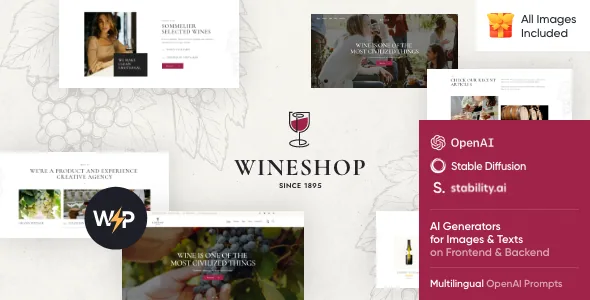
According to the vendor's feature list, WineShop's framework rests on two things: a "Setting Inheritance and Override System" and 750+ Customizer options behind a custom theme options panel. The marketplace description puts it more simply — the inheritance and override options let you set individual parameters for different sections of the site and for supported plugins.
Read together, that describes a different editing habit from the one most themes encourage. Instead of styling each page separately, you set a baseline once — colours, typography, widget and plugin parameters — and let pages inherit it. Where a particular section or a supported plugin needs to differ, you override that scope and leave the rest following the global value. On a wine shop with a shop archive, product pages, a blog and landing pages, a change to a shared element does not have to be repeated in five places.
The trade-off is the size of the surface. Several hundred Customizer options plus a separate options panel are useful when you know which layer a setting belongs to, and slow when you do not. Decide before you commit whether the site needs that granularity or just a clean demo you rarely touch.
The header is an Elementor layout too
The vendor lists Elementor support for modifying page content and, separately, states that header and footer layouts can be customised in the Elementor page builder. So the builder is not confined to the middle of the page: the persistent parts of the site are built there as well, which is what you want when the shop header carries a cart, a search field and a menu in a specific arrangement.
Page frames come in boxed and fullwidth versions — a structural choice made once and felt everywhere, because it changes how wide content runs against the viewport.
The listing declares Elementor compatibility. It does not say whether any header or footer widget depends on Elementor Pro, so confirm that before you plan a design around a Pro-only element.
Where the shop work has actually gone
The marketplace category is WooCommerce ecommerce, and the vendor's plugin list names WooCommerce itself alongside TI WooCommerce Wishlist, MC4WP Mailchimp for WordPress and elegro Crypto Payment. Those are declared integrations you install and configure separately, not features baked into the theme files.
The changelog is the better guide to where the shop effort sits. Release 3.24.0 added a search field to the WooCommerce Product Filter for lists over fifteen items, plus scrollable attribute lists in the sidebar. Release 3.21.0 fixed WooCommerce category and attribute names in non-Latin characters and optimised database queries in the Woo Products widget; 3.23.0 added WooCommerce API filters that let you disable TrxAddons components such as custom attribute types or the Product Filters widget so another plugin can register its own.
A product filter that stays usable with long attribute lists is the detail that matters on a wine catalogue, where region, grape, vintage and producer all compete for sidebar space. The API kill-switch matters if you already run a filtering plugin and do not want two of them.
Blog output built from switches, not a template
The vendor treats the blog as configurable output rather than one layout: multiple blog styles, flexible layout options, 20+ post animations, and a feed you can narrow by post type or category, with post views, likes, sharing buttons and a related posts section.
The feed control is the useful part for a food and wine site. A blog mixing recipes, vineyard notes and events can surface only the categories it wants in a given spot instead of dumping everything into one stream.
The animations are a stylistic lever and a large one. Twenty-plus entry effects across a feed wears thin on a long archive; pick a small set and apply them consistently.
Version 3.9.0 on the listing, 3.25.0 in the changelog
This is the one thing to settle before installing. The marketplace listing carries version 3.9.0, while the vendor's changelog runs to 3.25.0, dated 12 October 2026. Those numbers do not agree, so confirm which build you are getting.
The changelog also shows why the theme core and the companion addons plugin should be updated as a set: releases are full of TrxAddons entries, and 3.18.0 added an explicit warning when the theme core has not been updated before a skin update. The same release notes record a fix for an empty header or footer inserting full page content, and 3.24.0 records a batch of security fixes in the addons, including SSRF, stored XSS and PHP object injection. A build several minor versions behind that list is carrying those issues.
The listing declares WordPress support from 4.9.x through 7.0.x and WooCommerce 5.x.x and 6.x.x. The vendor's own key-features text still says "WordPress 4.5+ Tested and Approved" — an older statement, and evidence that the two sources are not kept in step. Treat all of it as vendor-declared scope rather than a result on your server. WPML appears in the compatibility list, which is the route to a translated storefront. Compatible browsers are declared as IE11, Firefox, Safari, Opera, Chrome and Edge; the IE11 entry is a good sign of how old parts of that list are. ThemeForest files included are listed as PHP, CSS and JS, and the theme is widget-ready and responsive.
Questions & answers
Do I need Elementor Pro for the WineShop header and footer?
The vendor states that header and footer layouts can be customised in the Elementor page builder without naming an edition. Elementor Pro is not listed as a requirement in the supplied material, but nothing confirms whether particular header or footer widgets rely on it. The changelog does reference Elementor Pro selectors and Pro tabs in some addon widgets, so check the specific elements you plan to use.
Can I keep running my existing product filter plugin?
Release 3.23.0 added WooCommerce API filters that let third-party plugins register their own attribute types and product filters without conflicting with TrxAddons. That is the intended hook for the situation, but it is a code-level filter, so budget a developer rather than expecting a switch in the options panel.
Will the installed theme match the changelog I read?
Not necessarily. The listing shows one version number and the vendor's changelog lists newer releases, so ask which build you are receiving. If it trails the changelog, weigh that against the security and compatibility fixes recorded in recent addon releases before deciding to launch on it.