The player is the site's structure, not a widget
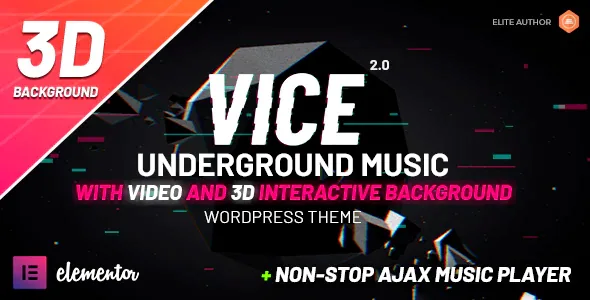
Most music themes place an audio player inside a post or a sidebar, so a visitor who clicks through to tour dates loses the track. QantumThemes' feature list describes a different arrangement for Vice: an Ajax page load built specifically for a cross-page music player, paired with a slide-up playlist and a hide/show toggle. The audio bar persists while the content around it changes.
That detail shapes how you plan a site. A visitor can start an album on the releases page, open an artist profile, read a news post and still be listening. Your layout decisions therefore revolve around the bar at the bottom of the screen — how much room it takes, whether the playlist stays open, and which pages need content that reads well when someone is only half watching.
Everything else the vendor lists plugs into that model: releases, podcasts and radio channels all route through the same playback surface.
Three sources feed one bar
The vendor describes three kinds of audio arriving at the same player. Album tracks come from a release's track list, with previews written as MP3, SoundCloud or YouTube links. Podcasts can be organised by genre and hold a SoundCloud, Mixcloud or MP3 file — the MP3 version plays in the main player across pages. Radio channels are the third source: the vendor says you can create an unlimited number of them, and that each needs an MP3 stream URL to work in the player.
That stream requirement is the part worth planning around. The listing attaches two conditions to radio playback in Chrome 55 and later: Shoutcast version 2 and a valid direct MP3 stream. This is a hosting and stream-format question rather than a theme setting, and the vendor offers to test a stream URL before purchase. If radio is central to your project, confirm your stream server's version before you commit to the layout that assumes it.
Releases carry the track and buy structure
Vice registers its music content as custom post types rather than generic posts: releases, artists, podcasts, events and gallery. The release is the richest of them. According to the vendor, an album can hold unlimited tracks, each track can credit unlimited artists, and each can carry an unlimited number of buy links. Tracks accept MP3, SoundCloud or YouTube previews.
Artists work the other way round: their pages use a tabbed layout, and the vendor says an artist page automatically lists that artist's releases. If your site documents a back catalogue across overlapping lineups, that relational setup saves a lot of manual cross-linking — though it assumes you enter the artist credits consistently on each release.
Related content is generated from taxonomies or dates for articles, releases, podcasts and artists, so your genre and category naming does real work rather than sitting unused.
Events are handled as a mapped module
The vendor's events coverage leans on a module rather than a calendar grid: an events map with an interactive Google Map and a sliding vertical menu, showing a flyer preview with a link through to the event page. Events are organised as a post type and can be linked to specific event types, which the listing frames as suited to DJs, booking agencies and clubs.
The flyer preview is the telling choice. A club night or a label showcase is usually promoted by artwork, so leading with the flyer rather than a date block keeps the visual emphasis where the audience expects it. That said, the module is described as a map-driven presentation; if your primary need is a dense chronological listing, the map is the wrong centre of gravity and you should check the demo before assuming the listing view matches.
Two design layers: the parent theme and DHRK
The listing announces an included child theme called DHRK, described as a minimal, fast variant that the vendor presents as the way to bring Vice into the current decade. The demo link recorded in the attributes points at the DHRK demo, so the look you see first is the child theme, not the parent.
That makes the first design question a fork rather than a colour pick. DHRK is a child theme, which means it inherits the parent's templates and functions and layers its own styling on top — it does not replace the parent's content model. Either way, the visual vocabulary the vendor describes is a glass, transparent, futuristic treatment: a glass header, an off-canvas menu with two levels of depth, an interactive 3D background, glitch effects and a fullscreen video background now supporting MP4 alongside YouTube and still images. There are also 120-plus round vector icons drawn for the theme.
Elementor support and a set of eight Elementor widgets belong to this same version-3 layer. The vendor also keeps the modular one-page approach, where page modules can be reused across several landing pages.
What the marketplace declares about compatibility
As recorded on 4 November 2026, the marketplace attributes list WordPress 6.8.x through 7.0.x under software version, and WooCommerce 6.x.x through 9.x.x plus WPML under compatible with. Elementor is also listed there and the package is given as PHP, CSS and JS files, built on the Underscores framework with a two-column layout attribute.
Those are vendor and marketplace declarations, not results from testing Vice on your server. The changelog for version 3.6, dated 1 June 2026, records a fix for WordPress 7.0 and a new customizer framework; earlier entries show the theme being updated for successive Elementor releases and PHP 8 fixes. WordPress 5 is still named in the older marketing copy, which reads as legacy text rather than a current limit.
One extra: the listing notes that Vice adds a cookies checkbox to the comment form for GDPR purposes, while the privacy policy content itself remains your responsibility.
Questions & answers
Do I need Shoutcast to use the radio channels?
Only if radio playback is part of the site. The vendor specifies Shoutcast version 2 with a valid direct MP3 stream for playback in Chrome 55 and later, and offers to test your stream URL before purchase. Release tracks and podcasts do not depend on that stream setup.
Is the DHRK demo a different theme I have to buy separately?
No. The listing describes DHRK as a child theme included with Vice, and the recorded demo URL points to the DHRK variant. It inherits the parent theme's content types and templates and changes the styling layer.
Can I build pages without Elementor?
The theme also offers its own modular one-page system, in which modules are reused across multiple landing pages, plus a fullpage slider. Elementor support and eight Elementor widgets are listed as additions in version 3, not as the only route.