Six businesses, one theme, one import decision
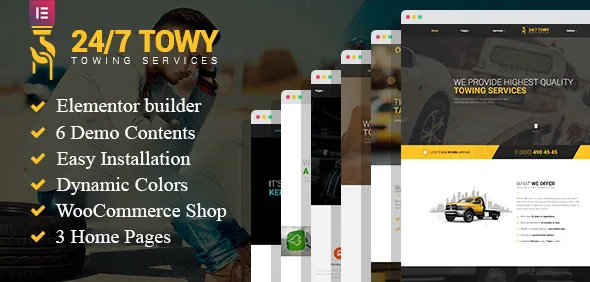
Towy is not sold as a single homepage you adapt. The vendor describes a set of demos built with the theme and supplied in the package, and the list reads like a small directory of car-related trades: towing and roadside assistance, an electric car charging station, a self-service car wash, an engine repair workshop, an Uber-like taxi service, and a car locksmith and key repair service.
That changes the first practical question. Instead of asking whether the theme's one design suits you, you ask which demo is closest to your actual work and how far the remaining content is from it. A recovery operator with a dispatch phone number needs different pages from a charging network, which needs different pages again from a locksmith serving customers at the roadside.
The breadth is also the limit. The vendor says these demos are supplied, but nothing in the description indicates that demo content is adapted for you or that layouts are interchangeable without edits. Treat each demo as a starting point for a similar business, not as six interchangeable skins.
Towing, car wash, taxi: what each starting point implies
The automotive demos cluster loosely. Towing and roadside assistance is the closest fit for a service business that responds to calls; the work is described in the marketing copy as car assistance, repair and breakage services. A repair workshop demo sits next to it with a different emphasis: scheduled work, service descriptions and a shop.
The three less-obvious demos are the ones worth reading carefully. A self-service car wash is a location business — visitors want opening hours and directions more than a service catalogue. A charging station demo has similar needs, with the added question of plug types and site coverage. The taxi service demo implies a booking or request path, and the locksmith demo a call-first layout.
None of that is spelled out in the marketplace description; the vendor lists the demo names and leaves the page inventories to the demo itself. If your business is one of the three less common ones, check whether the demo contains the specific blocks you need before committing.
Light and dark, boxed and wide
The vendor lists two site-level design switches: light and dark versions, and boxed versus wide layout variations. These are theme-wide choices rather than per-page styling, which means they set the frame for the whole site.
For an emergency service business, the distinction is not cosmetic. A dark palette and a high-contrast call-to-action can suit a night-time recovery brand; a light version often reads better for a workshop or a car wash with daytime customers. Having both in the theme means the decision is a switch rather than a rebuild, though the vendor does not describe how much per-section styling survives the change.
Boxed and wide work the same way. Boxed constrains content to a centred column with visible margins; wide lets sections run edge to edge. Whether a demo's backgrounds, image sections and header treatment look right after you switch is something to check on the live demo rather than assume.
The timetable is the page that matters most here
The vendor names the pages that come with the theme: an about page, a team page, a separate service page, a timetable, a shop, and secondary pages including coming soon, FAQ and 404. Most are ordinary for a business theme. The timetable is not.
Roadside assistance and towing are often sold on availability — who is on shift, when the depot is open, whether weekend recovery costs more. A timetable page gives that information a fixed home instead of burying it in a footer. The team page does similar work in a different register: a recovery crew is part of the trust proposition, and named staff with roles are more convincing than a stock photograph.
The separate service page arrangement matters more than it sounds. One template per service means each service — flatbed towing, jump starts, tyre changes, lockouts — can have its own content and its own call to action, rather than sharing a single list page.
Editing in Elementor, with the shop left to WooCommerce
The vendor builds the editing pitch around Elementor, describing visual drag-and-drop editing and the ability to create new pages without programming. The marketplace attributes list Elementor and Elementor Pro as compatible software, and Contact Form 7 alongside them, which is the likely route for enquiry and callback forms.
WooCommerce appears in the compatibility list across versions 6.x to 9.x. That states integration, not shop design: the description mentions a shop page among the supplied pages but says nothing about product templates, cart styling or commerce widgets. If you plan to sell parts or bookable services, the shop is WooCommerce's work, shaped by whatever the demo includes.
The marketplace also marks the theme as not Gutenberg-optimized. Read that as a statement about block-editor template support, not as proof the block editor is unavailable; the theme's own editing model is Elementor.
Files, versions and what the listing leaves open
The package file list names PHP, CSS and JS files together with Layered PSD and PSD files, so the design sources are part of what you receive — useful if a designer is reworking the layouts rather than just editing in Elementor. Documentation is marked well documented and the theme is listed as responsive, widget-ready and built on a four-plus column grid.
Declared software support, recorded from the marketplace listing on 4 November 2026, covers WordPress 6.1.x through 6.9.x, with Firefox, Safari, Opera, Chrome and Edge named as browsers. Those are the author's declarations, not results of independent testing, and a version range is a snapshot rather than a guarantee for a specific install.
One detail is worth checking before you plan around it: the listing marks high-resolution assets as not included. If a full-width hero image is central to your homepage, confirm what the demo actually uses. Beyond that, the description says little about performance or support terms, so the live demo remains the only way to judge how the theme behaves with your own content and plugins.
Questions & answers
Does Towy include demos for businesses other than towing?
Yes. The vendor lists six demo directions supplied in the package: towing and roadside assistance, an electric car charging station, a self-service car wash, an engine repair workshop, an Uber-like taxi service, and a car locksmith and key repair service.
Can I switch between light and dark or boxed and wide layouts?
The vendor describes both as available versions of the theme, so they are site-level choices rather than per-page options. How much section-level styling carries across a switch is not described, so verify it on the live demo.
Is Towy built for Gutenberg or for Elementor?
Editing is presented around Elementor, and the marketplace marks the theme as not Gutenberg-optimized. That flag concerns block-editor template support rather than whether the block editor works at all.
Are design source files included?
The marketplace file list names Layered PSD and PSD files alongside PHP, CSS and JS files, so the layered design sources are listed as part of the package.