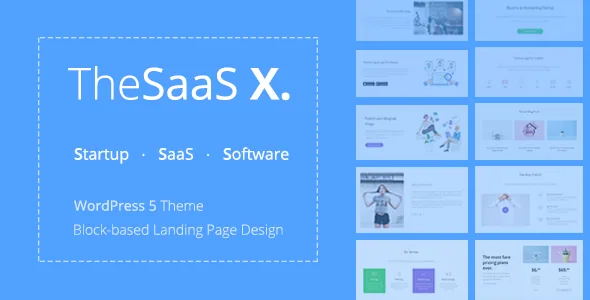
Blocks, not a bundled canvas
The vendor's feature list names both a "Visual page builder" and "Using Gutenberg Page Builder", and the marketplace marks the theme Gutenberg Optimized as Yes. Taken together they describe one editing surface: page layout happens in the block editor WordPress already ships, with TheSaaS X adding its own block set on top.
That matters most after handover. You are not teaching a marketer a vendor-specific canvas, and you do not install a second builder to keep landing pages editable. What you inherit is block editing, so the workflow of your site is the same one used for ordinary posts.
The vendor describes the theme as built for SaaS, software, startup and web app landing pages and says the package includes several landing page samples. The listing's demo is where those samples can be seen rendered.
What the block variations give you
The vendor claims over 100 block variations. Treat that as a library to test against your own page goals rather than a guarantee that any layout is covered: each variation is a prearranged section you drop in and edit, so a feature grid or a testimonial row starts from a designed arrangement instead of empty columns.
The changelog shows the controls behind those blocks rather than just their number. Version 1.1.0 added the ability to add and remove pricing plans inside pricing blocks #1 through #4 and to make blog block post counts configurable, plus support for the Page Break block and pagination in posts. Version 1.1.1 extended post-count control to portfolio blocks. A pricing page, in other words, is edited as content: plans are added or removed in the block settings, and the tabs are relabelled there too rather than rebuilt as images.
Bootstrap 4 as the styling layer
TheSaaS X is built on Bootstrap 4, and the vendor lists a "Bootstrap Like Data API and classes" alongside the ability to extend utility classes. The practical consequence is that spacing, alignment and grid conventions you already know apply to the theme's sections, and a developer can drop to class-level adjustments without working around a proprietary wrapper.
The vendor calls the code developer friendly, lists valid HTML5 and CSS3, and a changelog entry records SCSS files kept in the published theme under /assets/scss. Those are claims to verify against the markup you receive, but they indicate the theme expects editing at source level as well as in the editor.
Per-page overrides inside page settings
Some controls live on the page rather than in a global panel. The changelog records a custom CSS field and a custom JavaScript field for individual pages, and the ability to set a page layout to None so the page drops the standard header and footer frame.
That combination fits campaign pages that need to look unlike the rest of the site for a week: you can break the page out of the site chrome and add the specific styles or script it needs without shipping them site-wide. Section-level settings are in the same spirit, such as setting a section's background image size to cover.
Blog, shop and form pieces
TheSaaS X is a landing theme, but it is not page-only. Version 1.1.4 changed search results to follow whichever layout is selected for Blog Archive, and an entry in 1.1.3 switched header blocks to show published dates instead of last-modified dates on posts.
WooCommerce has its own layer: styling for shop pages, the option to assign different navbar, header and footer components to WooCommerce pages, and cart and search icons in the navbar. Earlier entries show the shop templates being kept in step with WooCommerce releases. For a site selling a few plans, products or licences, that covers presentation rather than a full commerce system.
Forms are handled through the theme's own contact blocks, with reCAPTCHA v3 support recorded in version 1.0.4, basic styling for Contact Form 7, and a WPForms conflict fixed in version 1.1.2. If your landing page collects demo requests or trial signups, those are the pieces that decide whether the form blocks are usable for you.
The 2020 release date
The marketplace listing records version 1.1.5 with a vendor update on 27 April 2020 and a declared software version of WordPress 5.4.x. That is the compatibility statement attached to the product; it is not a record of anyone running the theme on a current install.
The changelog explains part of the gap: the entries through early 2020 are fixes for WordPress 5.3 and 5.4 block editing, which was a period of rapid change in the editor itself. A theme whose layout depends on Gutenberg is exposed to those changes more directly than one shipping its own canvas, and no vendor activity after 2020 is recorded in the history.
Treat the age as a planning fact rather than a verdict. A new build on current WordPress carries risk the listing does not measure, so weigh it against how long the site needs to keep pace with editor changes.
Questions & answers
Does TheSaaS X use Gutenberg or its own page builder?
Both phrases appear in the vendor's feature list — "Visual page builder" and "Using Gutenberg Page Builder" — and the marketplace marks the theme Gutenberg Optimized as Yes. The described workflow is page building in the block editor with the theme's own block variations, not a separate bundled builder.
Can I change pricing plans without editing code?
The changelog for version 1.1.0 records the ability to add and remove pricing plans in pricing blocks #1 through #4, and a later entry covers relabelling the monthly and yearly tabs. Those controls sit in the block settings, so plan lists are edited as content.
How current is TheSaaS X?
The marketplace listing records version 1.1.5 with a vendor update dated 27 April 2020 and a declared WordPress version of 5.4.x. Those are vendor and marketplace declarations, not the result of testing on a current WordPress install.
Does the theme support WooCommerce?
The changelog records styling for shop pages, separate navbar, header and footer components for WooCommerce pages, and cart and search icons in the navbar, along with template updates following WooCommerce releases. That supports a small storefront; the description frames the theme around landing pages rather than commerce.