Every homepage idea arrives twice: once as a page, once as a scroll
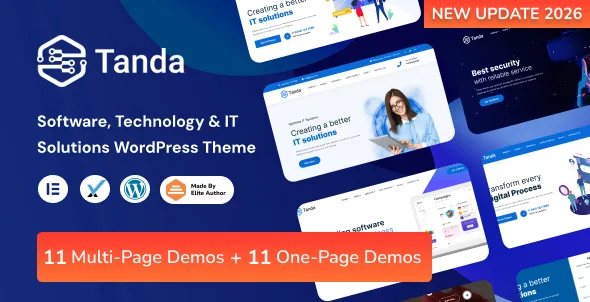
The vendor describes Tanda's demo library as 22 homepages, split as 11 multi-page and 11 one-page, with the feature list putting the inner-page count at 30+ in one place and 35+ in another. The pairing is the part that shapes a decision.
A one-page demo keeps services, projects, testimonials and contact on a single scrolling document with a sticky menu jumping between sections. That structure suits a consultancy whose whole offer fits one narrative, or a product launch that needs a single linear pitch. The multi-page version of the same design pushes those blocks onto separate routes, which is what you want when each service needs its own landing page or when a case-study archive has to keep growing.
Because both forms exist for the same visual direction, you can judge a design in whichever structure you actually need, instead of comparing a one-page demo against a multi-page demo built for a different look.
The vendor also says more demo pages and features are coming, so read the current count as a snapshot.
Eight About layouts and seven Service layouts do the inner-page work
Version 1.3.7 added eight About layouts and seven Service layouts in the same release as the pre-loader toggle. For an IT company site, those are the two pages that carry most of the differentiation: an About page that has to explain a team, a method and a set of certifications, and a Service page that has to describe an offer without turning into a wall of text.
Having seven Service layouts and eight About layouts means you are choosing a structure, not writing one from blank sections. The changelog does not say which demos use which layout, so the demo site is where you check how each reads with real content.
The vendor separately lists five blog and single post layouts. Version 1.6 in November 2025 updated the Blog Grid Three page template file, which is the kind of quiet maintenance that matters on a site publishing regularly.
One-click import gets the structure in place; the copy is still yours
Tanda ships a one-click demo importer, described by the vendor as a way to make your site look like the live preview so you can customise from there rather than build from nothing.
What the import saves is structural: pages, menus and widget arrangements arrive pre-assembled. Your own service descriptions, team photographs and project details still replace the placeholders. Plan on the import covering the scaffolding and your editors covering the content.
The changelog shows the importer has been worked on repeatedly rather than set up once: entries in versions 1.2, 1.3.3, 1.5.4, 1.7.1 and 2.0 touch demo import, and demo content files were refreshed in 1.3.1 and 1.3.7. That history shows attention and also hints that demo import has been a recurring place for small breakages.
The design controls are site-wide switches, not per-page overrides
Tanda's options panel runs on the Redux Framework, and the vendor's examples of what it changes are logo, favicon, header and footer. The changelog adds the specific toggles over time: breadcrumb enable/disable and topbar enable/disable in 1.3.6, footer and footer copyright enable/disable in 1.3.8, pre-loader enable/disable in 1.3.7.
Six pre-defined colour schemes arrived in version 1.2, with later entries referring to updates to the custom colour changing options. Six is a starting palette. If your brand colour has to be exact, expect to modify a scheme rather than pick one and stop.
These are global settings, which works well for a company site with consistent chrome and less well when one campaign page needs a different header from everything else. If per-page header or footer variation is a requirement, the evidence does not describe it here.
Elementor is the maintained editing path
Tanda is edited in Elementor, described by the vendor as a drag-and-drop surface where no coding skills are required. The compatibility attributes recorded on 4 November 2026 name Elementor, Elementor Pro and WooCommerce 6.x.x.
The changelog explains the lineage. An October 2022 entry announces the theme as Elementor compatible, and later releases carry Elementor version labels. Version 1.5 in April 2025 then records the WPBakery version as deprecated, so anyone who has seen an older Tanda build in WPBakery should not expect that branch to keep receiving updates.
One attribute needs careful reading. Gutenberg Optimized is marked No, which tells you the block editor is not the design target; it does not establish that the block editor is unavailable. The bundled file list is PHP, CSS and JS, the ordinary shape of a classic theme package.
Multilingual builds: WPML, a POT file and a child theme
The vendor lists full multilingual support through WPML, and names WPML compatibility again in the core feature list. In practice that covers the theme's interface strings, while WPML handles the content side.
Two supporting details matter more than the headline claim. Version 1.3.5 updated the POT file, which is what you need if you plan to translate theme strings in a tool like Poedit rather than only through WPML. Version 1.3 added a child theme, the right place for template edits so a future theme update does not overwrite them.
The record does not say which demos are translated, or whether demo content ships in more than one language. Assume the translation work is yours.
What recent releases show about upkeep
The newest entries are compatibility and detail work. Version 1.7 in February 2026 adds support for WordPress 6.9.x and updates typography options. Version 1.6 in November 2025 adds WordPress 6.8.x compatibility, refreshes the Blog Grid Three template, updates the contact section widget and ships Tanda Core v1.5. Version 1.5 in April 2025 adds 6.7.x compatibility and WooCommerce breadcrumb options.
Read together, that is a theme tracking WordPress releases and patching specific widgets and templates as needed. The larger structural additions came earlier, with the About and Service layouts in October 2024.
One practical point sits over any changelog: the marketplace listing records a version number that a copy on your drive may not match. Confirm which build you are working from before you judge a missing fix or a template difference.
Questions & answers
Are the one-page and multi-page Tanda demos the same designs?
The vendor describes 22 homepages as 11 multi-page plus 11 one-page, which reads as paired rather than duplicated. The demo site is the place to confirm how closely each pair matches in visual direction.
Can I give one page a different header or footer?
The evidence describes site-wide theme options with toggles for topbar, breadcrumb, footer and footer copyright. Per-page override settings are not described, so plan for consistent chrome across the site unless your own build adds that.
Is WPBakery still supported in Tanda?
Version 1.5 in April 2025 records the WPBakery version as deprecated, and later releases carry Elementor version labels. Build new work in Elementor.