Twenty-five medical page layouts, then a builder on top
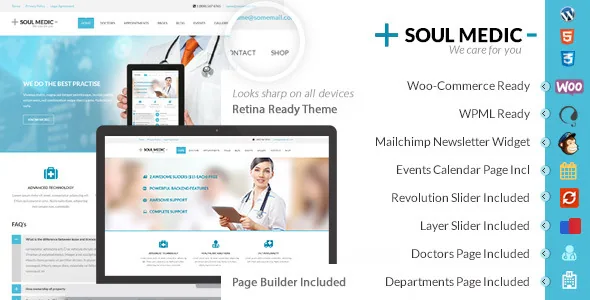
The listing's most concrete promise is a page inventory: more than 25 layouts named as doctors, departments, services, blog with comments, about, events or schedule pages, event detail, gallery with and without sidebar, two-, three- and four-column content, contact and appointment. That set already matches how a clinic or hospital department organises its public information, so a doctor directory or department list starts from a structure instead of a blank canvas.
On top of those layouts sits a "one click visual short code builder" with its own component library. The vendor names feature lists, carousels, testimonials, pricing tables, accordions, tabs, buttons, quotes, icons, dividers, toggles, progress bars and a fancy box. In practice a treatment FAQ becomes an accordion, patient feedback becomes a testimonial row, and self-pay rates can go into a pricing table while the page stays within the theme's own components.
The 2019 rebuild tells you where demo content lives
Version 4.0, dated 5 December 2019, is the most informative changelog line on the page: all demo content was moved to Visual Composer modules. The same entry warns that uploading the new theme files over an older installation would crash the site, and that anyone staying on the previous setup should use the separate legacy archive the vendor shipped. For a plan built around this theme, the takeaway is that the demo pages are builder assemblies rather than plain content you can lift out.
Two related details from that release matter for editing. The vendor added Gutenberg editor support for custom post types and moved theme options onto the Codestar framework with Customizer additions through Kirki. The marketplace separately marks the theme as Gutenberg Optimized. None of this indicates that the builder layouts and block-editor output are interchangeable, so decide which editor your team will actually publish in before importing demos.
Events carry the calendar detail; appointment is only a page
The Events Calendar and Events Calendar Pro are both listed under compatible plugins, and the description goes further than a compatibility checkbox: calendars rendered by day, week or month, event photos, maps, external links, descriptions, a countdown, featured and upcoming event lists, and event shortcodes. For open days, screening camps or a recurring clinic schedule, the countdown plus upcoming list is the part visitors look for first.
Appointment appears in the layout inventory as a page type. Nothing in the source describes availability lookup or slot booking, so a clinic that needs real appointment scheduling should plan for a separate booking plugin and treat the appointment layout as the page that wraps it.
Shop and multilingual support are declared, not delivered as content
WooCommerce is named twice: once in the description, which frames the theme as able to run a store for medicine, pharmaceuticals, cosmetics or other health products, and once in the compatibility list spanning versions 5.x through 9.x. Later changelog entries repeat compatibility with current WooCommerce in versions 5.1 and 5.7.
Compatibility is not the same as prepared shop layouts. The source does not describe product pages designed for pharmacy ordering, and a catalogue is yours to build. WPML is listed as compatible and the description presents it as the multilingual route; the changelog shows ongoing WPML maintenance, including a fix to header and footer WPML options in version 4.0. These are vendor and marketplace declarations recorded on 4 November 2026, not results from running the theme on a particular stack.
What the 2025 and 2026 releases say about upkeep
Recent entries are specific enough to read literally. Version 5.8, dated 3 April 2026, records an update to portfolio security and current WordPress compatibility. Version 5.7, dated 25 February 2026, records a fix for a reflected XSS vulnerability in the section ID attribute, along with WordPress and WooCommerce compatibility. Version 5.6, from 29 August 2025, records fixed notice errors and "security issues fixed".
Those entries say the vendor patched named issues in named releases. They say nothing about any copy you might be running, and a site kept on a build older than 5.6 would still carry what those releases addressed. The source also states plainly that demo photographs are copyrighted and excluded, so an imported site looks sparser until you supply your own images.
Package contents and the editing decision
The declared package contains layered PSD files alongside PHP, CSS and JavaScript. The PSDs are useful if a designer is preparing graphics for the site; they add nothing if all work happens in the browser. The listing also records widget-ready sidebars, high-resolution assets, a responsive layout with four or more columns, and a software range that reaches back to WordPress 4.9.
The decision rests on which editing layer you want to work in. SoulMedic's strength is breadth of medical page structure plus a shortcode builder that assembles it quickly, which suits a practice publishing doctors, departments, services and events without designing each page. A team that publishes in blocks and prioritises content portability over layout variety will find the balance less comfortable.
Questions & answers
Can I build pages with the block editor instead of the shortcode builder?
The marketplace marks Gutenberg Optimized as Yes and the changelog records Gutenberg support for custom post types from version 4.0. The demo content itself was rebuilt into Visual Composer modules in that same release, so the builder is what the supplied layouts are made of. Both are vendor statements; neither shows that the two editors produce the same output for a given page.
Does the theme book appointments on its own?
Only a page layout is described. The vendor lists an appointment template among the 25-plus page types and describes no scheduling engine, so slot booking needs a separate plugin.
Which calendar plugin does the event material rely on?
The Events Calendar and Events Calendar Pro are named in the compatibility list, and the description covers day, week and month views, event countdowns, featured and upcoming lists, and event shortcodes.
Are the demo photographs included?
No. The source states that demo images are copyrighted and excluded from the download, and offers links for buying licences instead.