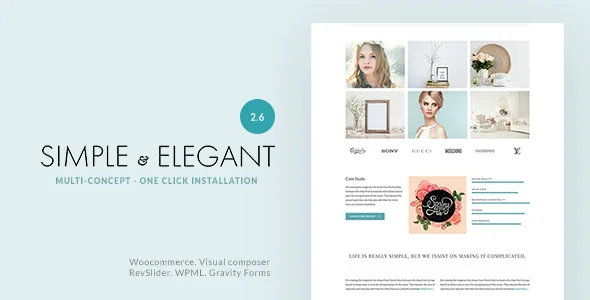
The style is the part you switch, not rebuild
The vendor description leads with a one-click concept switcher: a single click changes the fonts and colours across the whole site. Read that next to the rest of the feature list and the intent is clear. The visual identity of the theme is a stored concept rather than a set of decisions scattered through pages, so trying a different mood does not mean reworking every template.
Underneath sits a Live Customizer with 300+ options. Those cover font face, size, weight, style and text transform separately for body text, the menu, headings, the copyright line and more, plus unlimited colours for the topbar, header, menu, footer and text. A switcher alone would be a coarse lever; the Customizer is where you refine a concept once you have chosen one. Each claim here comes from the vendor's own feature list, not from a hands-on restyle.
Restyling is global, page structure is per page
A whole-site colour and font system does not build pages. That work happens in WPBakery Page Builder, which the vendor says is included, alongside a set of extra Simple & Elegant elements. The vendor also claims Slider Revolution is included, with importable slider archives so the demo sliders can be reused.
One small technical detail is worth noting because it shows the theme reaches into the builder. The description says parallax sections use a translate3d technique that overrides WPBakery's default row parallax for better performance. That is a vendor performance claim, not a measured benchmark, but it tells you the theme ships its own parallax implementation rather than relying on the builder setting.
The split has a practical consequence for your workflow: colours and type are one decision made once, while the arrangement of any given page lives in the builder elements on that page.
Four demos as starting concepts, not finished sites
The four prebuilt demos are named Simple & Elegant, Photography, Do It Yourself and Feminine. Together with the concept switcher, they read as alternate starting points for the same underlying theme rather than four separate products — the styling layer is what changes most visibly between them.
The one-click import is described as bringing in content, settings and widgets so the result matches the demo exactly, with no multi-step process. That is a claim about the import scope, and the sensible reading is that it covers the demo's exported content rather than anything you have already written.
One explicit exclusion matters before you plan imagery. The vendor states that the photographs used on the demo sites are for demonstration only and are not included in the theme. If your site depends on a photography-led look, those images are an asset you supply.
Portfolio, blog and post formats that carry real content
Beyond the demos, the content formats are where the theme earns the multi-purpose label. The portfolio supports gallery, video and audio formats, with column, style and image-ratio options at 2, 3 or 4 columns, and there are multiple single-project layouts with video and audio support on each.
Blog layouts come in standard, grid and list arrangements. Post formats are standard, gallery, video and audio, and the description says video thumbnails are pulled automatically from YouTube and Vimeo — useful if you publish video without preparing a thumbnail for every post.
Page-level layout is not fixed either: fullwidth, sidebar left and sidebar right are all available, with per-page options to show or hide the title and adjust padding. A built-in lightbox based on Magnific Popup handles responsive image viewing, and a side navigation option is described for long pages such as history or documentation. For a writer, photographer or coach site, those are the tools actually in use; the Customizer decides how they look.
Shop features and declared platform versions
WooCommerce support is described through specific storefront behaviours rather than a general compatibility statement: quick view, an off-canvas cart, image flip on product thumbnails, a shop sidebar, breadcrumbs and YITH Wishlist integration. Each is a feature the vendor reports for the shop templates, so confirm the ones you need on the shop demo if your catalogue depends on them.
The marketplace attributes observed on 4 November 2026 declare WordPress 6.0.x through 7.0.x and WooCommerce 6.x.x through 9.x.x, plus WPML, Gravity Forms and Facebook in the compatible-with list. Those are declarations, not results from running the theme against a current plugin set or a particular hosting stack. The marketplace listing reports version 2.6.7, while the description page mentions a 2.6.6 release; either way, check the changelog the vendor links for what changed before you update.
If your project is a personal or creative site whose look you expect to tune often, the switchable concept layer is the reason to pick this theme. If you need a fixed brand identity applied once and never revisited, that same layer is simply a settings panel you will rarely open.
Questions & answers
Does the concept switcher replace the Customizer?
No. The vendor describes the switcher as changing fonts and colours across the site in one click, while the Live Customizer holds the 300+ individual options for font face, size, weight, style, text transform and colours per area. The switcher sets a starting concept; the Customizer is where you adjust it.
Are the demo photos included with the theme?
The vendor explicitly states that the photographs used on the demo sites are for demonstration only and are not part of the theme. Plan on supplying your own imagery, which affects photography-led demos most.
Can I edit pages without WPBakery?
The described editing workflow runs through WPBakery Page Builder, which the vendor says is bundled along with extra theme elements. The marketplace also marks the theme as Gutenberg Optimized, but the vendor's own feature list documents the builder route, so treat that as the path the theme was composed around.
Does the parallax claim mean the theme is faster than WPBakery's own setting?
The vendor says its translate3d parallax overrides WPBakery's default row parallax for better performance. That is an unverified vendor claim about one technique, not a measured comparison of the finished site's speed.