The header options are scoped per style, not global
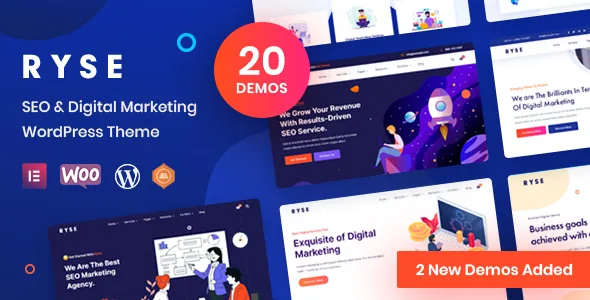
The vendor description spends its most specific sentence on headers: Ryse ships 16 header styles, and each one carries its own individual options, so changing a setting inside one style will not overwrite the settings of another. Read as a claim about how the theme stores configuration, that is the detail worth checking before anything else on this theme.
A digital marketing agency site usually needs more than one masthead. The homepage may want a tall hero header with a call to action; inner service pages often read better with a compact bar; a landing page may want something plainer. If header settings were shared globally, choosing a different style would mean rebuilding the same decisions. Per-style scoping means a style you have already configured stays configured. Note that this is the vendor's description, not a finding from running the theme.
Where those header settings live
The vendor says the theme options panel is Redux-based and describes it as feature-packed for an SEO site. The header style choice and the per-style options sit in that panel rather than in the page builder.
That matters for who does what. Header and footer decisions are an admin-side job, while page content is an Elementor job. If you hand one person the site's chrome and another the page layouts, the split is clean. The vendor's changelog shows this area being adjusted repeatedly across releases, including a note that header options were made simpler in one version and that a menu was fixed for a specific header style in another. Treat the current behaviour as something to confirm in the demo rather than assume from the feature list.
Footer builder: five styles, plus your own
Ryse includes a footer builder. Five footer styles come with it, and beyond those you can compose your own and assign it to any page.
Five styles covers the usual patterns — a wide multi-column footer for a homepage, a short bar for utility pages. The custom route is what a marketing site actually tends to need, because agency footers carry a lot: service links, contact details, social accounts, awards or partner logos. Being able to build that once and reuse it on every page is the practical value, provided the builder gives you the columns and elements you need. The vendor does not enumerate the builder's element set in the description.
Elementor carries the page layer
All demo pages were built with the free Elementor plugin, according to the vendor. On top of that, RadiantThemes supplies its own Elementor elements for blog, portfolio, testimonials and pricing tables.
Those four are the repetitive blocks of an agency site. Testimonial carousels, price tiers, case-study grids and a blog feed appear on nearly every page, and purpose-built elements save you rebuilding each one from generic widgets. The vendor calls them premium elements; the description does not say whether they are part of the theme or a separate add-on, so confirm that with the documentation before planning around them.
The homepage library is stated as 15 designed home pages aimed at SEO and digital marketing businesses. That is a starting shortlist, not a finished site — the demo import brings in the demo's own images and assets, and your copy and photography replace them.
Three routes to a typeface
Typography is unusually open here. The vendor lists Google Fonts, Typekit (Adobe Fonts) setup, and custom font installation from the admin, so a licensed brand typeface can be uploaded rather than approximated with a web font. The vendor also says that if a recent Google font is missing from the list, support can add it — worth reading as a request channel, not a guaranteed turnaround.
For an agency, the practical reading is that you are not locked into a fixed font pair. If a client's brand kit specifies a licensed family, the custom upload path is the one to test first.
What the listing declares, and one inconsistency to weigh
The vendor summary calls the theme "Gutenberg ready." The marketplace attribute reads Gutenberg Optimized: No. These are not the same statement: the attribute describes how the theme was built for the block editor, not whether the block editor is usable. If your team writes in blocks, build one page yourself rather than relying on either line.
Other declared attributes: responsive layout, 4+ columns, widget ready, high resolution, well documented, PHP/CSS/JS files, and compatibility with Firefox, Safari, Opera, Chrome and Edge. The software version list provided by the marketplace runs from WordPress 4.9.x up to 6.4.x, while the vendor listing carries an update date of 18 June 2026 — those two signals point in different directions, so check which WordPress version the copy you obtain was tested against. Elementor's own current release is not stated in the listing either.
The vendor's stated requirements are WordPress 5.0+, PHP 7.3+ and MySQL 5.6+, with recommended limits of 300s execution time, 128M memory and 32M upload/post size. Those limits matter because the vendor attributes failed demo imports and blank page content to low PHP configuration.
What the description leaves open
The unresolved question is where the header and footer built in the Radiant panels meet the pages built in Elementor. The vendor says footer layouts can be used on any page — but whether that holds for an Elementor-built template, and how per-style header options behave once a page overrides global settings, is not described.
That is a demo question, not a screenshot question. Load the live demo, switch a couple of header styles, and watch whether the settings you changed in the first stay put.
Questions & answers
Does Ryse require Elementor Pro?
The vendor says every demo page was built with the free Elementor plugin, so Pro is not described as a requirement. The custom Radiant elements for blog, portfolio, testimonials and price tables are a separate matter — the description does not say whether they ship inside the theme or as an add-on, so check the documentation.
Can I use my own brand font?
Yes, on the vendor's account. Beyond Google Fonts and Typekit, Ryse supports installing a custom font from the admin, which covers a licensed brand family that is not in either library.
Can different pages use different headers?
The vendor describes 16 header styles with individually scoped option sets, meaning configuring one style does not overwrite another. How that interacts with per-page overrides inside Elementor is not spelled out, so test it in the demo before committing.
What WordPress version does Ryse support?
The marketplace's software version list tops out at WordPress 6.4.x, while the vendor listing shows an update date of 18 June 2026. The vendor's own minimum is WordPress 5.0 or higher. Confirm which version the package you obtain was tested against.