Headers and footers live in the builder, not in theme files
Themepul's description makes an unusually blunt statement about Restly's structure: the default headers and footers were removed, and every header and footer template now sits in a header/footer builder driven by Elementor. The vendor repeats the point in its feature list, where a Header Builder and a Footer Builder appear as separate entries rather than as options inside a theme panel.
That changes what a redesign touches. In a conventional theme, swapping a header means a theme option or a child-theme template override, and each change is bounded by what the developer exposed. Here the header is a layout you compose from widgets and blocks, so a change of logo placement, a promotional strip above the navigation, or a different set of links on one section of the site is the same kind of editing as a page.
It also sets the switching cost. Sites built around Elementor already have the vocabulary; a team that avoids the builder will find its most structural decisions — what sits at the top and bottom of every page — routed through it.
The template library is the part that makes the model practical
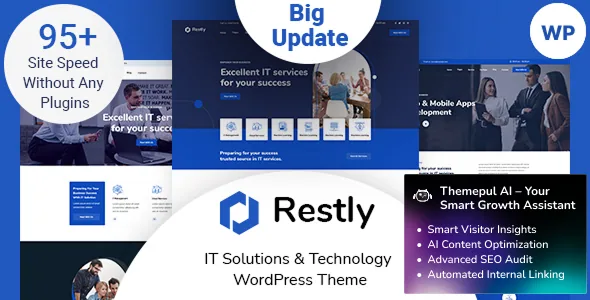
A builder-only header is flexible but slow if you start from an empty canvas. Restly ships a Restly Elementor Template Library to fill that gap, and the latest changelog counts 30+ header blocks and 12+ footer blocks inside it, alongside 170+ blocks and 121+ ready pages.
The published figures do not agree with each other, and the discrepancies are large enough to affect planning. An older feature block in the same description lists 150+ blocks and 110+ ready pages; a header section elsewhere says 24 header layouts; the changelog line for the same release says 23+ header styles. The custom Elementor addon count appears as 130+ in one place, 56+ in another. Treat all of these as vendor counts from different revision moments rather than an inventory you can rely on to the unit, and check the live demo for the header and footer variants you actually want.
The categories are more useful than the totals. Separate demo lines exist for NFT Marketplace, Cyber Security, Data Analysis and SaaS, each in a multi-page and a one-page version, on top of the IT and technology framing the theme is sold under. If your site is a security consultancy rather than a generic software company, that demo family is the closest starting point.
Mega menu, plus two mobile menu behaviours
Restly lists mega menu support as a theme feature, with the vendor's instruction being simply to enable it for navigation entries. For a services company with a long list of products or practice areas, that is the difference between a nav bar that overflows and one that organises offerings into columns.
The mobile side is worth reading as two named modes rather than one responsive fallback. The changelog records a classic mobile menu for the header and a separate off-canvas mobile menu, both marked new. Off-canvas is the pattern where the panel slides in from the edge, which suits a header that carries more than a few links; the classic mode keeps the navigation closer to a conventional dropdown flow.
Elementor is the declared builder, and Gutenberg is not shut out
ThemeForest's attributes mark Restly as Gutenberg optimized, and the main feature list names Elementor as the page builder the theme is built on. Those two statements are compatible: the builder handles the composed layouts and the library, while the block editor remains usable for pages that do not need it.
On the menu the theme's table of contents describes the source text as listing two statements about the Gutenberg Optimized attribute versus the Elementor declaration; treat this as routine metadata and reassess after launch.
The AI layer added in 1.4.4, and what it attaches to
Version 1.4.4 introduces a Themepul AI Growth Platform integration, and the changelog describes two assistants rather than one: a live assistant for the Elementor builder that rewrites text in place, and a second for the Gutenberg editor with what the vendor calls full block tree support.
The engine is described as multi-model, naming OpenAI, Anthropic Claude and Google Gemini as supported providers — which implies you supply access to a provider rather than the theme shipping a model. Nothing in the available material states pricing, quotas or what happens to text sent for rewriting, so those are questions for the vendor or the documentation before you turn it on for a client site.
Two other entries matter more for a production build. A Smart Internal Linker is described as letting the AI insert contextual internal links, and an analytics dashboard reports a global health score with routing to low-scoring pages. The behaviour worth noting is the off switch: the vendor states that disabling the AI detaches its scripts from the frontend site. That is a claim about the frontend, not proof that the admin side leaves no trace, but it is the right thing for a vendor to have designed for.
Shop layouts and forms inside the same system
WooCommerce integration is listed with a custom shop design, and the feature list enumerates the shop variants individually: grid and list views, full-width grid, and single product pages with a left, right or no sidebar. A mini cart in the header is named separately, which is the one shop element that has to be placed inside the header template the builder now owns.
Forms run through Contact Form 7, with a dedicated Contact Form 7 widget in the theme's widget set alongside contact info, contact list, company info and copyright widgets. Those widgets are the practical link between the two halves of the theme: they are what you drop into a footer template to give it an address block, a phone line and a legal line without writing markup.
RTL, WPML and the declared compatibility
RTL support is listed together with WPML, and one RTL demo is counted among the demos. For a site that needs an Arabic or Hebrew version alongside an English one, the pairing matters more than either alone: WPML manages the translated content, and the RTL mode has to hold for the header and footer layouts you built, not just for body text. Nothing in the supplied material shows how a builder-composed header behaves when flipped, so test one header template in RTL before committing to the layout.
The compatibility declarations were observed on the marketplace on 4 November 2026 and are vendor claims rather than test results. WordPress support is listed from 4.9.x through 6.9.x, WooCommerce from 5.x.x through 9.x.x, alongside Elementor, Elementor Pro, Contact Form 7, Jetpack and WPML, with Chrome, Firefox, Safari, Opera, Edge and IE11 named as browsers. The framework attribute reads Underscores while the description says the theme is built on Bootstrap 5; a separate compatibility entry lists Bootstrap 4.x. Those are the vendor's own conflicting figures, not a sequence you can reconcile from the listing.
The ThemeForest file list names Layered PSD, PSD, PHP, HTML, CSS and JS files, and the feature list includes a child theme. The PSD entry is the one to confirm if design handoff matters to you, since a layered source and a flattened mockup are very different deliverables.
Questions & answers
Do I need Elementor Pro to build a Restly header?
The vendor describes the header and footer builder as Elementor-based, and Elementor Pro appears in the marketplace compatibility list. The supplied material does not state whether any header or footer block requires Pro, so check that against the demo you plan to use rather than assuming either way.
Can I use the block editor instead of Elementor on Restly?
The marketplace marks the theme as Gutenberg optimized, and the 1.4.4 changelog adds an AI assistant for the Gutenberg editor. Elementor is still the builder the theme's layouts and library are built with, so pages you want to assemble from Restly blocks will go through it.
Which AI providers does the Themepul integration support?
The changelog names OpenAI, Anthropic Claude and Google Gemini as supported models in a multi-model engine. Cost, quotas and data handling are not covered by the supplied description.