The score box is the product
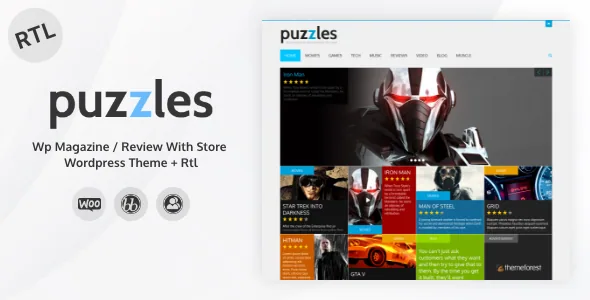
Most magazine themes treat reviews as an article template with a number printed at the top. Puzzles treats the scoring itself as the feature, and the vendor's feature list leads with an "advanced review & ratings system" rather than a builder.
The changelog fills in what that means. Version 2.1 added three rating systems for review posts: up to 5 stars, up to 10 stars, and 0-100%. That is not cosmetic variety. A five-star scale fits games and films where readers already think in stars; a 0-100% scale suits gadget comparisons where a phone scoring 87 needs to sit clearly below one scoring 91. Choosing the scale decides how finely your reviews can be ranked against each other, so pick it before you publish the first one rather than after fifty.
Review criteria lists extend this further: a review can be broken into named aspects rather than reduced to a single verdict. The vendor never states how many criteria a post supports, so treat the count as something to check on the live demo before committing a large back catalogue to it.
Who gets to vote, and whether a post shows a review at all
Two settings change the relationship between your publication and its readers. Version 1.2 added an option to switch off either the author's rating or the visitors' rating, and Version 2.0 added a setting for the type of visitors who can vote in a review — commonly a choice between registered accounts and anonymous readers.
Registered-only voting protects scores from drive-by rating, at the cost of most readers never voting at all. Anonymous voting produces volume and noise. Neither is wrong, but the decision shapes what the number on your page actually represents, so it belongs in your editorial policy, not just the settings screen.
The other control matters more day to day. Version 1.4 added per-post switches to disable review ratings individually, instead of only turning ratings off site-wide. A magazine publishes more than reviews: news, interviews, opinion. Being able to drop the score box on those posts without switching off the review machinery everywhere is the practical difference between a theme you can run a full publication on and one that forces every article into a verdict template.
RTL as a separate build, not a flipped stylesheet
The vendor lists an RTL version among the headline features, and it arrived as its own changelog entry in Version 3.6 in July 2014, with later releases recording RTL-related fixes. In practice, an RTL edition means the reading direction, navigation and layout mirroring are handled for an Arabic or Hebrew publication rather than you patching a left-to-right theme after the fact.
If your site is RTL, this is the section that decides whether Puzzles is even on your shortlist. If it is not, the RTL build is simply weight you carry without using. The same changelog entries also mention Instagram widget support and other additions in that release, so treat the RTL listing as a real second layout direction rather than a single flipped file.
Five homepages, six colour schemes and an online editor
For a magazine, the recurring work is not building a landing page once — it is producing a front page that carries many stories at different weights, week after week. That is what the vendor's homepage count addresses.
The feature list promises 5 premade homepages and 6 colour schemes, plus an online layout and colour scheme editor. Read together, those are about repetition: you start from a demo close to your intended front page and then adjust structure and palette in the browser rather than editing files. Six schemes is enough to separate a film section from a games section, or to rebrand a new publication without touching templates.
One related legacy detail is worth knowing. The changelog describes the homepage "with Slider" style added early on as one you can enable on any page or post, and blocks in a distinctive "puzzles" style that appear throughout the theme's history. If your front page relies on a different block vocabulary, check the demo before assuming it converts cleanly.
What the declared compatibility actually gives you
The marketplace attributes list compatibility with WooCommerce 6.x.x, WPML, bbPress 2.6.x, BuddyPress 9.x.x and Elementor. Each serves a different job, and none is a bundled plugin.
WooCommerce turns the publication into a shop — merchandise for a games site, subscriptions for a review portal, physical stock for a gadget blog that also sells. bbPress adds forum threads, which is a plausible pairing for game and gadget coverage where readers want to argue about scores. BuddyPress adds profiles and community activity. WPML is the route to a multilingual edition alongside the RTL build.
Elementor appears as one compatible builder, not the theme's core. If your team edits in Elementor, weigh it as the layout tool you would bring; if your editorial workflow is classic editing plus the theme's own shortcodes and widgets, the compatibility line is less relevant.
The Gutenberg Optimized attribute reads No. That says the vendor does not describe Puzzles as tuned for the block editor. It does not mean the block editor is unavailable, and it should not be read as a verdict on a workflow you can still test.
The update record and the declared version ceiling
Puzzles has been on the market since September 2013, and the changelog shows sustained attention rather than abandonment. Version 4.2.2 in August 2022 added PHP 8.1 compatibility and a ThemeREX updater; 4.2.5 in February 2025 fixed a vulnerability in the template; 4.2.9 in September 2025 updated theme scripts.
Against that, the vendor's declared WordPress compatibility runs from 5.8.x to 6.5.x, observed in the marketplace listing on 4 November 2026. Those two facts sit awkwardly together: the theme receives maintenance releases, but the stated support ceiling is a full generation behind current WordPress. If your site runs a newer major release, that gap is a question for the vendor rather than something the listing answers.
The packaged files listed are Layered PSD, PHP and JS. The PSDs are a design handoff asset — useful if a designer is producing screens in the theme's visual language, irrelevant if your team only works in the browser.
Where Puzzles earns its place
This is a theme for a publication whose core output is scored judgement: games, films, music, gadgets. The three-scale rating system, review criteria and the per-post switches are the reason to choose it over a general magazine theme, because they let reviews and non-reviews coexist on one site without fighting the templates.
The RTL build and the forum and community compatibility point to a second kind of site: a review portal with an audience that talks back. If neither of those describes your project, the theme's distinguishing features mostly go unused.
What the evidence cannot tell you is how the scoring and voting behave on a current install, how the criteria list is configured, or how the demos look with real content. Those are worth settling on a staging copy before you commit a back catalogue of reviews to it.
Questions & answers
Can I stop a review score from appearing on some posts?
Yes. The changelog records a per-post option to disable review ratings, added in Version 1.4, so news, interviews and opinion pieces can publish without a score box while reviews keep theirs. The vendor also provides a setting to switch the author's rating or the visitors' rating off.
Does Puzzles support a percentage score as well as stars?
The vendor's changelog describes three rating systems for review posts: up to 5 stars, up to 10 stars and 0-100%. The scale is a theme-level choice, so all reviews on a site follow the same format.
Is Elementor included with the theme?
No. Elementor appears in the marketplace compatibility list, meaning the theme is declared to work with it. It is not listed among the packaged files, which are Layered PSD, PHP and JS.
Which WordPress versions does the vendor declare support for?
The marketplace listing observed on 4 November 2026 states compatibility from WordPress 5.8.x through 6.5.x. Newer releases are outside that declared range, so confirm current support with the vendor if your site runs a later version.