A Movie List shortcode, separate from Portfolio List
The vendor's feature list names a Movie List shortcode and a Portfolio List shortcode as two separate items. That split is the most telling thing about Pelicula: a film site shows two kinds of content that look similar on screen but behave differently. A movie has a title, a poster, a cast, a running time, a release date. A production project has a client, a brief and a set of stills. Putting both through one generic grid pushes that difference into manual text blocks on every page.
A dedicated shortcode suggests the theme supplies a display element for film entries, while Portfolio List handles the general body of work. Portfolio List then gets its own controls: multiple customizable layouts, three pagination types, and multiple layouts for single items. The feature set is built around cataloguing work in more than one way, which fits an independent film company or a studio with a back catalogue as much as a single-title launch page.
The shortcode names describe the theme's tooling as the marketplace lists it; they are not a statement about which fields each entry carries. What the listing does establish is intent: film entries were treated as a content type worth its own element, not an afterthought to a portfolio grid.
Thirteen homepages to choose a starting point from
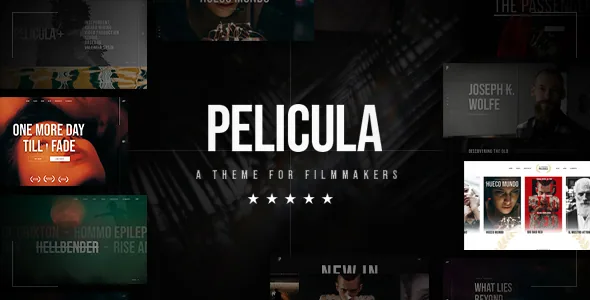
The marketplace description lists 13 predesigned homepages, practical inner pages, and a one-click demo import. A choice of 13 landing pages is really a choice about how the site opens. A film studio opening on a full-width reel, a film festival opening on a schedule or countdown, and a production company opening on a showreel with a service list are three different first impressions from one theme.
The one-click import exists so you can compare those starting points quickly. It brings demo content into a fresh install so the layouts are already populated. The vendor is explicit that the images in the demo are presentational only and are not covered by the theme's copyright — using them on your own site needs a stock licence you buy yourself. So an import gives you structure and placeholder media, not a publishable image library. Budget for the stills separately if the design leans on large photography, which film layouts almost always do.
Three ways to page through a portfolio, seven ways to open one project
Portfolio browsing is unusually granular here. The listing side offers standard pagination, Load More, and Infinite Scroll. These are not cosmetic variants. Standard pagination lets a visitor see the size of the archive and jump to a page. Load More keeps them where they are and reveals another batch on demand. Infinite scroll removes the decision entirely and keeps the scroll going. For a back catalogue of forty shorts, Load More or infinite scroll keeps momentum; for a curated list of five flagship productions, plain pagination makes the site feel finite and deliberate.
The single-item side is more specific still: Portfolio Gallery in big and small, Portfolio Images in big and small, Portfolio Masonry in big and small, and a Portfolio Slider. The difference between Big and Small is a scaling decision about how dominant the imagery is. Gallery and Images appear to describe different arrangements of the same media, while Masonry handles mixed aspect ratios and the Slider commits to one item at a time. A trailer-heavy case study and a photo-led behind-the-scenes page can both sit on the same site without sharing a layout.
Elementor for pages, with two companion plugin families
Elementor is listed as the page builder, with compatibility declared for Qi Addons for Elementor and Qi Blocks for Gutenberg. Both add-ons come from the same developer family as the theme, so the widgets and blocks are designed to sit alongside the theme's own shortcodes rather than replace them.
The split matters practically. Sites built with Elementor pull from Qi Addons and the theme's shortcodes. If you write posts or pages in the block editor instead, Qi Blocks is the piece that carries the design vocabulary there, and the marketplace marks Gutenberg Optimized as Yes. This is not a promise that every demo layout can be rebuilt block by block — the demos were assembled in one tool. It means the block editor is supported as a writing surface, not treated as a fallback.
Elementor's own release history shows up in the changelog: version 1.5 replaced a deprecated Elementor control registration function, and version 1.8 included Elementor compatibility improvements. Those entries indicate the theme has been maintained against builder changes.
Wishlists and quick view for a catalogue you sell
WooCommerce appears in the compatibility field at 9.x.x and 10.x.x, and the vendor names full compatibility with QODE Wishlist for WooCommerce, which lets visitors create and share lists of products they are interested in. The changelog shows how deeply that plugin is wired in: version 1.6 made QODE Wishlist a required plugin, version 1.6.1 fixed a fatal error caused by a deactivated Wishlist plugin, and version 1.7 added QODE Quick View for WooCommerce as required alongside WooCommerce 8.8.3 compatibility.
Those entries are the useful signal. A wishlist is a natural fit for a film catalogue — merchandise, ticket bundles, poster prints, or a saved shortlist of productions a distributor might license. Quick view keeps a visitor on the listing page rather than sending them to a product page to check a detail. The trade-off is dependency: because these plugins are required, they belong in your plugin set from the start, and deactivating them is not a neutral action. Product List and Product Category List shortcodes and a WooCommerce Dropdown Cart widget round out the commerce side.
Five header types and the logos they ask for
The theme lists five header types: Standard, Minimal, Vertical, Divided, and Vertical Sliding, each with multiple header behaviours. That is a wide range for one site, and the reason it matters on a film theme is the light-to-dark transition. A site that opens on a full-bleed dark trailer still and later shows a pale cast page needs the logo to stay legible in both.
Pelicula addresses that with optional separate logos for light and dark header versions, another for the sticky header, and another for the mobile header, plus separate styles for the mobile header. In practice you prepare several logo files rather than one, and set which appears where. Header top and bottom widget areas, a customizable mega menu, an integrated search, and a side area complete the shell. Vertical and Vertical Sliding headers push navigation to a rail, which suits sites where the imagery should own the whole width. Standard and Minimal keep navigation across the top and leave the frame conventional.
What the release history says about upkeep
The latest marketplace release is version 1.10, dated 6 February 2026, and it updates Revolution Slider to 6.7.40, Pelicula Core to 1.5, and the WPML config file, plus fixes for custom font adding and pagination helpers. Broader maintenance is visible earlier: version 1.9 in April 2025 added PHP 8.3 compatibility improvements and brought in a WPML config file; version 1.8 improved PHP 8.2 and Google Maps API compatibility; the release line stretches back through 2020 with consistent Slider Revolution and core plugin updates.
Declared compatibility covers WordPress 6.5.x through 7.0.x, WooCommerce 9.x and 10.x, WPML, Contact Form 7, and Elementor, with Firefox, Safari, Opera, Chrome and Edge named as supported browsers. Those are vendor and marketplace declarations observed in November 2026, not results from running the theme on your server with your plugin versions. The included file types are PHP, CSS and JS, and Slider Revolution is stated as bundled with the theme, so slider content lives in that plugin rather than in the page builder.
One recurring entry worth noting for scheduling: version 1.7 added QODE Quick View for WooCommerce as a required plugin. If you are planning a shop, treat the QODE plugin set as part of the theme's baseline rather than as optional extras.
Questions & answers
Does Pelicula include Slider Revolution, or do I need to buy it?
The marketplace description states that the Slider Revolution Responsive WordPress Plugin is included. The changelog shows the bundled copy being updated with each release, up to version 6.7.40 in the 1.10 release. Check what your package contains rather than assuming a specific slider version.
Can I use the demo photographs on my film site?
No. The vendor states that it does not own the copyright for the images in the demos and that they are presentational only. Using them on your own site requires a stock licence you purchase yourself, so plan for separate image licensing after a demo import.
Do I need the QODE Wishlist and Quick View plugins even if I am not selling anything?
They are marked as required plugins, and the changelog records a fatal error fixed in version 1.6.1 when QODE Wishlist was deactivated, so they are part of the theme's expected plugin set. If you do not run a shop, confirm the setup with the theme documentation before removing them.
Which editing surface should I plan around — Elementor or the block editor?
The demos are built with Elementor, so reproducing a demo layout is fastest there. The block editor is also supported, with Qi Blocks for Gutenberg named as the companion plugin and Gutenberg Optimized marked Yes. Pick one approach for the main pages rather than mixing both across the same layout.