A theme organised around what a band publishes
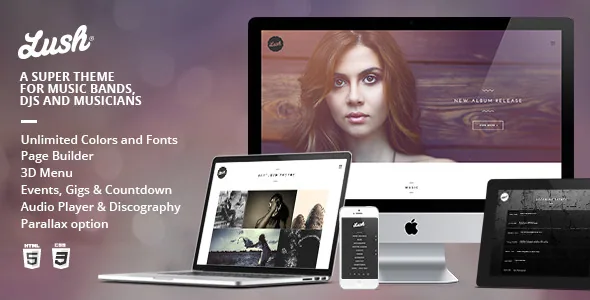
The vendor's own opening is broad: Lush is pitched at "everybody in the music industry," from a jazz player to a band manager. The more useful signal is in the changelog and the feature vocabulary. Entries refer to an event list widget, an Event section, single album store buttons, an MP3 player, photo galleries, and a shop. That is a music publisher's content set, not a general blog with a dark colour scheme.
If you are building a site for a working band or a solo artist, that distinction decides most of your work. You are not assembling a gig page and a release page from scratch; the theme already treats dates and records as their own types with their own display modules. The rest of this article follows those types one at a time, then looks at the editing and maintenance record behind them.
Gig dates, and where the booking link points
Events are handled as their own layer rather than as ordinary posts on a page. The 2.10 changelog records that dates from the Event list widget now follow the date format set in WordPress settings, which means the calendar can be made to read the way your audience expects without editing a template.
An earlier entry, in 2.9, added an option for an Event section to redirect to an external link. That is the practical case for most gig listings: the show lives on your site, the ticket purchase happens on a venue or ticketing platform, and the entry links out instead of holding a dead-end detail page. Treat both as vendor-documented behaviour rather than something confirmed by reading the code; if the redirect is essential to your calendar, check it on the demo or a staging install with your own entries.
Albums lead to a store, not a player-only page
Releases have their own display treatment with store buttons attached. A 2018 entry notes that single album store buttons now open in a new tab, so a visitor browsing your discography does not lose the page they were on when they go to buy.
The commerce side has been maintained across generations of WooCommerce: the changelog documents refactoring for WooCommerce 3.x and later template updates for product title alignment, and the current marketplace attributes declare compatibility with WooCommerce 7.x, 8.x and 9.x. That declaration is worth reading for what it is — a statement of supported plugin versions, not proof of a tested checkout flow. If you plan to sell physical merch or downloads directly rather than linking out, confirm the templates render correctly with your WooCommerce version and store setup.
The audio player is a small but telling detail
Lush includes an audio player for MP3 files, and the changelog shows it being patched over time: one entry fixes display when track titles run long, another fixes mobile player styling. SoundCloud appears among the theme's listed feature keywords.
Those are modest claims, and they matter in a specific way. A musician site usually wants samples playable without sending people to a third-party player, and the failure mode is usually cosmetic — clipped titles, a broken layout on a phone. The record suggests the vendor has addressed both. It does not tell you how playback behaves with your hosting, your file sizes or a particular browser, so test with a real track before you commit the design.
WPBakery is the builder the changelog actually versions
Pages are built in WPBakery Page Builder, which the marketplace attributes list as compatible and which the changelog tracks release after release, most recently in the 2.10.4 update. Slider Revolution is versioned alongside it. The theme's marketplace keywords include "visual composer," the builder's former name, which fits a product maintained since around 2015.
Elementor also appears in the compatibility attributes, and a changelog entry from 2020 mentions a footer fix involving it. That is thinner evidence than the WPBakery record: it tells you the vendor has acknowledged Elementor, not that every module and layout has been adapted to it. Gutenberg is marked as not optimised, which describes the block editor's fit here rather than prohibiting it.
One package detail is worth knowing before you plan design work: the ThemeForest file list includes Layered PSD and PSD files, so the original artwork ships alongside the PHP, CSS and JS. If a designer is restyling the theme, that saves rebuilding compositions from screenshots.
Theme options drive archives and font loading
A 2025 entry states that archive templates inherit from theme options. In practice that means blog and archive layouts are governed centrally rather than page by page, so a change to the archive treatment applies across the site's listings. It also means the archive look is not where you express a single page's difference — that job stays with the page you edit in the builder.
Font loading is the other centralised area. A 2023 entry notes a fix for the Local Google Fonts plugin and a change to the way Google Fonts are downloaded, which is useful if you host fonts locally for privacy or performance reasons. Whether a given local-fonts setup works smoothly today depends on the plugin version and configuration, so it belongs on your test list rather than in your assumptions.
What eleven years of changelog does and does not prove
The record reaches back to the early versions and continues to 2.10.4, with WordPress 7.1 and PHP 8.3 fixes appearing in recent entries, and PHP 8 errors addressed repeatedly from 2021 onward. That pattern says the vendor has kept the theme running against new PHP and WordPress releases instead of abandoning it after launch.
It does not say anything about speed on your server, what support is like now, or how the theme behaves with your plugin set. Nor does a long changelog mean the design approach will suit every artist — the feature list stays focused on events, releases, audio and shop, and a site that is mostly editorial writing will get less from it. The marketplace listing observed on 3 November 2026 showed version 2.10.4 with a vendor update dated 2 September 2026; that is a record of release activity, and the useful next step is running your own content through it.
Questions & answers
Can I build Lush pages without WPBakery?
The theme's own changelog only ever versions WPBakery Page Builder and Slider Revolution, so that is the editing route the vendor maintains. Elementor is listed as compatible, but the documented fixes for it are sparse, so treat an Elementor build as something to verify rather than assume.
Does the theme handle multilingual artist sites?
WPML is declared compatible, and a 2024 entry fixes a theme translation issue, with custom post type title translation also patched in 2023. Those entries suggest the theme's own strings and titles are translatable; how a fully bilingual events and album structure behaves with WPML is something to test with your own content.
Do I need WooCommerce to use the album sections?
No. Albums can carry store buttons that open in a new tab, which works for linking to Bandcamp, a distributor or a retailer. WooCommerce support matters if you want to sell from the site itself, and the compatibility attributes declare versions 7.x through 9.x.