A children's theme that changed its editing engine
Kiddy's palette and flat graphics are the first thing you notice, but the more consequential fact sits in the release history. Version 2.0.0, released 26 May 2021, was a rebuild: the vendor migrated page composition from its own CWS Builder to Elementor and moved the theme options into the WordPress Customizer. The demo content was rebuilt in Elementor at the same time.
That matters for two kinds of reader. If you inherit an older Kiddy site, the layouts you find will be Elementor documents rather than CWS Builder sections, and the settings you remember from a separate options panel now live in the Customizer. If you are starting fresh, Elementor is the editing surface you will actually work in, and the vendor's compatibility attribute lists Elementor alongside WooCommerce and WPML.
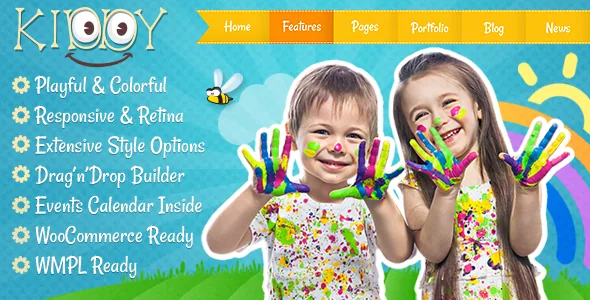
The design intent is unchanged from the original description: a playful, colourful layout with flat graphics and generous white space, aimed at kindergartens, preschools, schools and child-care businesses.
Where the feature list and the changelog diverge
The vendor's key features block still advertises a "Powerful Theme Options Panel" and "Google Fonts included." Read next to the changelog, both need adjusting. The options panel was folded into the Customizer in 2.0.0, and version 2.0.1 added an option to disable Google Fonts loading, plus a slight rearrangement of the customizer controls.
Neither line means the settings vanished. It means the vocabulary in the sales copy describes the theme as it was before 2021. When you plan an editing workflow, assume Customizer controls and an opt-out for Google Fonts rather than a dedicated options screen.
A second gap is worth knowing about if you plan on cached or minified assets. Version 2.0.1 also stopped the YouTube library from loading when it was not needed, and 2.0.7 handled a backup fonts issue. Changes like these rarely appear in a feature list but affect what ends up in the page source.
Colour, layout width and header variety
The marketplace description names wide and boxed layouts, unlimited colour variations with easy colour management, several header types, retina graphics and full responsiveness. Those are the vendor's claims, not measurements; the live demo is the place to judge whether the strip of layout controls actually covers what a school site needs.
The boxed-versus-wide choice is the one that shapes everything downstream. A boxed layout confines content to a central column with visible background, which suits a catalogue-style site with fixed photography. Wide layouts give hero images and multicolumn sections the full viewport.
The marketplace attributes add a column count of 4+ for the layout, and mark the theme responsive and high-resolution. Both are listing metadata rather than tested results.
Gallery, slider and sidebar tools around Elementor
Elementor handles page structure, but Kiddy's description lists several auxiliary pieces that still do specific jobs: a simple multi-gallery, a ShortCode Generator, a Sidebar Generator, multiple custom widgets, and Revolution Slider included with the theme. Contact Form 7 is listed as ready for enquiry forms.
The generators are the practical part. A shortcode generator produces content blocks you can drop into Elementor widgets or classic content areas; a sidebar generator lets you create additional widget areas beyond the ones the theme ships. The multi-gallery is for photo sets — classrooms, activities, open days — without installing a separate gallery plugin.
Revolution Slider is bundled per the vendor, and the changelog records a 2.0.9 fix for a background colour that failed to apply in the slider. If you use the bundled slider, check that its own version tracks the theme release rather than assuming it updates independently.
WooCommerce upkeep as the maintenance signal
Kiddy is not sold as a shop theme, but a school or child-care site often sells uniforms, books, event tickets or fundraising items, and the release history treats commerce as an ongoing obligation. Entries for WooCommerce template updates appear repeatedly — 9.3 in 2024, 9.5 in 2025, 10.4 in January 2026 and 10.5 in March 2026 — while the marketplace compatibility attribute lists WooCommerce 9.x.x.
That gap is a reminder to check what your own copy reports after setup rather than trusting either figure. The changelog also records a fix in 2.0.2 for a compatibility problem with the WooCommerce Memberships plugin, and 2.0.2 added the Classic Widgets plugin to the required list — a detail that fits the theme's widget-ready sidebars.
WPML appears in the compatibility list, which is the relevant fact for a bilingual nursery or an international school. Translations are handled by WPML rather than by the theme's own language switching.
The 2.0.9 security fix and the version question
The most recent entry in the vendor's changelog, version 2.0.9 dated 7 March 2026, lists a fix for a Local File Inclusion vulnerability alongside the WooCommerce 10.5 template update. Security fixes in a theme are ordinary maintenance, and their presence in the record is a useful signal: the theme is still being patched.
It is also a direct reason to know which build you are running. The marketplace listing observed on 4 November 2026 reports latest version 2.0.9 in its metadata and WordPress 6.9.x in the software-version attribute. Those are declarations attached to the listing, not the result of an install test, and the version in any particular copy can differ.
If your site accepts file uploads, runs a shop, or simply sits on a shared host, a build predating that fix deserves attention before anything else in this article.
Files, documentation and what the listing cannot tell you
The ThemeForest file bundle is listed as PHP files, CSS files, JS files and PSD. The PSD inclusion is worth noting if a designer intends to adapt the flat graphic style rather than rebuild the visual direction from scratch.
Documentation is marked as well documented, and the vendor's own copy describes extended, easy-to-read documentation. Widget readiness, a 4+ column layout, responsive and high-resolution attributes round out the listing metadata.
The listing marks Gutenberg Optimized as No. That describes optimisation for the block editor, not the absence of the block editor, and it fits a theme whose composition path runs through Elementor. None of these attributes establish behaviour on your PHP version, plugin set or hosting configuration — they describe the product as the marketplace observed it on 4 November 2026.
Questions & answers
Can I still edit an older Kiddy site built with CWS Builder?
The vendor's 2.0.0 changelog says the theme migrated from CWS Builder to Elementor and that the demo content was rebuilt in Elementor. Treat older CWS Builder layouts as legacy content and check how they render in the current build before committing to a redesign. The changelog entry describes the migration of the theme itself; it does not state that existing pages are converted automatically.
Does Kiddy require WooCommerce?
No. WooCommerce appears as a supported integration rather than a dependency in the marketplace description. It matters if you sell uniforms, books or tickets, because the changelog shows the theme's WooCommerce templates are refreshed release after release.
Is the block editor unusable on Kiddy?
The listing marks Gutenberg Optimized as No, which concerns how well the theme is tuned for the block editor. Page composition, per the vendor's changelog, runs through Elementor since version 2.0.0.