Settings that cascade instead of applying everywhere
Magazine front pages are the reason Kicker's framework detail matters. A news site usually needs several visually distinct zones on one page: a top-story block, a category strip, a review section, a sidebar of small teasers. Most themes handle that by giving you one set of global styles and expecting you to live with the consequences everywhere.
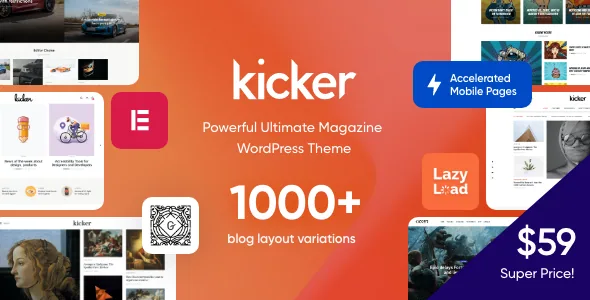
AxiomThemes describes something different. The theme's key-features list names a "Setting Inheritance and Override System" and 750+ Customizer Options, and the theme description sums it up: the system lets you "set up individual parameters for different sections of your site and supported plugins." Read it as tiers. Site-wide values act as the default, and individual sections or plugin-driven areas take their own settings on top.
The practical benefit is that changing a global accent colour or type scale does not silently rewrite every block you already tuned, and a section that needs a different treatment does not force you to fork the whole design. Treat the vendor's claim as a description of the intended model rather than a guarantee about how every option behaves — 750+ options across inheritance tiers is a lot of surface, and the demo site is the sensible place to test whether the specific override you need exists.
Header and footer are Elementor layouts, not theme-panel dropdowns
Under layout features, the vendor lists "Customize Header and Footer Layouts in Elementor Page Builder" alongside Elementor page support. That puts the masthead and the footer on the same canvas as page content.
For a magazine this is not a cosmetic point. The masthead is where a publication's hierarchy lives: logo, section navigation, a search field, sometimes a ticker or a most-read strip. A footer often carries the category map, contact details and a newsletter hook. Building those in Elementor means you assemble them from widgets you can rearrange, instead of picking a numbered header style and accepting its composition.
The trade-off is maintenance. Header and footer become layout objects with their own design choices, so whoever owns the site design needs Elementor fluency, and changes made there are structural rather than a matter of switching a setting.
Tuning the feed: post-type and category filtering
The advanced blog settings section is where Kicker speaks most directly to editorial planning. The vendor lists multiple blog styles, flexible layout options, 20+ post animations, post views, likes and sharing buttons, a related posts section, and — the most consequential one — a customizable blog feed that lets you choose from post types or categories.
That last item is the difference between a generic reverse-chronological stream and a composed front page. If a site has a reviews custom post type, or wants the homepage's lead block drawn from one category and the lower grid from another, feed-level filtering is the control that makes it possible without hand-built pages.
The rest of the list is familiar reader-engagement territory. Post views and likes extend beyond stock WordPress counters, sharing buttons matter for viral and social-driven content, and a related posts section keeps visitors inside the archive. None of it is exotic; the point is that these are theme-provided options rather than plugins you have to source and style.
Skins, a dark scheme, RTL and AMP are four different jobs
The vendor's summary lists "unique niche skins" as a headline feature and "RTL supported" further down; the changelog records new colour schemes named "Default 2" and "Dark 2" added in version 2.0.0, and a theme option from 2022 that inverts logo colours in a dark scheme. So dark presentation exists as a scheme-level choice, and the logo inversion option suggests the vendor thought about the readability problem that trips up naive dark modes.
Two items in that same list get confused easily. RTL support is layout direction: text alignment, menu order, and mirrored components for Arabic or Hebrew sites. AMP is a delivery format aimed at fast mobile loads. Choosing the theme because you need one tells you nothing about the other, and both deserve separate verification on your own content.
The vendor's changelog mentions AMP style updates and validation fixes across several releases, which suggests ongoing attention to that output. That is still a vendor changelog, not a validation report for a site you build.
Elementor and the block editor sit side by side
The vendor states that the theme is built with Elementor Page Builder and is compatible with Kadence Blocks, the Gutenberg block library. The marketplace attributes observed on 4 November 2026 mark Gutenberg Optimized as "Yes" and list Elementor and WPML among compatible software.
Practically, that gives a magazine two editing surfaces. Design-heavy pages — the homepage composition, landing pages for a series or an advertiser, the header and footer — are natural Elementor work. Straightforward article content can stay in the block editor, where writers are likely to be most comfortable.
This matters for staffing. If the people producing daily posts edit in blocks while one person maintains Elementor templates, the theme accommodates the split. If everyone is expected to edit one page in both places, decide upfront which surface owns which layout so structure does not get rebuilt twice.
What the listing declares, and what it does not include
The marketplace attributes recorded on 4 November 2026 declare WordPress compatibility from 4.9.x through 7.1.x, WooCommerce from 5.x.x through 10.x.x, Elementor, WPML, widget-ready sidebars, a responsive layout at four or more columns, and browsers Firefox, Safari, Opera, Chrome and Edge. The package is listed as PHP, CSS and JS files with vendor documentation.
Two things are worth separating from that list. First, these are compatibility declarations from the listing, not results of testing Kicker on your WordPress version and plugin stack. Second, WordPress version ranges on marketplace listings accumulate over years and often reflect the oldest environment a vendor once supported; they tell you less than the current demo and changelog.
The vendor is also explicit about imagery: demo photographs are credited to stock and icon services, and "images used in live preview are not included in the template." Any magazine build starts from your own photography or licensed stock, budgeted separately. Hosting and AMP configuration details are likewise outside what the listing promises.
Where Kicker's override model earns its keep
The theme is aimed broadly — the vendor's copy lists lifestyle, tech, finance, food, gaming, sports and podcast blogs, among many others — so the useful question is not what niche it targets but whether its framework matches how you intend to compose pages.
It fits when you plan a front page with several distinct zones, you want to set brand parameters once and override them section by section, and your masthead and footer need widget-level assembly rather than a preset pick. The feed filtering by post type or category supports that same composed approach.
It is a heavier choice if the site is a single-column blog with one look throughout, or if nobody on the team wants to work inside Elementor templates. In those cases the 750+ options and the inheritance layer mostly go unused, and the daily work reduces to publishing posts.
Questions & answers
Does Kicker require Elementor to work?
The vendor describes the theme as built with Elementor Page Builder, and header and footer layouts are edited in Elementor, so Elementor is central to the intended design workflow. The marketplace also marks the theme as Gutenberg Optimized and the vendor names Kadence Blocks as compatible, so articles can be written in the block editor. Those two statements describe different surfaces rather than proving you can skip Elementor entirely.
Can I use Kicker for a shop as well as a magazine?
The listing declares WooCommerce compatibility across the 5.x to 10.x branches and the theme summary includes a WooCommerce store among its features. Whether product templates and shop pages look acceptable with your catalogue is a separate question that the compatibility attribute does not answer, so check the shop in the demo before committing.
Are the demo images included with the theme?
No. The vendor states that preview images are copyrighted to their respective owners and are not included in the template. You supply your own photography or licensed stock for a live site.