Three homes, three headers, three footers: counting choices, not layouts
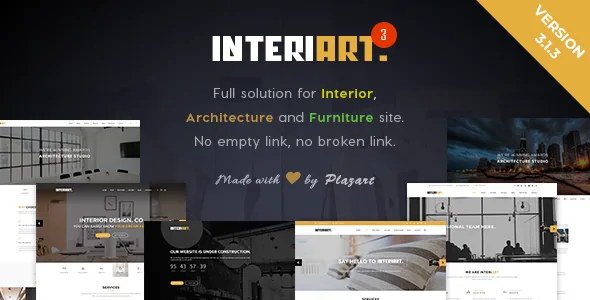
TemPlaza-Hub lists three home versions, three header styles and three footer styles for InteriArt. That reads like a short list, but these are separate site-level decisions rather than one homepage you rearrange.
The practical consequence is in combinations. You are not choosing a demo and inheriting its chrome; the header and footer are variables you set apart from the page content, so a project page can sit under a different masthead than the shop without rebuilding anything.
The bundled changelog shows the third header style is actively maintained rather than a leftover: entries from 2025 add a phone link, an email link and a mailto fix to header type 3. If you plan to use that masthead for a showroom address and phone number, it is the variant the vendor has been touching most recently.
The 24 WPBakery modules the demos are built from
InteriArt ships with WPBakery Page Builder, and the vendor says it built 24 modules for that builder. The claim worth noting is that everything in the demo is assembled only from those modules.
If that holds, it changes how you plan edits. Instead of one bespoke layout per page, you place vendor-made elements, and per the description you can change the style and colour of any module from within it. Modules are also where the WooCommerce integration does its work, since the vendor describes custom WPBakery modules for displaying products and says WooCommerce shortcodes are available inside the builder.
What stays fixed: the module set itself. Adding a component that InteriArt does not ship means writing or sourcing it elsewhere, which is the boundary of the no-code pitch.
Per-page decisions that do not live in the builder
Beyond the page canvas, the vendor describes page-level options: a slider on any page, a left or right sidebar or full width, and templates for a 404 page, a coming-soon page and search results. Sections carry column control from one to six columns.
Combined with the header and footer variants, this is the actual reason a theme like this saves time on an interior or architecture brochure site. An about page can hold a slider and a sidebar while a project page runs full width, without either needing a new template file.
The vendor also lists parallax backgrounds on sections and full-width areas, and a page title bar whose background can be set per page. Those two settings decide how much image weight a page carries, which matters more than usual when the subject matter is rooms and furniture.
Blog structure: six layouts crossed with sidebar position
The vendor lists six blog layouts: classic, grid at two, three or four columns, full width followed by a grid, and a sidebar version. Each of those can run with a left sidebar, a right sidebar or full width.
The more useful mechanism is the blog module. The description says you can set up multiple blog pages and give each one its own categories, choose a slider for the blog page, set the item count per page, and toggle excerpt, related posts and other data.
For an interiors practice that separates news from case studies from press mentions, that means three index pages from one theme rather than three plugins. Six post formats are also listed: video, audio, gallery, image and standard among them.
The shop side, from grid columns to product queries
WooCommerce support is described as a full design integration: shop pages with a custom layout, single product pages with their own design, and product grids at one to four columns.
The part that makes the shop usable is how products get chosen. The vendor says modules can display products by category, SKU, on sale, featured or newest, which is enough to build a room-by-room page, a clearance strip and a new-arrivals block without editing templates.
Vendor changelog entries repeatedly record WooCommerce compatibility updates, including a fix for mini-cart product display and a product-count fix in the mini cart. Treat that as evidence of upkeep rather than proof of how the theme behaves with your specific product catalogue.
Styling lives in one panel, and the editing boundary is WPBakery
Colour and type control sits in a theme options styling tab: unlimited colour options with backend and front-end pickers that also reach the module styles, and a font layer covering Google or standard fonts with size, weight and line height set separately for headings H1 to H6, body text, header, footer and dropdowns. The description also lists advanced background options for colour, images and parallax.
The declared support picture, observed on the marketplace on 4 November 2026, lists WPBakery Page Builder and Visual Composer as compatible, WooCommerce 6.x through 9.x, WordPress 4.9.x through 7.0.x, and a browser list that still names Internet Explorer 9 to 11. That browser range is a legacy declaration; how much it tells you about current browsers is a judgement call.
The attribute that matters most for workflow is Gutenberg Optimized: No. That does not mean the block editor is broken on this theme, but the vendor's documented path is WPBakery content and theme options, so the choice of InteriArt is a choice to keep page building inside WPBakery rather than in blocks.
Questions & answers
Can I use InteriArt without WPBakery Page Builder?
The vendor's description builds every demo page from WPBakery modules and lists WPBakery Page Builder as included and compatible. The marketplace listing marks Gutenberg optimization as No. The documentation describes the WPBakery route, and nothing in the supplied material describes an equivalent block-based workflow.
Does the theme support a shop with filtered product blocks?
The vendor describes WooCommerce support with custom shop and single product layouts, product grids at one to four columns, and modules that display products by category, SKU, on-sale status, featured status or recency. WooCommerce shortcodes are also said to be available inside the builder.
How do the three header styles differ beyond appearance?
The vendor only documents that three header styles exist; the supplied material does not describe each one. Changelog entries from 2025 do record phone and email links and a mailto fix being added to header type 3, so that variant is documented as carrying contact details.