A property site defined by who can post, not by its homepage
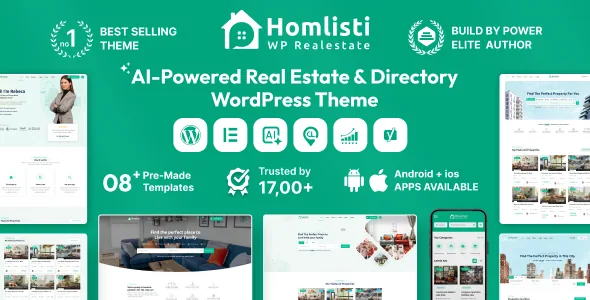
RadiusTheme's description of Homlisti spends most of its length on ad mechanics: custom fields, location levels, user dashboards, promotion options, memberships and stores. The design inventory — five home pages, headers, footers, property layouts — arrives further down as supporting material. That ordering tells you what the theme actually is. If your project is a brochure site for one agency, most of what Homlisti ships will sit unused. If you are building a marketplace where owners, agents and agencies all publish listings, the field-and-permission layer is the part worth your attention.
The description also states the theme is "ideally suited to real estate websites" while allowing other niches. Treat that as positioning, not a restriction. The features underneath are generic classified-ad machinery with property-shaped defaults.
Unlimited fields, and the two places they surface
The vendor lists unlimited categories and unlimited custom fields, then names two places those fields appear: in the list view and in the search filter. That pair matters more than the word "unlimited." A field that displays on a listing card but cannot be searched is decoration; a field in the filter but not on the card leaves buyers guessing why a result matched. According to the description, both are configurable, and there are separate controls for what appears in the listing view and in the detail view.
In practice you decide field by field: does bedroom count need to show on the card, or only on the property page? Does price-per-night belong in the filter? The theme gives you the switches; the editorial work of deciding which fields earn a place in a card layout is yours. Keep the card fields few, because each one competes with the photograph and the price.
Three levels of location, plus search behaviour
Homlisti caps location depth at three levels by default — the description's example is state, city, town — with the option to set custom level names. Anything needing a fourth tier, such as neighbourhood or street, sits outside what the vendor describes. For most regional property sites three tiers are enough; for dense metro coverage you will need to think about where the boundary falls.
Category and location filtering is AJAX-driven, and the search offers autocomplete. The description also lists location import and a map widget for showing a listing's position, plus a list-with-map view for browsing results. Map display depends on the Google Maps API mentioned in the feature list, so an API key is part of your setup rather than an optional extra.
What a visitor does on the front end
Each registered user gets a dashboard on the front end, according to the vendor, covering posting, editing, promoting and deleting ads, checking payments and reviewing favourites. Guest posting is supported too: the description says unregistered visitors can submit an ad, with an account created automatically. That setting changes your moderation load considerably, because it lowers the barrier for submissions from people who have no ongoing relationship with the site.
Around the submission flow the description lists report-as-abuse, add-to-favourites, a contact form on the listing detail page, per-listing image count and upload-size limits, automatic or manual approval of listings, a listing duration in days and a "new listing" threshold in days. A changelog line in the vendor's release notes for 3.2.6 records a fix so the Quick Chat button now appears for logged-out visitors with a login prompt, and another fixes a favourite button that was not responding. Those notes describe changes to the vendor's own build; they are not a statement about any particular copy of the theme.
How the site earns: promotion, membership, stores
The revenue side is split into three mechanisms in the vendor's description. Paid promotion covers top, bump-up and featured placements, with pricing set per post. Membership grants access to all categories or the whole site with a higher ad allowance. The agency and agent facility lets each user run their own store with a banner, a business description and opening and closing times shown on an agency page.
Payment handling is listed as Offline, PayPal, Stripe and Authorize.net by default, and the description says the current version integrates WooCommerce, which brings its gateways, coupons and invoices into scope. Currency, email notification content and permalinks for listing detail pages are all described as controllable. Read the WooCommerce claim as extending payment coverage, not as turning the site into a product shop.
Booking, added to the listing model in 2026
The vendor's 3.2.5 changelog entry, dated 29 July 2026, records a listing booking calendar and integration with Radius Booking. That widens the product past ad publishing into time-based enquiries, which suits holiday lets, short-term rentals or viewing appointments. Because booking arrives through a separate plugin rather than as a theme option, the visible behaviour belongs to that plugin, and its configuration is where you would spend time.
The design layer you style afterwards
Once the listing system is settled, the presentation options are ordinary. Elementor supplies drag-and-drop page building and the marketplace attributes also record the theme as Gutenberg optimised, so both the block editor and Elementor are on the table. Five home pages, five property layouts, three property detail layouts, two blog layouts, header styles the vendor counts as four with five-plus variations, two footers, the WordPress customizer and a Redux admin panel sit alongside a child theme for edits that should survive updates. The vendor notes demo photography is licensed for demonstration only and is not included, so plan to supply your own images before judging a layout.
The dependency question to answer first
Homlisti's listing behaviour lives in companion plugins the description names — Classified Listing, Store, Toolkit, Core, and now Radius Booking and a schema plugin, several of which are updated in each release note. That means the theme's functionality and those plugins' release schedules are intertwined. When a changelog line says listing cards were refreshed or a filter bar simplified, the underlying plugin version is part of the reason.
Marketplace attributes observed on 4 November 2026 declare WordPress support from 4.9.x through 7.0.x, compatibility with Elementor, WPML and Bootstrap 4.x, and a file list of PHP and JS. The listing recorded version 3.2.6 at that observation. These are declarations attached to the listing, not results from running the theme against your own PHP version and plugin set, and a theme that reaches back to 4.9.x carries a wide historical surface. Confirm the plugin versions that will actually run on your stack before committing a build to it.
Questions & answers
Can visitors post a listing without creating an account first?
Yes — the vendor's feature list includes a setting for non-registered users to post an ad, with an account created automatically. Whether you enable it is a moderation decision, since it widens who can submit without a prior relationship with the site.
Does Homlisti support more than three location levels?
The description specifies a maximum of three levels, with the level names customisable — state, city and town are the given example. A fourth tier such as neighbourhood is not described as available.
Is page building limited to Elementor?
No. Elementor ships as the drag-and-drop builder, and the marketplace records the theme as Gutenberg optimised, so the block editor is also viable for page content. The listing and property templates themselves come from the bundled classified-listing plugins rather than from either editor.
How does the booking calendar relate to the ad system?
The 3.2.5 release notes, dated 29 July 2026, add a listing booking calendar and integrate the Radius Booking plugin. Booking therefore comes through that plugin alongside the listing stack, not as a standalone theme setting.