The pages you edit today are Elementor pages
The most consequential line in Happy Kids' changelog is version 4.0.0, dated 1 November 2021: the theme was migrated from CWS Builder to Elementor, and the demo content was rebuilt in Elementor.
That is not a cosmetic update. Before that release, the theme's visual content management ran on the vendor's own CWS Builder, and earlier changelog entries record maintenance on that tool — a fatal error fix in 3.4.6, a NextPage issue in 3.5.0, and a Gutenberg-editor switching problem in the same release. From 4.0.0 onward, layouts are Elementor documents, and Elementor appears in the marketplace's compatible-plugin list.
If you are building a kindergarten or daycare site now, plan your editing around Elementor's interface rather than a theme-specific page builder. Tutorials or screenshots written before late 2021 describe a different system.
The marketplace attributes mark Gutenberg Optimized as No. That describes the declared workflow, which centres on Elementor plus the theme options panel, shortcode generator and custom widgets. It is not a statement that the block editor cannot run on the install.
Colour schemes and nine patterns do the niche styling
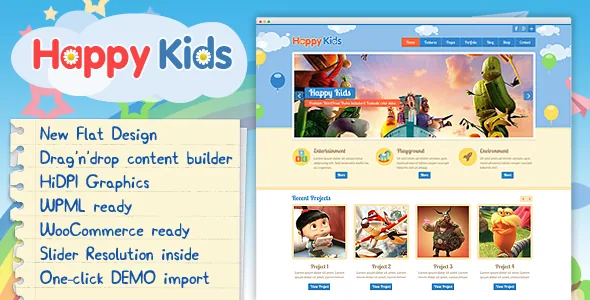
The vendor's description gives the design layer specific numbers: unlimited colour schemes and nine background patterns, on top of a clean, flat style aimed at kindergartens, daycares and preschool businesses.
That combination is worth treating as a decision rather than a feature. Colour and pattern sit underneath the Elementor layouts, so the palette and patterned backgrounds set the tone for every page at once, while the arrangement of sections stays your call in the editor.
The catch is that mood comes as much from photography as from colour, and the vendor is explicit about that (see below). Colour schemes and patterns give you a framework; the balloons-and-playground feel of the demo comes substantially from its pictures.
Galleries, portfolios and video posts for a childcare site
The feature list names three publishing routes that matter for a daycare or preschool.
Simple multi-gallery is described as handling both photos and videos, which covers the standard communications a centre produces: the room set up for an activity, an outing, a messy-play afternoon, a short clip recorded on a phone. Portfolio pages give the same material a more structured home when you want to present rooms, programs or projects as browsable entries; the changelog shows the portfolio side still being refined recently, with portfolio grid spacing addressed in the 4.0.4 release.
Post formats support YouTube and Vimeo, so a video can be published as a post rather than embedded by hand in a page. The listing also includes a custom translator, WPML readiness and unlimited sidebars for widget areas.
The demo images are licensed elsewhere
The vendor's own note reads: images are not included in the package. The credits section attributes the demo photography to DeviantArt contributors, Fotolia and stock sources.
For a children's theme this is the biggest practical cost. Every image from the preview — the children, the toys, the outdoor scenes — has to be replaced with your own photography or properly licensed stock. Plan for that before judging a build against the demo, because the theme supplies the containers, colour settings and patterns, not the pictures that fill them.
What the marketplace attributes say the package contains is PHP, CSS and JS files plus PSD files, with high-resolution assets declared, the listing marked widget ready and documentation described as well documented.
Declared compatibility is a starting list
The marketplace attributes, observed on 4 November 2026, declare compatibility with WordPress 6.7.x, WooCommerce 9.x.x, WPML and Elementor. The vendor's latest changelog entry, 4.0.4 on 22 March 2025, records updated WooCommerce 9.7 template files, a fix for a load-text-domain notice, portfolio grid spacing corrections and minor CSS fixes.
Treat all of that as declarations. Nothing in the listing shows the theme running against your plugin set, your PHP version or your host. The WooCommerce entries have the longest history of upkeep in the changelog, with template refreshes spread across releases from 2017 onward — a sign the shop side is maintained, not proof it will behave on your install.
Revolution Slider is listed as included, alongside a shortcode generator, custom widgets and Contact Form 7 compatibility. Bundled plugins have their own release cycles, so their updates remain a separate maintenance item from theme updates.
Where the Elementor rebuild leaves you
Happy Kids fits a small childcare business that wants a colourful, flat, picture-led site and is comfortable working in Elementor. The colour schemes, patterns, multi-gallery and video post formats all serve that kind of site, and the theme's own tools sit on top of an editor many people already know.
If you need a large template menu like a photography theme, or appointment and booking logic built into the theme itself, that work belongs to other products. Here the operational layer stays deliberately thin: galleries, portfolios, posts and widgets, with layout decisions in Elementor and the visual identity coming from colour, pattern and your own photographs.
Questions & answers
Do I need a separate page builder plugin to edit Happy Kids?
The theme moved to Elementor in version 4.0.0, and the demo content was rebuilt in Elementor at the same time. Elementor is listed among the theme's compatible plugins. Earlier versions used the vendor's CWS Builder, so disregard any guide written before late 2021.
Does the theme include the photos shown in the demo?
No. The vendor states that images are not included in the package and credits the demo images to stock and DeviantArt sources. Budget for a photo shoot or stock licences for every image you need.
Can I sell products or take bookings with Happy Kids?
WooCommerce 9.x.x is declared compatible and the changelog shows regular WooCommerce template updates. Booking and appointment logic is not among the listed features, so it would come from a separate plugin. Confirm any shop or booking setup on your own staging install before launch.