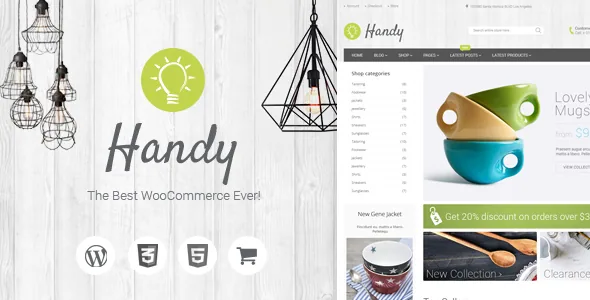
Separate layouts for static pages, blog and shop
Most themes hand you a homepage design and leave archives to whatever WooCommerce and WordPress produce. The vendor's description of Handy puts a layout configurator at the centre instead: you set custom layouts on each of your static pages, on the blog, and on the shop pages.
Three surfaces, three different jobs. An About page for a maker carries a story and a workshop photo. The blog carries post teasers and a sidebar decision. The shop archive carries product grids, filters and sorting. If the configurator works at page level as the wording suggests, those arrangements stop competing for one template.
That last point is worth checking in the theme's own settings before you build. A per-page assignment and a single global choice look similar in a feature list but behave very differently once a catalogue grows to a few dozen pages. The supplied description does not spell out how granular the control is.
Colour and typography in one panel
The same description says you can set any colours you like through the theme's control panel and that custom fonts are simple to apply. That is the second half of the same system: layouts decide where things sit, the panel decides how they look.
The feature list attributes this to a "Powerful Seasons Admin Panel," the vendor's own label rather than a framework name you can look up. The changelog excerpt bundled with the description separately mentions updated Kirki helpers and a Kirki typography fix, so parts of the styling layer appear to involve Kirki. Which controls are Seasons-branded and which are Kirki-driven is not stated.
For a handmade brand this is where the identity gets applied: a warm palette, a display face for headings, something quieter for product copy. Whether the panel allows different values per layout, or only one sitewide set, is not described.
One maker or many sellers: the fork in the build
Handy's title says marketplace, and the description offers the theme as a start for "your own handmade online shop" or for "a handmade goods marketplace like Etsy or Amazon." Those are two different projects sharing a storefront.
A single shop is one seller, one catalogue, one checkout. Multi-vendor means sellers register, receive their own dashboard, list their own products, and the site owner collects commissions or fees. A theme cannot supply the second on its own. The listing notes that "DOKAN lite support added," which points to Dokan, the WooCommerce multivendor plugin, as the mechanism.
Dokan Lite is the free tier. Its support entry means Handy's styling has been adjusted so Dokan's vendor pages sit inside the theme rather than looking bolted on. Marketplace rules — commission rates, payouts, whether vendors need approval — are configured in Dokan and decided by you, not by the theme. If multi-seller selling is the plan, Dokan deserves its own evaluation, including whether the free tier covers what your fee model needs.
Catalog Mode and the browsing-only variant
Of the listed features, Catalog Mode is the one that changes how visitors use the site rather than how it looks. In WooCommerce, catalog mode usually means product listings become a browsing experience while purchasing happens elsewhere or by enquiry — a sensible fit for commission work, made-to-order pieces, or a wholesale catalogue with offline ordering.
The listing names the capability without describing its scope. Whether prices disappear, whether the add-to-cart button is removed everywhere or per product, and whether checkout stays reachable are details to confirm in the theme settings or documentation before you build a store that depends on them.
The presentation side of the feature list names Revolution Slider, a page builder, shortcodes, banners and charts. The changelog excerpt goes further, recording Revolution Slider 5.4.6.4, Visual Composer 5.4.5 and a Handy Feature Pack 1.0.5 as bundled at that release. Those are the vendor's descriptions of what shipped alongside the theme at that point; slider and builder plugins carry their own licence and update arrangements, which you plan for separately from the theme itself. The listing also mentions WPML readiness, one-on-one support and video tutorials — support and documentation claims rather than things you can inspect.
What the version record says, and doesn't
The declared footprint is old. Marketplace attributes recorded on 4 November 2026 list WordPress 5.1.x through 5.9.x and WooCommerce 4.0.x through 5.7.x, with Chrome, Firefox, Safari, Opera, Edge, IE10 and IE11 named as browsers. The vendor's last recorded update is 31 July 2021, and version 5.2.1 is the latest marketplace release.
Those are declarations carried by the listing, not the outcome of installing Handy against a current stack. WooCommerce moved a long way past 5.7, and a shop is where template drift surfaces first: outdated product and cart templates, deprecated functions, conflicts with newer plugin versions.
If your store runs a current WordPress release, this record does not cover it — which is a reason to test on staging with your real plugin set, not evidence that the theme breaks. One attribute is easy to misread in the other direction: Gutenberg Optimized is recorded as Yes, meaning the theme has been adjusted for the block editor. It does not mean the demo layouts were built with blocks, and the description points to a page builder for design work. Widget Ready is also Yes, so classic sidebar areas are available.
Where the case is strongest, and where it isn't
The strongest reason to pick Handy is specific: a handmade or craft store whose shop archive, blog and story pages each need their own arrangement, with a colour and font panel to apply one identity across all three. Catalog Mode covers the enquiry-only version of that store.
If the plan is a genuine multi-vendor marketplace, Handy can dress the storefront but Dokan carries the marketplace logic, and that is where the harder questions sit. If the store must launch on current WordPress and WooCommerce, the 2021 last-update date outweighs anything the layout configurator offers, whichever way the design appeals to you. The listed package contains PHP, HTML, CSS and JavaScript files and is described as well documented.
Questions & answers
Can Handy run a multi-vendor marketplace by itself?
No. The theme supplies the storefront design; multivendor selling depends on the Dokan plugin, and the listing notes Dokan Lite support was added. Commission rules, payouts and vendor approval are set in Dokan and in your own policies.
What does Catalog Mode actually hide?
The feature list names Catalog Mode without describing its scope. Whether it removes prices, the cart, checkout, or all three needs confirming in the theme settings or vendor documentation before you rely on it for an enquiry-only store.
Is Handy ready for a multilingual shop?
WPML Ready is listed as a feature, which points to compatibility with the WPML plugin. No version or tested combination is stated, so check it against your own WPML setup and language configuration.
Has Handy been tested with current WordPress and WooCommerce?
Not according to the listing. The attributes recorded on 4 November 2026 declare WordPress 5.1.x–5.9.x and WooCommerce 4.0.x–5.7.x, and the vendor's last recorded update is 31 July 2021. A staging install with your own plugins is the only reliable check.