Where Gutenberg actually sits in Gutentype
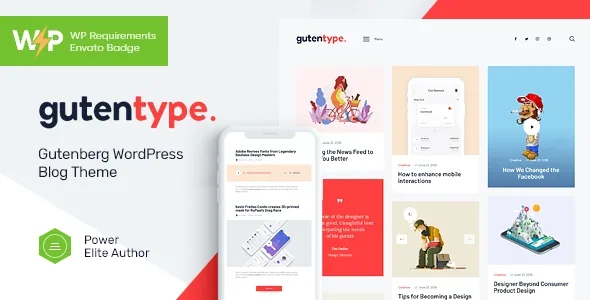
AncoraThemes describes the theme as a WordPress blog based on Gutenberg, and the vendor's feature list is more precise than "works with blocks": the demo content was made in Gutenberg using core block classes such as alignfull and alignwide. That matters when you import a demo, because you inherit layouts built the way you will build your own pages rather than a separate canvas that has to be rebuilt in the block editor afterwards.
The vendor also lists support for all Gutenberg blocks and enhanced block styles, and says its extra theme shortcodes are compatible with Gutenberg. Shortcodes inside block content are the practical part: you can keep a block-structured page and still place theme elements that a block set alone would not give you. The "100%" in the product name describes the demo path, not an exclusive editing surface — Elementor appears both in the vendor's compatibility list and in its own demo pages.
Inheritance and override: two levels of settings
The marketplace metadata summarises the framework as a system of inheritance and override options for setting individual parameters for different sections of the site and supported plugins. The feature list puts it beside 750+ Customizer options, a custom theme options panel, custom widget sets and custom shortcodes.
What that gives you is a baseline plus exceptions. You define a value once, then change it for one section — or for a supported plugin's output — without editing the global setting. On a blog the three surfaces rarely want identical treatment: a homepage feed, a category archive and a single post often differ in width, sidebar presence or metadata. Overrides keep those differences local instead of forcing you to keep separate templates.
Be realistic about the size. Several hundred options across the Customizer and a theme options panel is a large surface to learn, and the inheritance layer only stays manageable if you decide your baseline values first. Building page by page and overriding as you go tends to leave exceptions scattered with no record of why they exist.
The blog controls the vendor names
The advanced blog settings are editorial rather than cosmetic. A customizable blog feed lets you determine what enters the loop, by post type or category, which is how you keep a second content type out of the main stream. Multiple blog styles are listed as alternatives, so the archive can take more than one shape.
Post views, likes and sharing buttons are built in, so those on-site signals and outbound sharing do not need extra plugins. The vendor also lists 20+ post animations for how entries appear. Together these decide how a blog reads before you touch typography or colour.
For anything beyond publishing, the vendor names Instagram Feed, MailChimp for WP, Contact Form 7, WooCommerce, GDPR Framework WP and ThemeREX Addons as plugins it works with, and says a ready-made WooCommerce shop is available. A listed integration means the vendor states the two work together; it does not mean the plugin ships inside the theme or is required for every demo.
Elementor demos arrived one release at a time
The Elementor side is visible in the changelog rather than the headline claim: an Elementor Homepage 1 demo in 1.9.6, Elementor Homepage Food and Black in 2.0.0, and an Elementor Home Divided page in 2.1.0. Elementor pages were added to the theme over roughly a year instead of being shipped once and left alone.
That history is useful when you choose a starting point. A Gutenberg demo stays inside core WordPress. An Elementor demo assumes the plugin is installed and updated, and it brings its own editing model. Importing one does not give you the other, and editing a template in one editor will not rewrite content already saved in the other — treat the demo sets as separate beginnings rather than interchangeable skins.
What the listing claims, and what it cannot tell you
The marketplace attributes observed on 4 November 2026 mark Gutenberg Optimized as Yes, list Elementor, WPML and WooCommerce 5.x through 8.x as compatible, and give a software version range from WordPress 4.9.x to 7.0.x. The ThemeForest file list names PHP, CSS and JS files. These are vendor and marketplace declarations, not results from running the theme against your PHP version, caching layer or plugin set; a long range does not mean every combination inside it was tested.
Two practical boundaries come with the theme. The vendor states that images used in the live preview are copyrighted to their respective owners and are not included with the template, so a photography-led blog needs its own licensed images. And the changelog shows what releases actually changed — ThemeREX addons updates, demo data refreshes, style fixes, compatibility entries as WordPress moved, and a pagination-related security fix in version 2.1.12. A quiet changelog line is not proof a change went undocumented; read recent entries as a picture of what the vendor is actively touching.
Questions & answers
Can I build a Gutentype site without Elementor?
Yes. The vendor says the demo content is built on Gutenberg with core alignfull and alignwide classes and that theme shortcodes work inside Gutenberg content. Elementor is listed as compatible and has its own separate demo homepages, but the theme does not require it for the block-editor route.
How does the setting inheritance and override system work day to day?
You set a baseline value once, then override it for a particular section of the site or a supported plugin's output. The vendor describes it as setting individual parameters per section, layered on top of 750+ Customizer options.
Do the preview images come with the theme?
No. The vendor states that images in the live preview are copyrighted to their respective owners and are not included in the template. Plan for your own licensed photography.