Commission, wallets and payouts form the actual product
ScriptsBundle's feature list for Exertio describes a wallet system, commission taken from completed services, a separate referral commission system, milestone creation, and payouts the administrator can create manually or automatically. Those are rules about who holds money and when it moves, and they decide how you would run a two-sided site.
Commission on completed services means revenue is counted when work finishes, not when a listing goes live. Referral commission adds a second earning path that tracks who brought a user in and what that user's activity generates; the 1.3.2 changelog describes referral statements and earnings notifications being added. A wallet means balances sit on the platform between transactions, which is what makes the payout step meaningful at all.
Bidding is monetised separately. The vendor lists featured bids, top bids and sticky bids as paid placements, so visibility inside a project's proposal list can be sold on top of the commission rate. No default rate appears in the listing, so treat the percentage as your own decision.
Disputes land on the administrator, by design
Once a marketplace holds other people's money, the interesting question is what happens when a job goes wrong. The 1.2.9 changelog describes a dispute status feature: employers can mark services and projects as disputed, separate pages exist for disputed services and disputed projects, and the administrator can move amounts into either the employer's or the freelancer's wallet. The same release added the ability to mark a payout as rejected.
Read together, those entries show who holds authority. The admin is not watching a payment gateway's decisions from the side; the admin is the one who resolves the transfer. That works if you intend to mediate, and it is a liability if you have no plan to, because resolution falls to whoever runs the site.
One related fix belongs in the same conversation: the 1.3.6 changelog records corrected behaviour where accepting a project offer was not properly crediting the freelancer's wallet and earnings. Payout correctness on money paths is exactly what to verify with your own test transactions on a staging install before registration opens.
Profile completion scoring gates supply; Smart Match ranks it
Version 1.3.5 added admin options requiring a certain amount of profile completion before a freelancer can post services or send proposals. Version 1.3.6 added data-based profile completion scoring, bulk recalculation of those scores, and independent saving of sections on the Freelancer Edit Profile page, so a member does not lose the whole form when one part fails.
That trio is a supply-quality tool. Rather than letting every new account publish immediately, you set a threshold and the scoring system measures profiles against it. An earlier release, 1.2.7, described profile scoring as a way to show or hide freelancers from the search page, so the score has been used as both a gate and a visibility filter.
Ranking sits on its own layer. The 1.3.6 notes describe a Smart Match search relevance engine with a match percentage, a Recommended badge, matched skills and Best Match sorting, plus recommendation widgets on both the freelancer and employer dashboards, and a five-tier automatic performance badge for freelancers. Whether a match percentage feels convincing in your niche is something only real profiles can answer.
Two dashboards built around decisions, not settings
The account area splits by role. Employers post projects, invite freelancers, and can create private invite-only projects; freelancers build profiles, post services with images and video, and bid with proposals they can later edit. Custom offers exist on both the service and the project side, so the two parties can agree terms outside the standard bid flow, and admins can edit or delete proposals.
The 1.3.6 redesign is described in reporting terms. The freelancer dashboard gets KPI cards, an earnings chart, an action center and next-step guidance. The employer dashboard gets weekly trends, a hiring funnel, proposal analytics and recommended freelancers, plus a Current Plan widget showing employer package status, expiry and renewal. That points at screens meant for people making working decisions, which is a different priority from a dashboard that mostly collects preferences.
Smaller pieces support the same idea: saved searches with a job alerts page, shortlist and un-shortlist from a project's proposal list, per-user email notification preferences, and proposals marked read automatically when you open a project's proposals.
Elementor handles the look, not the transaction screens
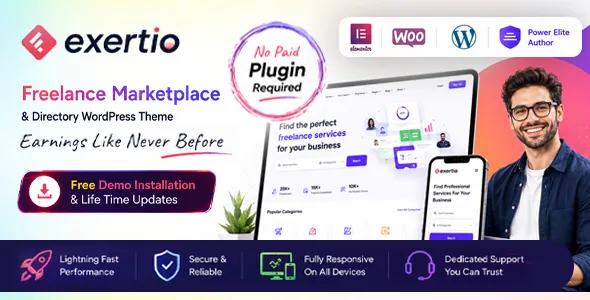
Exertio's layout surface is narrower than its operational surface, which matters if you are choosing it for its appearance. The vendor lists Elementor and Elementor Pro compatibility, an Elementor header and footer, and Redux theme options. Marketplace attributes recorded on 4 November 2026 agree on Elementor, Elementor Pro, WooCommerce 5.x through 9.x and Bootstrap 4.x and 5.x, and the package lists PHP, CSS and JS files.
The vendor's front-end elements are multiple listing styles, a creative category grid, an advanced search sidebar, targeted ad spots and reusable sections. Elementor is where you restyle and rebuild those, and Redux is where global settings live. The dashboards, wallets and dispute pages are described as built-in functionality rather than builder content, so plan on assessing them as they are.
WooCommerce matters here for one reason: packages. Freelancer and employer packages are sold through the shop, and the changelog shows ongoing cart and notice template maintenance alongside fixes to package listings.
Two stated dependencies to settle before you build
The vendor says the theme is supported by the WhizzChat WordPress chat plugin and that WhizzChat is a paid plugin, while the feature list also names a built-in chat system. The description does not say which demos use which, so treat chat as a component you may end up licensing separately from a different vendor.
The listing carries a Google Maps policy-change note without spelling out the consequence, and it withholds support for adult and dating sites. Everything above comes from the marketplace description and its changelog plus attributes recorded on 4 November 2026; none of it is hands-on testing of the wallet maths, proposal flows or dashboard reports.
Questions & answers
Is chat included, or do I need to buy WhizzChat?
The vendor's description is split. The feature list names a built-in chat system, while a separate note says the theme is supported by the WhizzChat WordPress chat plugin and that WhizzChat is a paid plugin. The listing does not say which demos rely on which, so budget for a possible separate licence.
Can I stop freelancers from bidding until their profile is filled in?
Yes, according to the changelog. Version 1.3.5 added admin options requiring a certain amount of profile completion before a freelancer can post services or send proposals, and version 1.3.6 added data-based scoring with bulk recalculation. The threshold is yours to set.
Does Exertio need Elementor to run?
The marketplace attributes list Elementor and Elementor Pro as compatible, and the vendor describes Elementor header and footer support plus Redux theme options. That covers the theme's documented editing path for template areas; it does not tell you what each template requires, so judge that from the demo.