Five homepages, five different pitches
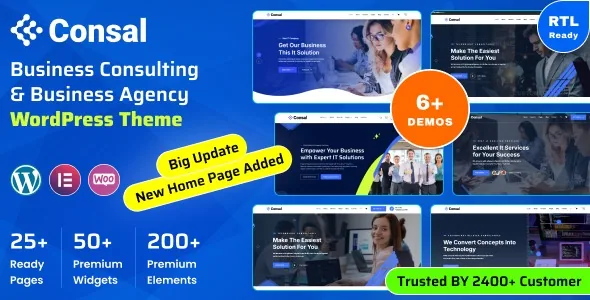
Orbitaps describes Consal as an IT-services theme for cybersecurity, SaaS, software development, web apps, app development, data centers and IT consulting, then backs that breadth with five homepages the vendor calls distinctive, alongside designed inner pages. That count is the most consequential thing about the theme for anyone planning a build: you are choosing between five front-page arguments, not five colour schemes.
The practical effect is that a decision gets made early, before design work starts. A consultancy selling advisory hours needs a different opening than an app company selling a product, and a five-demo theme lets you look at both before committing. What the description does not do is label each demo with the niche it was drawn for. The demo site is the place to work that out; the feature list only tells you five exist.
Elementor is the editing layer, and it comes with conditions
The theme is built for Elementor, and the marketplace lists Elementor and Elementor Pro as compatible alongside Contact Form 7. The vendor's framing is the standard one: drag-and-drop layout work without touching code, with a range of theme options for the settings you would rather not rebuild on every page.
Read the two layers separately. Elementor handles layout and content arrangement inside a page. Theme options hold the site-wide choices. When you change a section of the homepage, you are usually working in Elementor; when you change a colour or a global setting, you may not be. Elementor Pro appears in the compatibility list but the vendor does not describe which theme features depend on it, so treat any Pro-only widget you see in a demo as something to verify rather than assume.
A matching set of inner pages ships with the homepages. Since the vendor describes them as designed rather than generated, expect each to be a starting layout you adapt, not a blank template that fills itself.
Underscores parent, child theme in the box
Consal is built on Underscores, the WordPress starter theme, and the package includes a child theme. That combination is the part of the setup most likely to matter after launch.
Underscores gives the theme a conventional WordPress template structure, which is reassuring if a developer joins later and needs to find their way around. The child theme is what keeps your customisations separate from the parent files. If a client asks for a modified header on one template, or an extra template part, that work belongs in the child, and parent-theme updates stay low-risk. Do customisation in the parent and the next update is a merge problem.
One thing to keep straight: the vendor lists Gutenberg Optimized as Yes, which describes how the theme handles block content. It does not mean the designed pages are built from blocks. Those are Elementor layouts.
Forms: Contact Form 7 plus Mailchimp
Two form routes are named. Contact Form 7 handles contact forms, and the vendor says the theme arrives with a form preconfigured but that you can build your own if the default does not fit. Mailchimp forms are listed separately, which is the newsletter path.
The useful distinction is what happens to a submission. A Contact Form 7 message is an enquiry that lands somewhere you read; a Mailchimp form adds a subscriber to a list. Keeping both on a site is normal for an agency, but plan which page carries which so a visitor is not asked to do both in the same block.
Sass in the file package, and why that matters for hand-off
The declared package contains PHP, HTML, CSS, Sass and JavaScript files. The Sass entry is the detail worth pausing on. A theme that ships only compiled CSS can be restyled through the options panel or with overrides; a theme that ships Sass source lets a developer change the underlying variables and recompile instead of layering more rules on top.
That shapes who you hand the site to. If a designer or front-end developer will take over the styling, Sass source makes the hand-off cleaner. If the site stays with a content editor, the theme options and Elementor are the relevant layers and the Sass files are simply there if needed.
The compatibility record, as declared
As recorded on the marketplace listing on 4 November 2026, the latest marketplace version is 3.0.0 and the vendor's last update is dated 5 June 2025. The declared WordPress range runs from 4.9.x up to 6.7.x, the theme is listed as responsive, high resolution, widget ready and well documented, and the browser list names Internet Explorer 9 through 11, Firefox, Safari, Opera, Chrome and Edge.
The Internet Explorer entries say more about when the list was assembled than about what a current build needs. The WordPress range is the number to check against your install, and it is a declaration rather than a record of testing on your server or against your plugin stack.
Questions & answers
Does Consal need Elementor to work?
The vendor describes the theme as integrated with Elementor and builds the demo pages with it, and the marketplace lists Elementor and Elementor Pro as compatible. The description does not state whether the theme falls back gracefully without the plugin, so plan on running Elementor if you want the designed layouts.
Are the five homepages different industries, or five layouts of the same idea?
The vendor calls them five homepages with distinctive design and a separate demo count of five, but does not map any demo to a specific niche. Compare them on the live demo before deciding which front page suits an IT consultancy, a SaaS product or a data-center business.
Where do site-wide changes live compared with page changes?
Elementor covers layout and content arrangement inside a page. Theme options hold site-wide settings. For anything deeper in the styling, the package includes Sass source files alongside the compiled CSS.