Two plugin lists that disagree on forms and calendars
The supplied material contains two inventories of plugins, and they only partly overlap. The vendor description names Contact Form 7 for enquiry forms and Slider Revolution for slides, and it mentions WPML for multilingual layouts alongside a .pot file for localisation. The marketplace's compatible-with attributes list Events Calendar, Gravity Forms and WPML instead.
Work out which list your build depends on before you commit. The first names a form plugin most garage sites would use for quote or booking enquiries, plus the slider that drives the hero. The second swaps in Gravity Forms as an alternative form option and adds Events Calendar, which points at a workshop calendar: service days, MOT slots, open evenings.
WPML is the only name in both, which makes it the strongest signal in the set. Even that is a vendor statement of support, not a description of how service pages, team profiles or a booking form behave once translated.
Where pages and posts are written
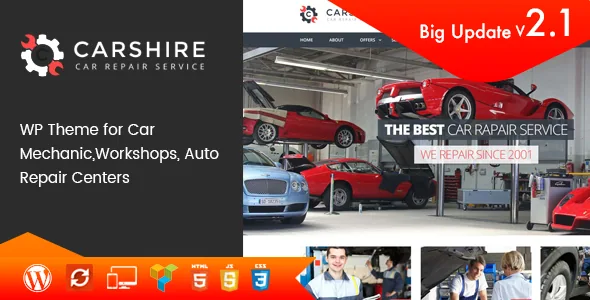
The vendor's feature overview gives drag-and-drop page building its own section and names both Elementor and Visual Composer as the tools. That reads as page layout assembled on a builder canvas.
The marketplace attribute "Gutenberg Optimized" is listed as No. That does not say the block editor is switched off or unusable, and it is not a statement that posts must be written somewhere else. It means the vendor has not declared block-editor optimisation, which fits a description that never mentions blocks.
Visual Composer has shipped in more than one form over the years, and the vendor text does not say which form is referenced. If you already work in Elementor, or want to avoid maintaining two builder stacks, confirm which builder your copy of the theme actually ships and supports before planning a build.
Styling splits between the options panel and the canvas
Car Shire is described as built on the vafpress theme options framework, with a custom theme and page options layer on top. That splits design decisions in two: layout on the builder canvas, and typography and brand styling in the options panel.
For type, the vendor claims access to the Google web fonts library, described as 600+ families, plus custom font support. If your brand already uses a licensed typeface, test the custom font route first, since it does not depend on a catalogue entry.
Custom CSS is listed, the code is described as commented, and custom page templates are included. Combined with the options panel, that means restyling does not require a design source file. ThemeForest's file list for this item is PHP, CSS and JavaScript only, so visual changes happen in CSS, the options panel and the builder.
Widget areas, retina images and the package contents
Widget Ready is marked Yes, and the vendor lists unlimited sidebars and bottom footer widget areas. Sidebars and footer columns are therefore managed through WordPress widgets, which suits reused blocks such as a service list, opening hours or contact details.
Retina and high-resolution support are both marked present, alongside a responsive layout, so upload high-resolution images rather than reusing small web exports.
With only PHP, CSS and JS in the package, a developer overriding CSS against the theme's own class structure has what they need. There are no layered design files to hand to a designer.
Demo content, the one-click installer and the full-screen slider
The vendor describes demo content as included and loadable after activation, paired with a one-click installer and demo sliders. The stated workflow is to start from designed pages and replace their content with your own.
Treat that as a starting point rather than a design system. Nothing in the description says editing a template updates every page built from it, and "easy customisation with variable content sections" is a vendor phrase without a documented mechanism behind it.
The vendor also lists a full-screen background slider, with Slider Revolution doing the animation work. If a full-bleed rotating hero is central to your homepage plan, check that combination before you build the rest of the page around it.
Version declarations and the legacy browser baseline
The marketplace declares WordPress 6.0.x through 7.0.x and records version 3.6.0 with a vendor update dated 23 November 2025; those attributes were observed on 5 November 2026. A range running forward through 7.0.x is unusual, so read it as the vendor's stated intent rather than as proof of how your install will run.
Separately, the vendor's cross-browser claim starts at IE9, and the attribute list repeats IE9, IE10 and IE11 alongside Firefox, Safari, Opera, Chrome and Edge. That baseline suggests how much legacy-compatibility code sits in the stylesheet. It says nothing about how the site behaves on a current phone.
Both are questions for a staging copy with the plugins you intend to run, on the pages you care about.
Which vehicle trades the theme is aimed at
The vendor's positioning list covers mechanic workshops, car wash, auto painting, body shops, MOT and servicing, diagnostics, tyre and glass work, and says the theme also suits small businesses outside that world. Two consequences follow: the demo photography and section vocabulary speak to vehicle trades, and the vendor describes the theme as editable by someone without programming skills as well as by a developer.
The natural fit is a garage, service centre or body shop that wants designed pages quickly, accepts a builder-driven editing workflow, styles the brand in an options panel and takes enquiries through a form plugin.
It fits less well if your team writes everything in the block editor and does not want a builder in the stack, or if you expect the theme itself to supply booking, scheduling or vehicle-diagnostics logic. None of that appears in the supplied feature list, so those become separate plugin decisions with their own setup.
Questions & answers
Does "Gutenberg Optimized: No" mean the block editor is unavailable?
No. The attribute records that the vendor has not declared block-editor optimisation. The vendor describes page building in Elementor and Visual Composer instead, so plan on a builder for page layout and confirm how posts are edited in the documentation for your copy.
Which plugins does Car Shire actually depend on?
The vendor text names Contact Form 7 and Slider Revolution, and the marketplace attributes name Events Calendar, Gravity Forms and WPML. Only WPML appears in both. Read them as listed integrations rather than requirements every page needs, and confirm the builder and form plugin in your own copy.
Is demo content locked to one layout?
The vendor presents demo content and demo sliders as something you load and then replace with your own material. The description does not promise that template-level changes propagate to existing pages, so rework pages individually rather than assuming automatic updates.