Rates are the part you configure first
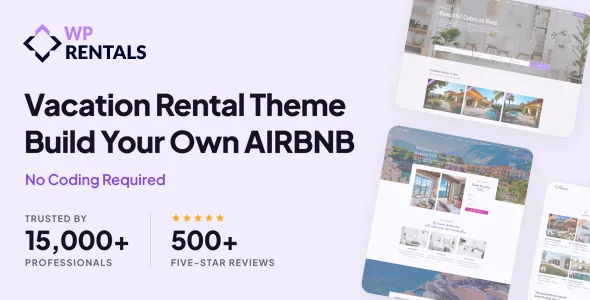
The vendor's feature list for WP Rentals is dominated by price rules, not layouts. Three figures set the scale: more than 200 theme options, 20 pricing settings and 24 pre-built demos, observed in the marketplace description on 3 November 2026.
Each listing starts with a base price per night, with other amounts layered on top: a different rate for stays over 7 days and another for stays over 30 days. The 7 and 30 themselves are editable, so a site can discount at different stay lengths than the defaults suggest. Weekend nights can carry their own price, and a minimum booking period applies to every request.
Fees, guests and the options owners add themselves
Fees are configured with a calculation base rather than as flat add-ons. The cleaning fee is a fixed value; the city fee can be fixed or a percentage; either can be charged per night, per guest, or per night and guest. Security deposit, a percentage tax value and changeover days sit at listing level, and the tax value appears in the owner dashboard for the owner to act on.
Extra-guest pricing is set per listing with no cap the vendor mentions on how many extra guests are allowed. Owners can also add their own booking options from the front-end submit form, each priced as a single fee, per night, per guest, or per night and guest. Those options can be edited or deleted later without changing requests already taken, which matters on a marketplace where owners come and go.
A separate switch lets a listing be paid by guest number alone instead of by the night.
Period overrides are entered one at a time
Seasonal pricing goes beyond the global tiers. For a specific period the vendor lists a custom nightly rate, a custom minimum stay, custom extra-guest pricing and custom turnover days. An early-bird discount is set as a percentage plus a minimum number of days in advance, and it applies to the nightly price rather than the whole invoice.
The operational detail worth weighing before you commit: custom periods are set manually from a calendar, one period at a time. On a handful of seasonal windows that is a short job. Across dozens of listings with monthly rate changes, maintaining prices becomes recurring admin work, which is the main cost of this pricing model.
Hourly rates, and booking forms that drop the guest field
Bookings can run by the hour as well as by the night. The admin can switch hourly booking on for all listings, or leave the choice to each owner. Hourly settings mirror the daily ones: an hourly price, a weekend hourly price, custom hourly prices for specific periods, a minimum number of hours and hours availability per listing.
Object rental is a distinct toggle. With it on, the guest option disappears from the booking form, and the vendor says the guest dropdown can also be removed from the listing submission form. Custom fields plus the adjustable advanced search then define what visitors filter on. That arrangement suits equipment, vehicles or spaces where asking "how many guests" is the wrong question.
Deposits, the admin's service fee, and where money is collected
Two controls shape the money model. A deposit fee, fixed or a percentage, is collected when someone submits a request, before the booking is confirmed; if you take only part of it, the balance can be paid before the stay starts, though full online payment is optional.
The service fee, or admin booking fee, can be a fixed amount or a share of the invoice. Its routing is specific: it is deducted from the owner's earnings but paid by the guest as part of the deposit, and once it is set it becomes mandatory for a booking to confirm.
Collection has two routes. The theme's own path covers PayPal, Stripe and wire transfer recorded as an offline payment, for listing publication fees and per-booking service fees. Alternatively, WooCommerce can process booking payments, which the vendor recommends for its merchant ecosystem; the marketplace compatibility list names WooCommerce 9.x.x. With Instant Booking on, a WooCommerce deposit does not require the guest to log in. On confirmation, the vendor says the availability calendar is blocked for that period on the site.
iCal keeps dates in step, not prices
Import and export feeds let your site's calendar exchange availability with platforms that publish iCal, and the vendor says you can import as many feeds as you want. Airbnb and HomeAway are the two named examples.
Be clear about the boundary: iCal carries blocks of booked time. It does not push rates, listing copy or booking rules to another platform, and it is not a two-way rate sync. If you also sell elsewhere and prices must match across channels, expect to maintain those figures by hand.
One owner or many, and the showcase option
The same installation can be closed or open. Theme options decide which users may submit listings, which the vendor presents as the way to run a single-owner site without removing the marketplace machinery. Left open, users register, submit places or objects, and manage reservations from their own account area.
There is a third arrangement worth naming: the Book Now form can point to a third-party URL, including an affiliate link to a platform where the booking actually happens. That is a legitimate way to publish a catalogue, but the pricing rules above are the theme's real substance, and a site that forwards the transaction to someone else never uses them.
Templates built with Elementor Free
Design work runs through WPRentals Studio, which the vendor describes as building and assigning templates with Elementor Free, stating that Elementor Pro is not required. The template slots are named individually: single property, single blog post, property categories, single owner, header and footer.
The theme also registers 13 of its own Elementor widgets, including a search-form builder that you can use to compose a custom search form instead of taking one of the included examples. For anyone who prefers WPBakery, the vendor bundles Bakery Page Builder, Ultimate Addons and Revolution Slider for the demo content and that editing route.
Gutenberg Optimized is recorded as "No" in the marketplace attributes. That reflects the vendor's documented authoring path, Elementor and WPBakery, not a switch that turns the block editor off.
Translation, API and the peripheral integrations
Multilingual sites have two documented routes. WPEstate Translate is the vendor's own plugin for creating languages with automatic translation. The package includes 23 translation files, covering Catalan, Danish, Dutch, Finnish, French, German, Greek, Hungarian, Icelandic, Italian, Lithuanian, Norwegian Bokmål, Polish, Portuguese (Brazil), Romanian, Russian, Serbian, Spanish, Swedish, Turkish and Ukrainian, among others. The vendor cautions that translations may need edits, which is worth planning for when the strings describe fees and deposits. WPML is listed as compatible, not bundled, so that route needs its own licence.
For systems outside the site, the WPRentals Property API exposes listings, booking data and user information to external applications such as a mobile app or a CRM. Twilio provides SMS notifications to verified phone numbers, listing pages can carry a 360-degree virtual tour, and the vendor states full RTL support in the current release line.
Compatibility entries are vendor and marketplace statements rather than test results on your hosting, and the declared WordPress range runs from 5.6.x to 7.0.x as observed on 3 November 2026.
Questions & answers
Do the 7-day and 30-day price tiers have to stay at 7 and 30?
No. The vendor says both thresholds are editable, so a listing can change rate at shorter or longer stays than the defaults, including in a direction that raises the nightly price for shorter bookings.
Can a listing be bookable by the hour only?
Yes. The admin can enable hourly booking for every listing or let each owner choose the mode per listing; the vendor demonstrates hourly use with a ski-rental demo and mixed hourly-or-daily use with an office-space demo.
Does iCal sync keep rates identical on Airbnb and other platforms?
No. The feeds exchange availability, so dates booked elsewhere can be blocked on your site and the site's bookings can be published outward. Rates, listing content and booking rules are not carried through iCal.
Is Elementor Pro needed for the theme's templates?
The vendor states WPRentals Studio builds and assigns templates with Elementor Free and that Pro is not required. The template slots named are single property, single blog post, property categories, single owner, header and footer.