Twenty headers for a page that never leaves the scroll
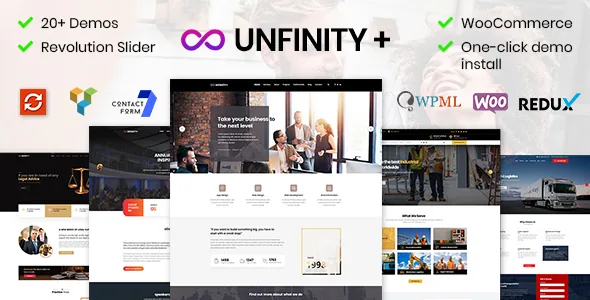
A one-page site removes the usual navigation burden: there are few destinations, and the header mostly tells a visitor where they are and what they can do next. Unfinity's vendor feature list treats that narrow job as the interesting problem. Alongside "20+ Demos One Page" it lists "20+ Header Layout," and separately names a sticky menu that engages on scroll-down plus a sticky header.
Taken together, those claims describe a theme where the header is a design decision rather than an inherited default. On a long single scroll, a sticky header keeps contact details or a primary button within reach after the opening screen, and the layout you pick decides how much vertical space that persistent bar takes from every section beneath it. Twenty variants is more than most landing pages need, so the practical question is whether one of them matches your content order — a tall centred opener reads differently from a slim bar that appears only after the first fold.
Demo import gives you a page, not a page plan
The vendor lists one-click demo content import, which turns the 20+ demo claim into something you can stand up and edit. It is worth being clear about what that gets you: a populated single page with sections already in an order, media in place and header styling attached.
That is a starting position, not a finished site. Demo images in any marketplace theme are preview material and not licensed for your own launch, so the photography is the first thing to replace. The section sequence is the second: a single scroll works when it answers the questions a visitor arrives with, in the order they ask them, and a demo built for a different business will have a different order.
Global styling in the Customizer, effects on the section
Unfinity's effect vocabulary is described section by section. The vendor names a section video background, parallax and video backgrounds, carousel elements, CSS3 animations and smooth transition effects, plus unlimited colour options. The background layer is the one that changes how much of the design you can vary without touching layout.
Configuration is split between two places. The vendor puts theme options in a real-time WordPress Customizer and also refers to a separate theme options panel; page sections are assembled in WPBakery, which the listing names as included. Colour, fonts and global styling belong to the theme options side, while the video background, parallax and carousel belong to the section you build. If you plan several campaign pages from one theme, that split matters — restyling globally is fast, but a different background treatment means editing the section itself.
WPBakery is the editing surface, and Gutenberg Optimized is marked No
The marketplace attributes, observed on 4 November 2026, record Gutenberg Optimized as "No" while still naming Block Editor among the compatible-with items. Read those as two separate declarations. The first describes where the vendor's design work sits: the demos and layouts are built for WPBakery, which the feature list names as included alongside a stated $34 saving. The second lists the block editor among compatible software without claiming the demos are block patterns.
For your workflow, that means the sections you import are WPBakery elements, and your page edits will happen in that editor. Revolution Slider is bundled as well, with the vendor's own $25 figure. Both are declared inclusions, not a statement about which specific plugin builds appear in any copy, so check the bundled versions against your PHP and WordPress setup before committing to a build.
RTL support and WPML are listed as different jobs
The feature list names RTL language support and WPML localization support as separate items, and that separation matches how the work divides. RTL support concerns direction: text alignment, mirrored spacing and the reading order of a layout. WPML handles translated strings and the language-switching interface.
Unfinity's single-page structure makes the WPML side less consequential than it is on a content-heavy site, because there is usually less text to translate and no archive of posts to duplicate. Where the RTL declaration earns its place is a launch in Arabic, Hebrew or another right-to-left market, where the whole section stack has to mirror without columns collapsing. Treat the declaration as a vendor claim to verify on your own content — a broken mirroring shows up in the first scroll.
What the compatibility list does and does not promise
The declared compatible-with set runs wide: Contact Form 7, WPForms and Gravity Forms for enquiries, WooCommerce 5.x through 9.x for a shop layer, Jetpack, Events Calendar, Easy Digital Downloads, WP EasyCart, bbPress 2.5.x and 2.6.x, BuddyPress 9.x and 10.x, WPML, WPBakery Page Builder, and Bootstrap 4.x and 5.x. These are compatibility declarations attached to the listing — not dependencies every demo needs, and not proof that each layout ships with those elements configured.
The form plugins are the ones most likely to matter on a landing page: a single scroll usually ends in an enquiry form, and the theme lists three options rather than committing to one. The e-commerce and community plugins point at the possibility of adding archive pages around the landing page, but nothing in the available material indicates the demos arrive with shop or forum layouts set up. Declared WordPress support spans 4.9.x through 7.0.x, which is a broad range rather than a statement about the version combination you will actually run.
Where the single-scroll shape stops fitting
A single scroll works while the whole story fits inside it: a service business, a launch page, a portfolio of a few projects, a consultant with one offer. Unfinity is pitched for multipurpose business use, and the header variants plus unlimited colour options give you room to differentiate within that shape.
The limit is structural rather than a missing feature. Once you need many individual pages with their own navigation — a blog archive, per-service detail pages, a documentation section — the header becomes a menu again and the demo stack stops doing the work. The declared file list covers PHP, CSS, JS and PSD; the Photoshop source matters if your design will be adapted from the demo's visual direction rather than rebuilt inside the builder.
Questions & answers
Does Unfinity work with the block editor?
The marketplace lists Block Editor among the compatible-with items but marks Gutenberg Optimized as No. The demos and layouts are built for WPBakery, which the feature list names as included, so section editing happens there. That attribute describes where the vendor's design work sits; it does not state that the block editor is unavailable.
Can I build more than one page with Unfinity?
The theme is designed around a single scrolling page, and the 20+ demos are one-page layouts. The listing declares WooCommerce, bbPress and BuddyPress compatibility, which suggests additional template types are possible, but nothing in the available material says extra demo pages are included or preconfigured.
Do I need WPML to use the RTL support?
No. RTL language support and WPML localization support are listed as separate features. RTL support handles layout direction; WPML handles translated content and language switching. A right-to-left site in one language depends on the first, not the second.