Twenty landing pages instead of one design with new colours
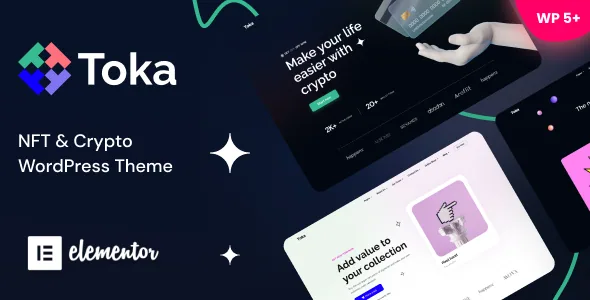
Toka isn't a niche theme that sells a single look. It sells a list. The vendor's "List of Landing Pages" names twenty separate starting points: NFT Landing Page, NFT Collection Landing, NFT Platform, NFT Marketplace, NFT Game, NFT DAO Platform, NFT Website, Metaverse Website, Crypto Trading, Crypto Exchange, Blockchain Services, Crypto Cards, ICO Landing, Crypto Startup, Payments with Crypto, Crypto Trading App, Crypto App, DeFi Project Landing, Crypto Hardware Wallets and Crypto Wallet App.
That headcount changes the first decision on a project. If you're launching a DAO and a wallet app under one brand, you don't have to stretch one homepage across both subjects; you pick the two demo identities that already match and adapt each. If you build a single NFT marketplace site, the other nineteen pages are samples you can ignore.
The honest way to read the list is as a survey of the business models the theme's authors expected buyers to have. Whether "Crypto App" and "Crypto Trading App" differ by more than layout and copy isn't stated anywhere, so compare the demos before assuming they are separate products rather than rearrangements of the same sections.
The page set was assembled release by release
The changelog explains where those pages came from, and it wasn't one launch. Version 1.23 added four landings in April 2022. Version 1.24 added two more a fortnight later. Version 1.26 added four in May 2022. Version 1.29 added Crypto Hardware Wallets and Crypto Wallet App alongside WooCommerce 7 and WordPress 6 updates. Version 1.30 added Metaverse Website and NFT Website in December 2022.
That timing has practical consequences. Versions added in 2022 were built on the same theme as later ones, and the 1.29 note says earlier landings received small style improvements at the same time — spaces, fonts, small animations. It describes a restyling pass across the set, not a rebuild of each page. If you plan to use an older demo as the base for something elaborate, expect its structure to date from its own release rather than the newest one.
There's also a gap worth knowing about. After that run of additions ended in late 2022, the recorded releases are compatibility checks, performance improvements and changes to the demo installation method. The page set has been stable for a while; the maintenance has gone into the stack underneath it.
The header, not the page content, is where you separate a site from the demo
Every demo in this category arrives with the same risk: your site can look like several hundred others. Toka's answer is a set of controls in the theme customizer rather than in page content.
The vendor lists changing main accent colours, changing, enabling or disabling a CTA button in the header, and enabling or disabling a sticky header. A logo height control was added in version 1.31 under Appearance → Customize → Header. The changelog also records a gallery customizer and scroll animations as separate features.
Those are the levers that let one demo read as a slightly different brand: a different accent, a header button that says "Connect Wallet" instead of "Buy Toka", a sticky bar that keeps navigation available while a long landing page scrolls. Because the accent setting is described as changing main colours, treat it as a palette control rather than a global repaint — expect to adjust individual sections in Elementor for anything it doesn't reach.
The vendor is a design shop and describes the pages in aesthetic terms: eye-catching design, gorgeous scroll animations, easy colour customisation. Judge the theme on whether that default look suits your audience, because the customizer adjusts it rather than replacing it.
Editing happens in Elementor, on a Bootstrap 4 grid
Pages are built in Elementor, which the vendor calls a drag-and-drop visual builder and a "100% visual page builder" for the theme. Underneath sits a Bootstrap 4 grid, which governs how columns and spacing behave when you build sections of your own.
Beyond Elementor, the feature list names Smart Slider 3, Contact Form 7, MailChimp readiness for newsletter signup, and a front-end theme customizer. Blog layout customisation and a gallery customizer round out the content-side pieces. Listing an integration doesn't mean every demo depends on it, so check the specific demo you import before planning a plugin stack around it.
One note on editing intent: the theme's Gutenberg Optimized attribute is recorded as No. That describes where the theme's designed layouts live — in Elementor — not a statement that the block editor is broken. If your team works from block patterns and theme.json, this theme points elsewhere; the Elementor-first surface is the reason to choose it or to skip it.
Selling and translating
WooCommerce support is stated as full, and the compatibility attributes list WooCommerce versions 5.x through 10.x. For a crypto-adjacent shop — merch, hardware wallet accessories, event tickets — product and checkout pages fall within the theme's scope rather than being something you style from scratch.
WooCommerce turns up repeatedly in the changelog. Version 1.28 fixed WooCommerce 6, 1.29 updated WooCommerce templates for the 7 line, and 1.35 recorded a WooCommerce 8+ compatibility check. A theme that keeps refreshing those templates is doing work that otherwise lands on you after each plugin update.
For language, WPML is in the attribute list and the description also names TranslatePress. Both are described as supported, but nothing shows the two running together, and no demo has been checked for layout survival after translation. Crypto landing pages tend to carry tightly spaced headings and short button labels, so test the demo you chose with one translation plugin before committing to a multilingual build.
Stock imagery, two Google fonts, and what "included" means
The feature list says "Images and graphics included", and the demo assets do ship in some form. The vendor also names where the imagery comes from: Pexels, Unsplash, Flaticon and Freepik. Those libraries have different licence terms, so confirm the licence for each asset you actually publish rather than treating inclusion in the theme as permission.
Fonts are simpler. Raleway and DM Sans both come from Google Fonts, so swapping them is standard customizer or Elementor work — though changing the pair will shift the balance of every imported demo page.
For a crypto project the practical consequence is a replacement job. Most buyers will substitute their own artwork, token graphics and product shots anyway; the stock sources tell you the demo is a placeholder set, not a brand kit.
Declared compatibility and the version question
Observed on 4 November 2026, the marketplace attributes declare WordPress 5.0.x through 7.0.x, Elementor, WooCommerce 5.x through 10.x, WPML, Bootstrap 4 Grid, and Chrome, Safari, Firefox, Opera and Edge as supported browsers. Those are declarations from the vendor and listing, not the result of testing against your plugin stack, PHP build or hosting.
The changelog shows how the declarations get made: 1.35 recorded WordPress 6.5 and WooCommerce 8+ compatibility checks, and 1.37 through 1.41 recorded checks against WordPress 6.6, 6.7, 6.8 and 6.9. The later entries, 1.42 to 1.44, describe compatibility and performance improvements without naming versions. That pattern is useful context: the theme is maintained, but the newest releases don't document new pages or features.
The listing records 1.44 as the latest marketplace version, dated 23 September 2026, sold under a regular licence at 69 USD with a 4.29 rating from 17 reviews at the time of that observation — marketplace figures, not a statement about any copy you install. Files are listed as PHP, HTML, CSS and JavaScript, and the version reported inside WordPress after installation is the only number that describes the code in front of you.
Questions & answers
Does Toka work with the block editor?
The theme's Gutenberg Optimized attribute is recorded as No, and the editing surface the vendor describes is Elementor. That attribute reflects design intent rather than a hard block on the block editor, but demo pages will be Elementor content, so plan an Elementor workflow.
Are the demo photos licensed for my site?
The vendor says images and graphics are included and names Pexels, Unsplash, Flaticon and Freepik as sources. Those libraries carry different licence terms, so check each asset you publish rather than treating its presence in the theme as permission.
Is a Smart Slider 3 installation required?
Smart Slider 3 appears in the vendor's feature list, and a listed integration doesn't prove that every demo depends on it. Check the specific demo you import before assuming which plugins it needs.