The shopping actions happen without a reload
Supro is presented as a minimal, product-focused WooCommerce theme, and the vendor's feature list spends its most specific language on interaction rather than decoration. Four items sit in a row: a fully AJAX filter, add to cart and remove from cart handled by AJAX, a built-in live search, and product quick view.
Each one removes a page load from the buying path. Filtering updates the product grid as a shopper narrows it, so someone comparing a category does not lose their place every time they pick another attribute. Adding to cart, and taking something back out of the cart, happens in place, which is the difference between a cart that feels responsive and one that forces a round trip for every correction. Quick view opens a product's essentials in an overlay, letting a shopper judge an item without abandoning the grid. Live search and SKU search cover two different kinds of visitor: one who describes what they want, and one who arrives with an order code.
Swatches are listed as three distinct types — colour, label and image. That distinction matters in practice. Colour swatches suit anything with a palette, label swatches suit sizes or named variants, and image swatches let a customer see the actual finish. Taken with the filter, they turn the shop grid into the main browsing surface rather than a list you leave whenever you need detail.
What the minimal design is aimed at
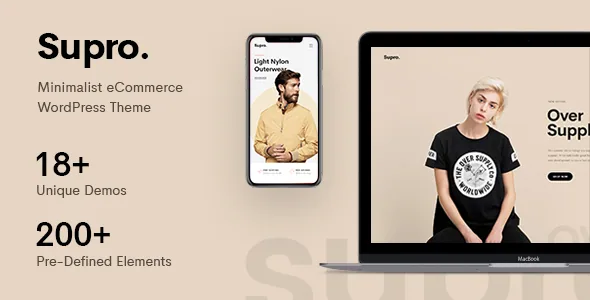
The marketplace description positions Supro for fashion, furniture and decoration stores and argues that a sparse layout keeps attention on the products. It is a posture, not a template: the theme's job is to get out of the way of photography and product data.
The shopping features around that core are conventional WooCommerce ground the vendor lists explicitly — simple or variable products, downloadable items, external or affiliate products, ratings and reviews, unlimited categories and sub-categories, coupons, order tracking and a shipping calculator. Wishlist is described as optional, which is the honest framing: it depends on a wishlist plugin being present rather than being baked into the theme.
Two smaller vendor features fit the product-first stance more than they first appear. A featured product video gives a single item a large piece of media without adding noise to the grid, and a gallery lightbox lets a customer inspect images at full size from the product page.
WPBakery assembles the pages; the shop runs on its own templates
The page-building layer is WPBakery, listed as included in the theme. Around it the vendor counts 15 predefined homepages, 6 header layouts, 3 footer layouts, mega menu support, a sticky header and a boxed layout option, all importable through one-click demo content.
The separation is worth keeping straight in your head. Homepages, campaign pages and marketing sections are WPBakery work. The shop archive and single product page are WooCommerce output that Supro styles, with the AJAX layer described above wrapped around them. If your plan is a large content site with a small shop, most of your editing time goes into the builder; if the shop is the site, most of your time goes into the WooCommerce settings and product data, and the builder handles the pages around them.
A child theme is included in the file list, which is the sensible place for template overrides. The marketplace files are declared as PHP, CSS and JS. Attributes observed on 4 November 2026 also mark the theme as Gutenberg optimized, so the block editor remains available for ordinary content even though the vendor's page work targets WPBakery.
One packaging detail deserves a plain reading: the changelog shows Slider Revolution and WPBakery versions being bumped inside theme releases. Plugin versions bundled with a theme lag their standalone releases between theme updates, so confirm what your copy actually contains rather than assuming the newest plugin release.
The changelog tracks WooCommerce, not just the theme
Supro's release history is unusually legible about maintenance priorities. Entries from version 1.7 through 2.0.4 are dominated by WooCommerce compatibility updates, with WPBakery and Slider Revolution bumps sprinkled through. The most recent visible entry, 2.0.4, is a WooCommerce 10.5.1 compatibility update; the vendor's summary also states compatibility with WordPress 6.9.x and WooCommerce 10.5.x.
That cadence tells you the theme is maintained against WooCommerce's release cycle, which is the risk that actually bites store owners. It also tells you something about the past: bugs such as AJAX add-to-cart failing on the single product page (fixed in 1.8.3) and missing gallery thumbnails (fixed in 1.8.2) show where the AJAX layer has needed repair, and how promptly it got it.
The marketplace attributes and the changelog do not agree on ranges, and that is normal. Attributes observed on 4 November 2026 declare WooCommerce 9.x and 8.x, while the changelog records compatibility work up to 10.5.1. Listing attributes are declarations attached to the item, not results from a test install on your stack. Check the combination you intend to run — WordPress core, WooCommerce, WPBakery and any wishlist or currency plugin — on a staging copy, and check which theme version your copy holds before judging any of it.
Languages, currencies and the integrations you must install
WPML appears among the compatibility attributes, and the vendor advertises RTL language support. The two together matter for a store that sells in more than one language or in a right-to-left market: translated product data is a WPML job, while mirrored layout is a theme job, and Supro claims both sides.
Currency switching is listed as compatibility with a currency switcher plugin, not as built-in functionality — the plugin has to be installed and configured. The same boundary applies to YITH WooCommerce Wishlist, MailChimp for WordPress and Contact Form 7. Each is an integration, so nothing appears on the site until the plugin is present and connected.
The theme also names Instagram Shop and Instagram product photos as features. Treat those as presentation of a feed you have connected, with the images and account remaining yours to supply.
Where this theme earns its place
Supro is at its most useful when the catalogue is the site and browsing is the main activity: a fashion shop with many variants, a furniture store where swatches carry the decision, a decoration store where a quick view saves a shopper from opening ten product pages. In those setups the AJAX filter, swatches, live search and quick view do daily work, and the 15 homepages are simply starting points you replace with your own.
If your store is small enough that customers reach products through search engines or a single menu, most of that interaction layer sits idle, and the theme becomes a competent WooCommerce skin with a page builder attached. The vendor's own description keeps the promise modest — a clean, minimal shop with product focus — and that is the right scale for judging it.
Questions & answers
Do the AJAX filter and quick view work out of the box, or do they need a plugin?
They are listed as theme features rather than as plugin integrations, so they belong to the theme itself — unlike wishlist, currency switching or MailChimp, which the vendor lists as compatibility with separate plugins. Because these behaviours sit close to WooCommerce templates, verify them on your own WooCommerce version in a staging copy before launch.
Can I use the block editor on pages built for WPBakery?
The marketplace attributes mark Supro as Gutenberg optimized, so the block editor is available for content. The vendor's 15 homepages are built for WPBakery, which ships with the theme. Mixing both on one site is possible but means maintaining two editing vocabularies for whoever writes the pages.
How many variants can a product show with swatches?
The vendor lists colour, label and image swatches as three separate types, which map naturally onto variable product attributes — colours, sizes and a pictured finish. The swatches display the variants you create in WooCommerce; they do not generate them for you.