Fonts and colours set element by element, not one accent colour
Plenty of business themes give you a single accent colour and a body font. Success's vendor description goes further: you set colour and font for each typographic selector individually, so headings, navigation, buttons and body copy can follow a brand guide separately rather than sharing one setting. The font list comes from Google Fonts, with more than 650 faces and a live preview, according to the marketplace description.
That matters for firms whose identity is already defined — a solicitors' practice with a licensed typeface pairing, or an accountancy brand with strict heading colours. You can reproduce it in the theme options instead of overriding it with custom CSS later. The same description also lists a background photo and pattern uploader, a boxed-or-full-width switch, and colour control for the header, so the chrome can be tinted to match.
The controls are described as global theme options. Nothing in the supplied material documents per-page style overrides, so plan for one site-wide design rather than different palettes on different landing pages.
Header, footer and sidebar as switches
Success treats the pieces around the page content as settings. The vendor lists a sticky header option, adjustable logo and header height, and a choice between showing two footers or just one. The news template can run with a left sidebar, a right sidebar or none at all.
Those are not cosmetic toggles. A two-footer arrangement suits advisory sites that want a slim utility strip above a heavier contact block; a single footer keeps the page shorter. Adjustable header height is what lets a long wordmark sit comfortably without cropping. On the news side, dropping the sidebar gives article pages a wider column, while keeping one lets you park a contact prompt or service list beside the copy.
Layer options in the vendor list also include background photographs or patterns, which pairs with the boxed layout if you want the page to sit on a textured surface.
WPBakery builds the pages; LayerSlider builds the banners
The marketplace compatibility attributes name WPBakery Page Builder, and the vendor states the plugin is included with the theme, describing it as worth $46. It is the editor you use for page content: rows, columns and the theme's own shortcodes, mixed and matched.
LayerSlider is bundled as well, described as worth $25, with the vendor noting you can create unlimited sliders. Sliders that need layered animation belong there rather than in WPBakery rows.
The changelog is worth reading for how these two are maintained. Success releases tend to pair a theme version with the plugin versions it supports — the 10 October 2026 entry for version 1.5.4 lists WPBakery 9.0.1 and LayerSlider 8.4.0, and earlier entries follow the same pattern back through 2019. That tells you the bundled plugins are tracked as they update, though it does not tell you which plugin release is inside any particular copy you receive.
WooCommerce 10.x.x also appears in the compatibility list. A consulting site rarely needs a shop, so treat that as available rather than required.
The page set is shaped like an advisory practice
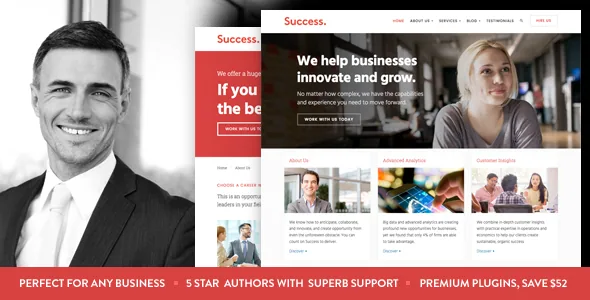
The vendor's page list reads like a services firm's site map: Solutions, Customer Stories, Testimonials, an About page explicitly framed around attracting people to work in your business, and a Contact page. Shortcode-driven contact forms are described as unlimited, with JavaScript validation.
Read that as content shapes to fill, not finished pages. Customer Stories is where a consultancy puts its engagement narratives, and the sidebar option lets each one carry summary detail. Testimonials give you a place for client quotes that is separate from the case-study flow. The About page's stated recruitment angle is a useful prompt: if hiring is part of your growth plan, that page needs a careers section rather than a company history.
The theme also lists Bootstrap 3 grid and a 404 error page among its layout features, and the framework attribute records Underscores as the base.
The demo photos are placeholders, not assets
The vendor is direct about this in its FAQ: demo images came from Shutterstock and cannot be distributed with the theme, and you are expected to supply your own. The one-click demo import therefore brings in grey placeholders where photographs would be.
For planning, that means the import gives you structure and layout, not the visual impression of the demo. If your proposal depends on that photography, budget for commissioning or licensing images before you design around the demo's look. The vendor points to Unsplash for free options.
One-click demo import itself is listed as a feature, with sample content installed in minutes. Installation steps belong in the theme's own documentation rather than here.
What the listing declares, and when it was observed
As recorded on the marketplace listing on 4 November 2026, the declared software version is WordPress 7.1.x, the layout is responsive with 4+ columns, the theme is widget ready, high resolution and documented, and the included files are PHP, CSS and JavaScript. Compatible browsers are listed as Firefox, Safari, Chrome and Edge. Gutenberg Optimized is marked No, which describes how the designed layouts are built — with WPBakery — and does not by itself mean the block editor is unusable on the site.
Child theme support is listed in the vendor features, which matters if you intend to modify templates and keep those changes across updates. These are vendor and marketplace declarations, not the result of testing against your own plugin stack, so verify the specifics you depend on against what you actually install.
Questions & answers
Can I set a different font for headings and body text in Success?
Yes. The vendor describes colour and font settings for each typographic selector, so headings, navigation and body text can be configured separately, with more than 650 Google Fonts available to preview.
Does the demo import include the photos shown on the demo site?
No. The vendor says the demo photographs came from Shutterstock and cannot be distributed, so the import substitutes grey placeholders. You supply your own imagery.
Do I need WPBakery installed separately?
The vendor states WPBakery comes with the theme, alongside LayerSlider, and the marketplace compatibility attributes name WPBakery Page Builder. Page content is built with it.
Can article pages run without a sidebar?
The vendor lists left, right and no-sidebar options for the news template, so you choose the arrangement rather than accepting a fixed one.