Playback that survives navigation, and what that costs you
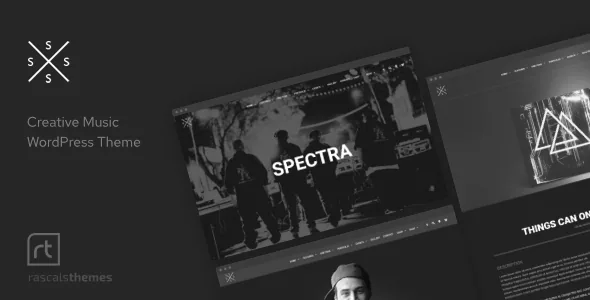
Spectra's vendor, Rascals, describes how the theme works rather than just what it looks like: it fetches HTML from your server, replaces the contents of a container element, and updates the address bar with pushState. The player sits outside that container, so it isn't rebuilt when the content changes. Scripts and stylesheets also don't get re-executed or re-applied on each swap.
The audible result is that someone can start a track on a release page, click into tour dates or a gallery, and keep hearing it. The vendor puts the controls in an overlay that stays available for play, pause and fast-forward.
Two different mechanisms are involved, and it helps to keep them apart when you plan. Continuous playback across page changes comes from the AJAX loading. Survival through a browser refresh comes from session storage, which the vendor names explicitly in a closing note. Neither is the same as playback continuing after the tab closes.
The Scamp player as a catalogue tool
Scamp accepts self-hosted MP3s, hosted MP3s and Shoutcast streams. The vendor states that track capacity is limited by client-side resources and browsing speed rather than by a number set in the theme, which is a claim worth watching in practice if your catalogue runs into the hundreds.
Each playlist entry can carry its own cover image, so a singles compilation doesn't have to display one shared square of artwork throughout. The vendor also says links in HTML can pull in dynamic content without interrupting what's playing, which points to presenting extra material mid-track instead of sending the listener to a new page.
A Tracks Manager custom post type stores the entries, with drag-and-drop AJAX sorting for ordering. On the front end, the Tracks widget renders a single track, a tracklist or a grid, so the same catalogue can appear as a compact sidebar item and as a fuller block on a release page.
Events: dates that file themselves
The event manager is described with touring in mind. You can set recurring and multi-day events, and a counter counts down to the next date. Once an event has happened, the archive moves it from the future set to the past set automatically, so the upcoming list stays clean without weekly pruning.
Google Maps integration shows the location of individual events, and an Events widget surfaces dates wherever widgets are supported \u2014 which pairs naturally with the persistent player, since a listener can hear a track and see the nearest show on the same screen.
The description stops short of ticketing. Events here are records you publish and display; selling admission is a separate job.
Headers, backgrounds and the layout tools
A Background Generator sets a different background header per page, post or portfolio entry, and the advanced header designs can hold titles, images, sliders, videos and maps. That is how a release gets its own visual identity without a new template.
Layout composition runs through WPBakery Page Builder, which the vendor describes as bundled, and the feature list mentions unlimited one-page builds made with it. The theme also lists five custom post types \u2014 Portfolio, Events, Slider, Tracks Manager and Gallery \u2014 with drag-and-drop AJAX sorters on Portfolio, Slider and Tracks Manager, and a slide panel widget area that closes itself after the page loads.
The marketplace attributes record Gutenberg Optimized as No, which describes how the theme is presented for block-editor templating. It doesn't remove the block editor from WordPress; it tells you the theme's own layout work lives in WPBakery.
One practical detail from the vendor's notes: preview images are for demonstration, and importing dummy data leaves placeholders behind. Plan on your own photography and cover art.
Why the shop loads differently
The most useful line in the vendor description for anyone planning to sell is the admission that WooCommerce pages are not fully AJAXed, because the plugin isn't compatible with the technique. Keep commerce on normal full-page loads is the sensible reading, since a checkout that swaps content in place is a liability.
Spectra lists WooCommerce support for selling music, physical goods, affiliate items and coupon codes, and the marketplace attributes declare compatibility with WooCommerce 9.x.x. That is a compatibility declaration, not a promise about your specific product types, payment gateway or digital-delivery setup.
So the site has two rhythms. Browsing, listening and reading stay in the no-reload flow; cart, checkout and order confirmation behave like a conventional WordPress shop. Build the store as its own experience rather than expecting the player's world to extend through it.
Declared versions and the maintenance record
Observed on the marketplace on 4 November 2026, the theme declares WordPress 6.6.x through 6.9.x and WooCommerce 9.x.x, plus Firefox, Safari, Opera, Chrome and Edge. The marketplace records 2.6.8 as the latest release, dated 1 June 2026, with minor bug fixes and updates to the bundled WPBakery builder and toolkit plugin.
The visible changelog also shows a PHP object injection fix in the admin area in 2.6.6, followed by PHP error fixes in 2.6.7. Those are vendor release notes rather than an audit result, and they show maintenance of the moving parts the theme depends on.
If your WordPress branch sits outside the declared range, or your plugin mix includes something that hooks into navigation, verify the behaviour on your own stack instead of assuming the declared versions cover it.
When continuous playback is the deciding feature
Spectra earns its place on a site where the music is the reason someone arrived and you want them to keep hearing it while they read a bio, check dates or look through photos. Continuous playback, session-stored state, per-track covers, the Tracks widget and the self-maintaining event archive form a coherent set, and a general-purpose theme would need several plugins to approximate it.
The friction is concentrated in commerce. Selling music, merch or tickets means stepping out of the no-reload flow, so treat the store as a separate build with its own navigation. Test playback persistence on your target phones and browsers before you commit to it as the site's spine, and test the store separately. The rest of the decision is whether WPBakery is the editing surface your team wants.
Questions & answers
Does playback continue when a visitor moves to another page?
According to the vendor, yes. The theme loads pages via AJAX into a container and leaves the player outside it, so audio keeps running while the content changes. The vendor also says the player uses session storage, which covers a browser refresh rather than only navigation.
How many tracks can the player hold?
The vendor sets no fixed number and says the only limit is client-side performance and browsing speed. Treat that as a description rather than a benchmark; a long catalogue is worth testing on the devices your audience actually uses.
Are event tickets sold by the theme?
No ticketing feature is described. The event manager handles scheduling, recurring and multi-day dates, a countdown to the next event, automatic moving of past events, and Google Maps locations. Selling tickets would be a separate WooCommerce or plugin job.
Do the demo images come with the theme?
No. The vendor states that preview images are for demonstration only and that importing dummy data leaves placeholders in their place. You'll need your own artwork, press shots and track covers.