Three inventories, one agency site
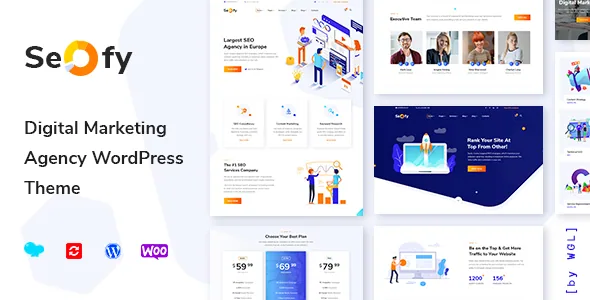
Most of what Seofy offers is counted rather than described. WebGeniusLab's listing names 5 predesigned home pages, 10+ portfolio page layouts and more than 15 blog layouts, plus separate team member, clients and services page layouts. That is a lot of prebuilt furniture, and the practical question is which of those three stacks you will actually populate.
A digital marketing agency tends to need all three at once: a home page per service line if you split SEO, PPC and social into their own funnels, case studies to show outcomes, and a blog for the content work clients hire you for. Seofy is arranged around that assumption. The counts below come from the vendor description; they describe what ships as layout, not how a finished page will look after you replace the demo copy.
Portfolio layouts are the vendor's own pick
The description singles out the gallery set: 10+ portfolio page layouts, presented as the thing that makes the theme distinctive. For an agency selling results, the project page is where the pitch lands, so having a range of them matters more than a large hero animation library.
Ten-plus layouts within one theme usually means variations in grid density, caption placement and media treatment rather than ten unrelated designs. Confirm which arrangement fits each case study type on the demo before assuming a single layout can carry a whole portfolio. The vendor also notes a custom link option for portfolio items in an earlier release, which is the kind of detail that lets a project tile point at an external case study or campaign page.
The blog side is unusually deep for an agency theme
More than 15 blog layouts is a higher number than most agency templates advertise, and the description ties it to a newsletter subscription feature. If your growth plan depends on publishing regularly and capturing emails, that pairing is the part of Seofy worth testing first: index layouts that suit long-form posts, short posts and link roundups, with a signup placed where readers finish an article.
The marketplace attributes mark Gutenberg Optimized as Yes, and the changelog points to that flag being added back in version 1.4. Treat the two facts as separate: the flag says the theme was built with block-editor support in mind, while the layout count says the vendor prepared its own templates for archives and single posts. Whether a post written in the block editor inherits the styling you expect is something to check with your own content.
Where page building happens
The feature list puts a flexible header builder with presets in the theme, alongside more than 30 modules and extended row animations. The header is its own build rather than something produced inside a general page builder, which is useful on an agency site where each service landing page may want a different top bar or navigation emphasis.
Row animations apply at the row level, not to individual elements, which is a constraint as much as a feature: you get motion on whole bands of a page without stacking animation settings on every widget.
Two modules in the list go beyond generic page composition. A timetable shortcode suits agencies publishing consultation slots or webinar schedules, and a dedicated team members module covers staff pages, which almost every services site needs and few themes treat as a first-class object.
Selling services or products through WooCommerce
The listing declares WooCommerce compatibility across the 5.x, 6.x, 7.x, 8.x and 9.x lines. For an agency, that opens a route to selling audits, retainers or digital products such as downloadable templates on the same site as the marketing pages.
The changelog mentions updated WooCommerce templates in a 2020 release, which indicates the theme has, at some point, carried its own shop template overrides. It says nothing about how shop layouts look now, and nothing in the description covers checkout customisation or product filtering. If commerce is central to your plan, the honest check is a test install with the plugin versions you run.
Maintenance record and what it tells you
The marketplace record observed on 4 November 2026 shows version 1.6.21 with a vendor update date of 17 October 2026. The changelog text supplied with the listing stops earlier: its most recent entry is 1.6.11 from 23 June 2025, which records a fix for a local file inclusion vulnerability in an AJAX handler plus bundled plugin updates. A 1.6.8 entry from February 2024 notes PHP 8.2+ compatibility.
That gap is worth reading carefully. The vulnerability fix is a genuine reason to want a recent copy, and the absence of later changelog text in the source is not proof that nothing changed. Changelog entries also describe a problem that existed in the version before them, so what matters is running the current release rather than an arbitrary older archive.
Elsewhere the listing is plain: a child theme is included, the theme is translation ready, the vendor copy describes it as RTL-compatible and WPML-ready, and the packaged files are PHP, CSS and JS. Compatibility with WordPress 5.1.x through 7.0.x and with Firefox, Safari, Opera, Chrome and Edge is declared on the listing, not the result of testing your stack.
Questions & answers
Does Seofy use its own page builder or the block editor?
The vendor's feature list describes the theme's own surface: a flexible header builder with presets, more than 30 modules and extended row animations. The marketplace also marks Gutenberg Optimized as Yes. In practice, plan for headers and page furniture from the theme's builder, while posts and simple pages can use the block editor, subject to how the theme styles block output.
How many portfolio layouts does Seofy include?
The vendor description lists 10+ portfolio page layouts, described as galleries, and calls them out as the theme's distinguishing feature. The exact variations between them are not itemised, so compare them on the demo against the case study formats you publish.
Is WooCommerce required to use Seofy?
No. Seofy is a marketing and agency theme whose pages can be built without a shop. WooCommerce compatibility, declared across versions 5.x to 9.x, only matters if you want to sell services or digital products directly from the site.