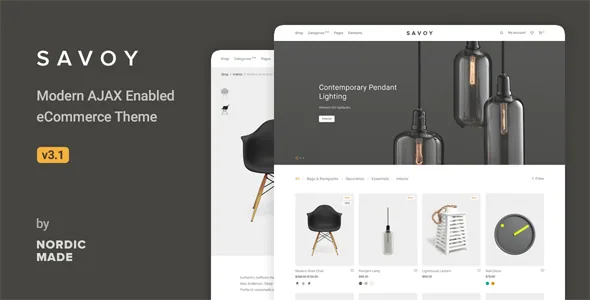
The shop interactions live in the theme code
NordicMade's description of Savoy makes one claim that decides most of the buying question: the shop is "Fully AJAX Enabled (no plugins required)." Category and attribute filtering, add-to-cart, product search, quick view and cart quantity controls are all listed as theme features that work without a page reload.
What that gives you is a smaller moving parts list. A filter plugin, an AJAX search plugin and a quick-view plugin each carry their own updates and their own assumptions about WooCommerce templates; here that behaviour ships as one codebase with one changelog. The other side of the same arrangement is that you cannot swap the filtering engine for a third-party one without working against the theme.
Controlling how dense the catalog reads
The catalog grid runs from one to six columns. That range covers a single-product spotlight as well as a tight tile wall, and it is a per-store decision rather than a fixed template: a jewellery shop with large photography and a wholesale parts catalog want opposite ends of it.
Variable grid layouts let column widths differ within the same view, so a featured product can occupy more space than its neighbours instead of every tile matching. Combined with colour-swatch filters and product labels that appear as both filter controls and on-product attributes, the density controls are aimed at browsing by image rather than by list.
The sidebar decision: static or slide-panel
Filters can sit in a static sidebar beside the grid or in a slide-panel that opens over the content. The static option keeps filters permanently visible, which suits a store where narrowing by attribute is the main way people shop. The slide-panel gives the grid the full width and hides the filters until a shopper asks for them.
That choice interacts with column count. Six columns plus a permanent sidebar leaves little room for product imagery on a laptop screen; a slide-panel is usually what makes the wider grids workable. Whichever you choose, the AJAX layer means applying a filter updates the grid without a full page load.
Quick view, the cart panel and infinite scrolling
Quick view opens product details over the grid. The changelog shows the vendor refining it rather than leaving it alone: version 3.0.9 in August 2025 added a setting to change the quick-view link label and excluded private and draft products from the quick-view Ajax request.
The cart is a panel with AJAX quantity controls, and a free-shipping meter can be shown inside it — an option added in version 3.0.6. Infinite loading is listed for both the shop and the blog, and the same release moved the result count above the load button, which matters on a long catalog where shoppers need to know how far they have scrolled.
Catalog Mode disables the ecommerce behaviour while keeping the product layouts, so the same pages can serve as an enquiry catalog or a lookbook. The vendor does not itemise what Catalog Mode removes.
Header search that gets specific
Savoy's header carries product search with instant suggestions, and several changelog entries show that feature being treated as a real store tool. Version 3.0.4 added a setting to search by SKU for the suggestions. Version 3.1.0 added a setting to display suggested search keywords. Version 3.1.2 applied WooCommerce price tax settings to suggested results, so a search dropdown shows the same price logic as the product page.
The header itself has multiple layouts, a floating sticky version that stays on screen while scrolling, and page-specific transparency so a landing page can open over an image while category pages keep a solid bar. An alternative logo with its own visibility settings covers the light-mark-on-dark-image case. A side-panel mobile menu, with a setting to use that panel on desktop too, arrived in version 3.1.0.
Two builders, both actively maintained
Content is authored with Elementor or WPBakery Page Builder, with more than 40 page builder elements, a built-in banner and slider system, and a bundled Slider Revolution. A starter child theme is included for code-level changes.
The changelog is worth reading on this point because it shows both routes receiving work in the same period. WPBakery version bumps sit alongside Slider Revolution updates in many releases, and Elementor-specific fixes appear separately — widget stylesheets missing on archive pages (3.1.8), a Banner Slider PHP warning, widget settings not applying in rare cases. Neither builder reads as a legacy path kept alive at the margins. That does not prove both are equally polished for your layouts. Note also that the vendor describes WPBakery as an optional plugin with a stated value and Slider Revolution as a premium plugin included in the package; those are claims about the vendor's bundle.
Translation and the marketplace compatibility record
Language files ship for eighteen locales, including Danish, Dutch, Finnish, French, German, Italian, Norwegian, Portuguese (Brazil), Russian, Spanish, Swedish and Turkish. WPML is listed separately as compatible and is not part of the package, so a multilingual store needs its own WPML licence.
The marketplace attributes, observed on 3 November 2026, name WooCommerce 5.x.x through 10.x.x, Elementor, Elementor Pro, WPBakery Page Builder, WPML and Contact Form 7, with a declared WordPress range of 5.0.x to 7.1.x. Gutenberg Optimized is marked Yes. These are vendor and marketplace statements rather than test results. The theme's own changelog explains why the ranges keep moving: releases through 2026 are largely WooCommerce template compatibility work from 10.x up to 11.2, plus WordPress 7.0 compatibility updates. The included file list names Layered PSD, PSD, PHP, CSS and JS files.
Where Savoy's model pays off
The theme is built for a store whose value is browsing: a furniture, jewellery or design-goods catalog where shoppers filter by attribute, preview in a panel and expect the page not to jump. The plugin-free interaction layer and the column-and-sidebar controls point at exactly that.
If your shop depends on a specific subscription or filtering extension with its own logic, Savoy's centre of gravity sits elsewhere. The same applies if your team works entirely in the block editor for page building, since the documented authoring routes are Elementor and WPBakery.
Questions & answers
Does Savoy need extra plugins for AJAX filtering, search and cart behaviour?
NordicMade describes the shop as fully AJAX-enabled with no plugins required, listing category and attribute filters, add-to-cart, product search, quick view and cart quantity controls as theme features. WooCommerce itself is the platform the theme is built on, not an add-on in that sense. Third-party filter or search extensions are optional rather than stated requirements.
Can Savoy run a site that does not sell online?
Catalog Mode is listed among the shop features and disables the ecommerce behaviour while keeping the product layouts, so the theme can present a lookbook or enquiry catalog. The vendor does not describe which elements Catalog Mode removes, so confirm the result on the demo or a staging copy before you commit.
How current is the WooCommerce support?
The changelog shows compatibility and template updates in most releases through 2026, moving from WooCommerce 10.x up to 11.2, alongside WordPress 7.0 compatibility work. The marketplace attributes list WooCommerce 5.x.x to 10.x.x as compatible. Neither is a substitute for checking the versions you actually run.