Menu and reservations are the reason to pick Savory
Elated Themes lists three restaurant-specific items in the feature set: a Restaurant Menu shortcode, a Reservation Form shortcode and OpenTable integration. Those are separate components rather than one bundled booking system, and the distinction matters when you plan the site.
The menu shortcode is a content unit you place inside page layout, so a menu can share a page with story blocks, gallery images or a call to action instead of living on its own template. The vendor does not specify in the description how menu items and prices are structured or whether seasonal menus are supported, so look at the demo pages before assuming a particular editing model.
The reservation side splits in two. The theme supplies a form, and the vendor separately points to OpenTable for table booking. Nothing in the supplied description says the two are wired together, so treat them as an either-or decision: use the theme's form and handle requests yourself, or hand booking to OpenTable and present it as an external service. Sites that already run OpenTable will care far more about that integration than about the form shortcode.
Twelve homepages, one-click import, and demo images you cannot ship
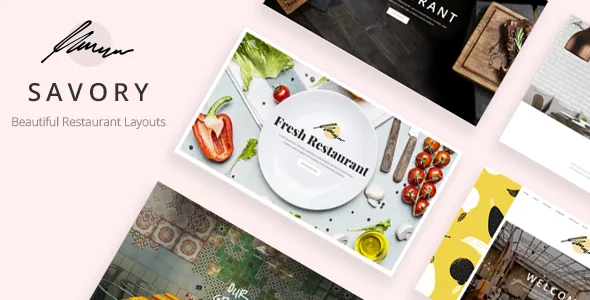
The vendor lists 12 homepage examples plus a one-click demo import. That is a starting-point decision rather than a build-it-yourself brief: you import a layout and replace its content, which is faster than composing the same structure row by row in WPBakery.
The catch is stated plainly by the vendor. The photographs in the demos are not covered by the theme licence and appear for presentation only; using them on your site requires a stock image licence of your own. For a restaurant, food photography is the site, so budget for a shoot or a licensed image set before launch rather than after. A restaurant that imports a demo and keeps its pictures is running imagery it has no right to use.
Front-of-house layout: five headers and a passepartout frame
Header choice is unusually deep for a theme aimed at one industry. The vendor lists five header types — standard, dual, divided, full-screen menu and vertical — with three behaviour types covering sticky, sticky on scroll up and fixed. On a restaurant site these do different jobs: a full-screen menu suits a short list of four or five links, a vertical header gives a menu column persistent presence, and a dual header can carry both navigation and contact details along the top.
Mobile styling is handled separately, with its own options and logo sizing, and multiple logo versions for sticky and mobile headers are listed. Two smaller items change the feel more than their size suggests. An optional passepartout border frames the whole site, which reads as a printed menu card rather than a web page, and one-page anchor functionality lets a single long landing page carry menu, story and booking sections with in-page navigation.
Below that sit the usual structural pieces — side area, footer with one to four columns, footer top and bottom, an uncovering footer effect, footer background images, parallax sections and video backgrounds.
The Instagram and Twitter widgets in the listing versus the changelog
The feature list still names an Instagram Feed Widget and a Twitter Feed Widget. The release notes tell a different story. Version 2.6, dated 1 October 2025 in the vendor changelog, removed the Eltd Instagram Feed plugin "due to Instagram API changes". Version 2.4 had already removed the Elated Twitter plugin for the same reason on Twitter's side.
Read the two together and the social feed widgets should be treated as historical listing entries rather than a promise. Feeding Instagram into a site now generally means an embedded post, a third-party aggregator or a platform-sanctioned embed route, and the theme documentation is where to confirm what the current build actually supports. This is not a small footnote if social proof is part of your plan — a restaurant that wants its latest plates on the homepage needs that answered before committing to the design.
Recipes, events and other publishing layouts
The vendor's description mentions sharing recipes and blogging about food, and the feature list backs that with three blog layouts: standard, masonry and masonry gallery. Pagination runs to standard or load-more, and there are Blog List and Blog Carousel shortcodes for pulling posts into other pages.
Post formats cover audio, video, standard, gallery, link and quote, which is more than a simple recipe blog needs and useful if you publish interviews or event recaps. A portfolio section comes with four list layouts — gallery, masonry, Pinterest and tiled — plus multiple single layouts, so an image-led set of dishes, interiors or private-dining spaces can be built without a separate gallery plugin. Social sharing is listed as its own feature and shortcode.
WPBakery, Slider Revolution and the declared compatibility ranges
Pages are built in WPBakery Page Builder, which the vendor lists as included in the package with a stated $46 value, alongside Slider Revolution at a stated $26 value. Those are vendor bundle claims for the theme package; whether a given file set includes them is something to confirm in the package details rather than infer.
A long shortcode list comes with the builder — process, info box, team, product list, single product, video button, image gallery, call to action, carousel, Google Map and social share among them — plus seven icon font packs and 600+ Google Fonts. The admin panel handles typography and the global options.
The marketplace attributes captured on 4 November 2026 declare compatibility with WooCommerce 10.x.x and 9.x.x, WPBakery Page Builder and WPML, with WordPress versions from 6.3.x to 7.0.x and the usual desktop browsers. Translation readiness and a child theme are both listed. These are vendor and marketplace declarations made at a point in time, not results from running the theme against your PHP build or plugin set. Version 2.6 also records a WPML config file added in 2.5 and WooCommerce 10.2.x support in 2.6, which suggests those integrations are being maintained rather than left as legacy badges.
Questions & answers
Does Savory include a working table booking system?
It includes a Reservation Form shortcode and the vendor points to OpenTable for online booking. The description does not explain whether the form connects to OpenTable or works as a standalone request form, so confirm the behaviour you need before relying on either.
Can I keep the demo photographs on my restaurant site?
No. The vendor states the demo images are presentational only and must be licensed separately, for example from a stock image site, before you publish them.
Are the Instagram and Twitter feed widgets still available?
The feature list names them, but the changelog records the Instagram feed plugin removed in version 2.6 and the Twitter plugin removed in version 2.4, both citing API changes. Treat the widget entries as out of date and check the documentation for the current build.