The calendar is the part most vCard themes skip
The vendor description lists an availability calendar as one of the template's advantages, described as a way "to show your customers when is the best moment to contact you." On a personal profile site that is a different job from a contact form: a form takes a message, while the calendar shows a visitor which days you are already occupied before they write.
The changelog shows how the detail was handled. Version 1.0.4 changed busy days in the calendar from the main accent colour to grey, so occupied dates read as neutral rather than as a feature. Version 1.1.5 made calendar months follow the WordPress language, which matters the moment the site is not in English.
That is the honest scope of the claim. The vendor does not describe booking, payments or a two-way sync with an external calendar, so treat it as an availability display for enquiries rather than a scheduling engine.
How the CV is assembled: sections, not a long text field
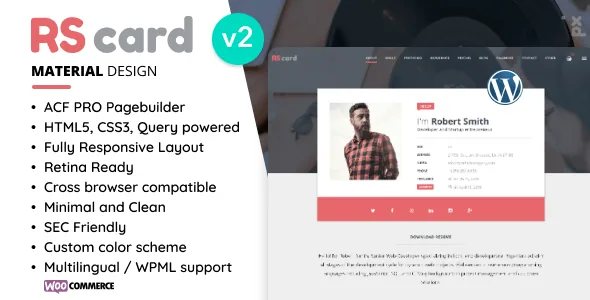
RScard's page is built from sections, and the vendor credits an "ACF PRO page builder" as the mechanism. The description names the content areas it is designed around: experience, skills, services, education, works, awards, expertise, clients, testimonials and pricing. You fill fixed section types with your own material rather than designing a page from blank blocks.
The changelog is the better guide to what those sections can be adjusted to. Version 2.0.5 added a statistics section with a choice of two, three or four columns, a sticky header, a second profile image that appears on hover, and a new text editor in the header area. Version 2.0.0 added an image slider section, four button styles, icons in the menu and transparent section backgrounds. Version 1.1.9 added a switch to show or hide skill percentages.
Those are structural choices you make once. If your CV has no numbered statistics, or you would rather not publish skill percentages, the toggles exist rather than requiring template edits.
Portfolio: a filterable grid with a popup, plus an inner page
The vendor feature list describes a "Filterable + Popup Preview Portfolio" and credits the Isotope jQuery plugin for the filtering behaviour. Two versions in the changelog fill in the shape: 2.0.0 introduced the portfolio section and a separate portfolio inner page, and 2.0.4 raised the number of portfolio posts the theme allows to 100.
The pairing is useful for a freelance profile. Some visitors want to scan a filtered grid and open a quick preview; others want a page they can link to directly. Both routes exist here.
One boundary to note: the listed portfolio features describe the filtering and preview, not a masonry or gallery system with its own lightbox options. For a résumé site with a handful of case studies or project shots, the grid and inner page cover the need.
A second language, or a right-to-left layout
The vendor lists WPML support and RTL support as separate features. The changelog dates them: RTL support arrived in 1.1.5 alongside the calendar language change, and WPML compatibility was added in 1.1.7, with that release's tag reading "wpml plugin compatibility."
For a personal profile, WPML is the more demanding of the two. It means the CV text, section labels and portfolio entries can exist in more than one language, which is relevant if you are applying across markets or if your clients read a different language from your own. RTL is the layout question, whether the interface flips for right-to-left scripts. Both are vendor claims about support rather than proof that every section of a translated page behaves as expected, so test a second language on the sections you actually use.
Light and dark skins, and where colour comes from
The theme description calls RScard "minimalist / clean / material style" with "two color skins: light and dark." The vendor feature list adds a custom colour scheme alongside that. The skin sets the overall tone of the page, a light card on a pale ground or the inverse, and the colour scheme handles the accent used across headings, buttons and highlights.
Two related options appear in the changelog: a dark skin style for the Google reCAPTCHA widget (1.1.6), added in the same release that introduced API key fields for Google Fonts and Google Maps, and the ability to change the header image overlay colour. Small things, but they are the ones that break visual consistency on a personal site.
The marketplace record marks Gutenberg Optimized as "No." That attribute describes block-editor optimisation, not whether the block editor exists in WordPress. Section content here is described as assembled through ACF PRO fields, so plan on editing values inside those sections rather than composing the page from blocks.
Maintenance signals worth reading before you commit
The changelog is long and mostly unglamorous: ACF PRO is bumped release after release, along with WordPress compatibility notices and small fixes. That pattern matters for a theme whose sections depend on ACF PRO fields, because a stale bundled plugin is the usual way these builds break after a WordPress update.
Two entries deserve attention. Version 2.2.8 removed "outdated Instagram and Twitter integrations," so a personal site expecting a social feed pulled from those networks should not assume one; the current feature list instead mentions 200+ social icons, which are links rather than feeds. And 2.2.0 records opting out of the block-based widgets editor introduced in WordPress 5.8, which tells you the widget areas are managed the classic way.
The marketplace attributes observed on 4 November 2026 list WordPress 6.3.x through 7.0.x, and the changelog's entry for 2.3.2 records compatibility up to WordPress 7.0.3, a PHP 8.1 compatibility improvement in 2.2.7, and PHP warning fixes in 2.2.9 and 2.3.2. Those are vendor and marketplace declarations of tested ranges, not a run against your PHP version, caching layer or plugin set. With 1,983 sales and a 4.75 rating across 84 reviews at the time of observation, the item has a visible track record, though that is marketplace context rather than a guarantee of how it will behave with your content.
Questions & answers
Does the availability calendar take bookings?
The vendor describes it as a way to show customers the best moment to contact you, and the changelog records busy days being shown in grey and month names following the WordPress language. Nothing in the supplied description mentions booking, payment or external calendar synchronisation, so treat it as a display of your availability rather than a scheduling tool.
Is the theme built for the block editor?
The marketplace record marks Gutenberg Optimized as No, while WordPress itself ships the block editor regardless. RScard's content is described as assembled from ACF PRO-driven sections with their own fields, so day-to-day editing happens inside those section settings and text fields rather than by composing pages from blocks.
How many portfolio items can I publish?
Version 2.0.4 of the changelog raised the allowed portfolio post count to 100. The vendor feature list describes the portfolio as filterable with popup previews, and 2.0.0 introduced both the portfolio section and a separate portfolio inner page.
Can I run the site in two languages?
The vendor lists WPML support and RTL support, and the changelog dates them to versions 1.1.7 and 1.1.5 respectively. WPML is a separate plugin, and the compatibility note in the listing is a vendor claim rather than a tested pairing with your specific configuration.