The seller's pitch is the booking-to-delivery chain, not the gallery
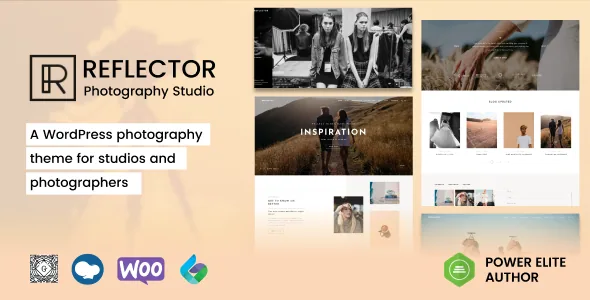
Most photography themes describe their demos. Reflector's marketplace description is organised around a sequence of business tasks instead: clients book a session through the Scheduled plugin, choose a package from one of three pricelist layouts, log into a password-protected private gallery to review and select images, and buy prints, digital downloads or gift vouchers through WooCommerce.
That framing is the useful thing to test. If your proofing, booking and print sales already live in separate services that work well, the theme's advantage shrinks to layout and styling. If you want a client to stay on your own domain from first enquiry to final print order, every one of those pieces is listed as part of the theme rather than an integration you assemble.
What the description does not explain is the seam between them. How a client's selections in a proofing gallery move toward an order is not described, and the vendor material only says clients can review and select. Confirm that flow on the demo before promising it to a client.
Proofing galleries: three types, described only as password-protected
Client proofing appears twice in the vendor list. Once as a business tool, defined as password-protected private galleries where a client logs in, reviews and selects images from your branded site. Once inside the gallery section, as album and proofing galleries with three proof gallery types included.
The three types are named as a count and nothing else, so the difference between them is not documented in the description. Treat it as a design question for the demo: whether the variants differ in layout, in how many images show at once, or in what the client can mark.
That makes the gallery count the more practical entry point. Across 17 gallery styles, the vendor separates masonry grids for editorial and documentary work, full-screen immersive layouts for landscape and fine art, and album and proofing galleries for delivery. A documentary set, a fine-art series and a wedding handoff each want a different treatment, and the theme's claim is that all three sit in one installation rather than requiring a different theme per project type.
Booking now means Scheduled, not Booked
The changelog is more specific here than the feature list. Version 1.3.2 records that Booked was replaced with the Scheduled plugin. The current description lists Scheduled as included, so any tutorial or forum thread that walks you through Booked inside Reflector describes an older branch of the theme.
The booking types named are consultations, portrait sessions and studio appointments, booked directly on the site. "Included" in a vendor list is not the same as ready to use: bundled plugins still need installing, activating and configuring their own calendar and availability settings, and their licence terms sit apart from the theme's.
One small inconsistency is worth knowing. The marketplace compatibility attributes observed on 3 November 2026 name WooCommerce and WPBakery Page Builder only, so booking does not appear as a declared compatibility entry even though the description presents it as a theme feature. That reflects how the attribute fields get filled in, not evidence about whether scheduling works.
Prints, vouchers and shop pages under WooCommerce
The WooCommerce line covers prints, digital downloads, photography packages and gift vouchers. For a portrait studio the two that carry money are the voucher sold ahead of a session and the print order placed afterwards.
Compatibility declarations disagree with the changelog in a way that matters for a shop. Attributes recorded on 3 November 2026 list WooCommerce 5.x through 9.x, while a 1.3.9 changelog entry refers to a WooCommerce 10.5.x compatibility update. Neither source is a test of your stack, so match your installed WooCommerce version against the demo before committing to a checkout flow you rely on.
An image-heavy catalogue is a different animal from a text store: product galleries, thumbnails at several sizes, and a lightbox that has to coexist with the theme's own. The vendor lists lightbox, slideshow and hover effects for galleries generally, not for shop pages specifically, so look at a product page rather than a portfolio page when you evaluate it.
WPBakery and The Grid sit under the imported layouts
Editing happens in WPBakery Page Builder, listed as included along with The Grid for responsive portfolio and blog grids. The latest changelog entry, version 1.4.4, bumped those two bundled tools to WPBakery 9.0.1 and The Grid 2.8.2 — a small entry that nonetheless says the dependencies are being kept current.
The practical consequence is that the 25 homepage layouts and 90+ templates across 20 filterable categories are builder layouts. Importing one gives you a starting structure; changing it means editing rows and elements in WPBakery, and a team that prefers WordPress blocks will find the layouts easy to adopt and less easy to restructure. Twenty-five homepages spanning editorial, full-screen, minimalist, bold and studio directions also means the choice is about which structure fits your work, not which one looks busiest.
Beyond the builder, the vendor lists unlimited colour skins, typography control over fonts, weights, sizes and spacing, and theme settings you can back up, import and export. The settings export is the quiet one worth planning for if you run a staging copy or a second studio brand.
What the release history and package facts show
The changelog reads as maintenance rather than reinvention: WordPress compatibility checks, plugin version bumps and small fixes such as an Instagram page image bug in 1.4.0, inconsistent blog post spacing in 1.3.7 and a testimonial widget issue in Firefox in 1.3.3. PHP 8.0, 8.1 and 8.2 support arrived in 1.3.1.
One later entry changes how activation works. Version 1.4.3 added a theme licence activation system with Envato purchase code verification and removed the Appsero client tracker and theme updater. A build older than that release behaves differently, which is relevant if you are comparing versions.
For the package itself, the marketplace file list names PHP, HTML, CSS and JavaScript files, and the vendor lists a child theme, documentation, one-click demo import and a settings backup/import/export tool. Declared compatibility recorded on 3 November 2026 covers WordPress 5.0.x through 7.0.x, with Gutenberg Optimized marked Yes and the layout responsive. Those are declarations, not a record of testing against your own plugin stack.
One warning the vendor states plainly: the demo photographs are for demonstration only, are not included with a purchase and cannot be used on your site. Since the work is the content for a photographer, that is mostly a scheduling issue — choose the gallery style that suits your images rather than the one that looked best with someone else's.
Questions & answers
Is client proofing built into Reflector or supplied by a plugin?
The vendor description presents password-protected private galleries with three proof gallery types as a theme feature and names no separate proofing service. How a client's selections are stored or exported is not documented, so check that on the demo before relying on it for deliveries.
Can I keep the photographs shown in the Reflector demos?
No. The vendor states that the demo images are for demonstration only, are not included in a purchase and cannot be used on your site. You supply your own photographs or licensed images.
Which WooCommerce version should I plan for?
The marketplace attributes observed on 3 November 2026 declare WooCommerce 5.x through 9.x, but the 1.3.9 changelog entry refers to a WooCommerce 10.5.x compatibility update. Match your installed version against a test install rather than treating either number as final.