Transitions and grid sizes are chosen per page, per region
Qode's description of Passage doesn't open with a page builder or a demo count. It opens with a control most themes bury: how one page gives way to the next.
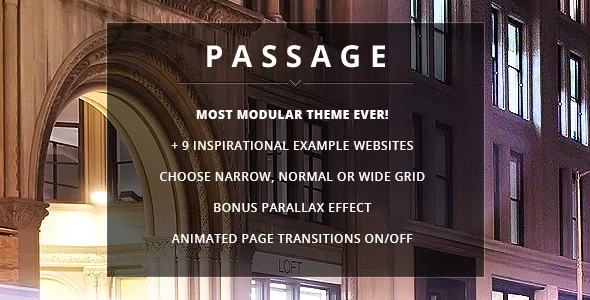
The vendor lists four fluid AJAX animated transitions for navigation between pages, each with an on/off switch. Turning AJAX off returns the site to ordinary page loads. What makes this more than a global effect is the per-page setting: alongside the predefined animations, the description says you can pick the animation type for any individual page. So a calm services page and a slow parallax microsite can sit in the same site without forcing every click into the same motion.
A second mixing control runs alongside it. Header, footer and content each take their own grid width — full-width or small, normal, or large — chosen separately. Read together, these two settings describe a theme built for assembling pages that don't all share one silhouette. If your projects tend to be one design stretched across many templates, this granularity is overhead rather than help.
All feature claims here come from the vendor's marketplace description. They describe intended behaviour, not a run of the theme.
Headers are per-page objects, and menus come in two modes
The vendor says every page can carry its own header, with its own height and its own background image or slider, plus a fixed-header toggle. In practice that lets a campaign or landing page open with a tall hero and a slider behind the navigation while the blog archive keeps a compact fixed bar.
Two dropdown menu modes are listed: the default dropdown and a wide, modern “move down” menu. The wide variant is the one to look at if a top-level item has to open into columns, such as a services index with several sub-groups. The default suits a short link list where a full-width panel would feel heavy.
Because both header treatment and transition type are set at page level, the two decisions interact. A page with a tall header and a fixed bar can feel very different depending on whether it slides in under an AJAX transition or loads plainly.
Parallax pages and the interactive element set
Passage includes what the vendor calls bonus parallax pages, and the admin description mentions adding unlimited parallax sections to any page. The framing is presentation-led — the vendor positions parallax pages for presentations, microsites or an alternative homepage rather than as a default site-wide treatment.
The element list points in the same direction: counters, horizontal graphs, vertical graphs, charts, animated services blocks and elements with animation. This is a vocabulary for a page that has to report something — numbers, a process, a set of capabilities — rather than a page that mostly holds prose. A corporate site using Passage would likely use these on a single-pager or campaign page and leave the blog and contact sections plain, because stacked scroll effects and animated counters on every page get tiring quickly.
Google Fonts handling has a relevant history here. Version 2.2 added a Disable Google Fonts option, which matters if fonts served from Google are a privacy or performance concern for your project. The theme also lists 500+ Google fonts and unlimited colours and sizes.
Custom sidebars as a content-architecture tool
The vendor lists unlimited custom sidebars, assignable globally or at post and page level. That turns sidebars into a routing decision rather than a fixed column: a services section can show a contact widget set, the blog can show categories and recent posts, and a single page can override both.
The changelog is worth reading on this point. Version 2.2 added fixes for creating custom sidebars in the new Widgets layout and for deleting them, and earlier entries back in 2013 also record deletion fixes. Those notes indicate the feature has needed maintenance as WordPress's widget system changed. If a lot of your site's navigation lives in sidebars, check that creation, assignment and deletion behave on your WordPress version before you migrate existing widget content across.
Widget Ready is listed as yes in the marketplace attributes, so the theme registers standard widget areas alongside its custom ones.
Slider Revolution is a vendor bundle claim, with an ownership question
The description says a Slider Revolution responsive WordPress plugin is included, valuing it at $26, and the changelog shows the bundled copy updated repeatedly — most recently to 6.7.18 in version 2.3. The theme package also depends on a companion plugin, Passage Core, which the changelog tracks separately (version 1.1 in 2023).
Both statements describe what the vendor includes in the theme they sell. They are not a description of every copy of the theme floating around, and they don't tell you who supplies Slider Revolution updates afterwards. If the slider is central to your homepage, confirm how its updates are delivered before you build around it, and treat the bundled version as a starting point rather than an entitlement to future releases.
WordPress compatibility is a separate matter. The marketplace attributes observed in November 2026 declare support for WordPress 6.0 through 6.9, while the most recent changelog entry — version 2.3, dated 11 September 2024 — claims only WordPress 6.6.2 compatibility. The gap between those two statements isn't explained, so test on the version you actually run.
What the version history means for adoption
Passage's first release was July 2013, and the changelog runs through many WordPress generations. The 2019 version 2.0 update was the structural one: it added WordPress 5.x compatibility, introduced the Passage Core plugin, moved dynamic CSS and JS to static files for performance, escaped variables and text domains, and prefixed functions and templates. Version 2.2 in 2023 added PHP 8 compatibility work, core search block support, and the Google Fonts switch.
After September 2024, the record as supplied shows nothing further. That doesn't prove the theme is abandoned, and it doesn't prove it breaks on newer WordPress releases either — absence of changelog entries is not a verdict. What it does mean is that you should treat the declared version range as a vendor claim and validate the specific features you need against your environment.
The marketplace attribute for Gutenberg optimisation is not a yes here. That attribute alone doesn't establish that the block editor is unusable; it says the theme isn't described as tuned for block-based editing. Layout work on this theme is driven by shortcodes and the Qode options panel, so plan for a workflow built around those rather than site-wide block templates.
One licensing point is explicit in the description: the demo images are presentational only and are not licensed for your site. Budget for your own photography and iconography.
Where Passage rewards a page-by-page approach
Passage makes sense for a project where individual pages carry different jobs and you want to decide, page by page, how a visitor arrives and leaves it: four optional transitions with a per-page override, headers with their own height and slider, and grid widths set independently for header, footer and content. Add parallax sections, counters and charts, and you have tools for a small number of ambitious pages rather than a uniform template set.
It suits you less if the block editor is meant to be your main design surface, or if you need a theme whose recent release history is documented beyond 2024 for the version you plan to run. The multilingual path is narrow but clear: WPML is the only plugin in the compatibility attribute, and translation files are prepared for po/mo work.
Questions & answers
Can I turn off the AJAX page transitions without losing the rest of the theme's features?
Yes — the vendor describes an on/off switch for AJAX animations alongside the four transition styles. Turning it off gives classic page loads; the other settings, including per-page headers and grid widths, are separate options.
Does Passage require Slider Revolution?
The vendor says Slider Revolution is included in the package and the changelog tracks its updates, but the description doesn't state that every page needs it. Headers can use a background image or a slider, so image-based headers are described as an option too.
Is Passage suitable for a multilingual site?
WPML is the only plugin listed under compatibility, and the theme ships po/mo translation files. The vendor describes WPML as fully compatible for building multilingual sites; the public attributes don't extend that claim to other multilingual plugins.