Special Boxes change how the catalogue is merchandised
NooTheme singles out Special Boxes as the theme's own feature, and the description of the mechanic is short: you select products to make a special set, then sell that set. That is a different shopping pattern from a category grid. A category page asks someone to choose one jar of honey; a box presents a breakfast bundle, a seasonal vegetable crate or a gift hamper as a single buyable thing.
For an organic shop the pattern fits how people actually buy. Produce boxes and weekly staples carry a higher basket value than single-item browsing, and a curated set shows the shop's judgement rather than just its stock. What the description does not cover is the build side: how products are attached to a box, how the set is priced, and whether variations carry through. Treat it as a capability to verify on the vendor's demo before you plan navigation around it.
Two content types that hold provenance and praise
Organici registers two custom post types beyond posts and pages. Testimonials are entered once and placed on any page with a testimonial shortcode, so the same quote can appear on the home page and beside a product without being retyped. Farmer entries let you add and change the people or farms behind the produce.
That is the part that separates a provenance-led shop from a general grocery store. If your positioning names growers, that content needs its own type rather than a stray blog post. Nothing in the supplied material says farmer entries link automatically to products, so plan that connection yourself with custom fields or shortcodes.
Six headers, nine home pages, and why the header list matters more
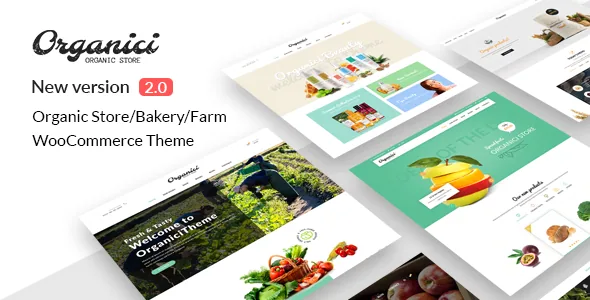
The theme ships in two styles, Organic Food and Organic Bakery, with nine home page variations and six named headers: Default, Agency, Business, FullWidth, Shop and Logo Center. Nine demos describe breadth of choice, not nine finished sites.
The header names are the more useful list for a store. A Shop header leads with the storefront; a Logo Center header shifts where the eye starts. Because the names are not described in the copy, compare them against each layout on the vendor's landing page rather than guessing which one suits a bakery with a narrow catalogue versus a farm shop with a wide one.
What you edit with, and what controls the look
WPBakery Page Builder is the page-building layer, and the vendor says it comes with the theme alongside Slider Revolution, citing savings of $46 and $25. Those are claims about what the purchase covers, made in the marketplace description.
Colour and type sit in a live theme customizer: a colour scheme with unlimited element colours and Google Fonts for typography. Right-to-left support is listed, which is relevant if the store serves Arabic or Hebrew customers. Contact Form 7 is named as the form plugin the theme works with, and the description also lists a mega menu for organising a large catalogue.
The compatibility attribute marks Gutenberg Optimized as No. That means the theme was not built around the block editor; it does not establish that the block editor is unavailable. If block-based editing matters to your team, the builder fact is the one to weigh, since Organici's layouts are assembled in WPBakery.
Declared compatibility and the WooCommerce template treadmill
The marketplace attribute lists WordPress 6.5.x through 6.9.x and WooCommerce 6.x through 9.x, as recorded on 4 November 2026. The vendor's description text also claims WooCommerce 10.x readiness. Those are not the same statement, and the attribute list is the narrower one, so check your installed versions against the vendor's changelog rather than a summary.
The changelog shows what that maintenance looks like in practice: entries for outdated WooCommerce template files recur across releases, including 2.1.4, 2.1.3, 2.1.2, 2.1.1 and 2.1.0. Release 2.1.3 also records fixes for a PHP object injection vulnerability and a cross-site scripting issue. This is normal for a theme that follows WooCommerce templating closely, and it is a good reason to tie a WooCommerce upgrade to a theme release already checked against it.
Is Organici the right base for your shop?
If you sell mostly single items and want a standard category-and-product flow, Special Boxes is an extra you can leave alone. The theme's default shop mechanics are conventional, and the decision then rests on the header and home layouts you prefer.
If your offer is built around assortments, crates or gift sets, the ability to select products into a sellable set is the feature most likely to shape your home page, navigation and product copy. That makes the box mechanic the first thing to test on a staging copy before the design work begins.
Questions & answers
Does Organici work with the block editor?
The marketplace marks Gutenberg Optimized as No, which means the theme was not developed around the block editor rather than proving it is disabled. Pages are assembled in WPBakery Page Builder, which the vendor lists as included.
Which WooCommerce versions are covered?
The compatibility attribute lists WooCommerce 6.x through 9.x as recorded on 4 November 2026, while the vendor description also mentions WooCommerce 10.x. Since releases repeatedly address outdated WooCommerce templates, match your version against the vendor's changelog entries.
Do Special Boxes need a separate plugin?
The vendor presents Special Boxes as a theme feature in its own feature list and does not name an additional plugin for it. How boxes are configured and priced is not described, so confirm it against the vendor's demo and documentation.