A ten-year-old theme that was extended, not replaced
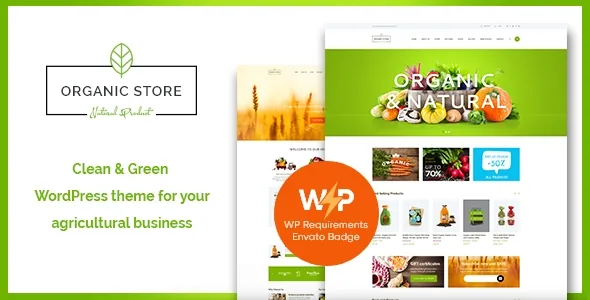
Organics was released in March 2016 and has been updated steadily since. The vendor's changelog, which runs from version 1.0 to 1.6.13, is the most detailed record of what changed, and it tells a clearer story than the marketing feature list: the theme kept its original structure while acquiring new editing tools and plugin support along the way.
That history matters more than usual here, because two of the theme's structural decisions were made years ago and still shape how you work in it. If you are evaluating Organics for an organic food shop, farm or eco-products store, the useful question is not whether it has a shop layout — it plainly does — but which editor you will build pages in and where the theme's controls actually live.
Elementor and WPBakery sit side by side
The changelog for version 1.6, dated July 2021, records two additions in the same line: "Compatibility with Elementor Page Builder has been added" and "Elementor-based homepage has been added." WPBakery support was not removed in exchange. The vendor's feature list still offers both canvases and describes each the same way — modify any page content easily.
So the choice is real, and it is a per-project decision rather than a technical superiority contest. If your team already builds in Elementor, you get a homepage layout built that way from the start. If you work in WPBakery, that route remains documented and supported. What you should not assume is that a demo page built in one builder can be opened and edited in the other; the changelog describes two supported tools, not a translation layer.
One attribute needs reading in context. The marketplace listing marks Gutenberg Optimized as No, even though the vendor's own description calls the theme Gutenberg compatible and an earlier changelog entry records Gutenberg compatibility being added in 2018. Neither statement means the block editor is unusable on this theme — only that the vendor has not optimised the theme for it. If block-based page building is central to your plan, look at the demo before committing.
Theme options live in a companion plugin
Version 1.5, September 2018, contains the line that affects day-to-day maintenance most: "Theme options, widgets, and shortcodes are moved to Themerex Utilities plugin."
Read plainly, the controls you use to configure the theme are delivered by a plugin rather than by the theme folder itself. That changes your housekeeping. A backup routine that covers only the theme misses the settings. When you update, the theme and the utility plugin are separate items, and a changelog that says plugins were updated to their latest versions refers to that set. If you build a child theme for customisations, know that your customisations are one layer and the options panel another.
A related plugin, ThemeREX Updater, is recorded as added in version 1.5.9 (April 2020), which is the update channel the vendor built for this theme family.
RTL is maintained, and it pairs with WPML
The product name carries "+ RTL" as a headline promise, and the changelog backs it up beyond an initial release: version 1.6.1, February 2021, records "RTL theme styles have been improved." RTL styling is therefore an ongoing concern for the vendor, not a stylesheet shipped once and forgotten.
For a shop, right-to-left layout is only half the problem. Store text, product names, checkout strings and any custom labels also need translating. The marketplace attributes list WPML among the compatible-with items, which is the standard route for a multilingual WooCommerce site. Worth noting: RTL styling handles direction and typography flow; WPML handles content in another language. They solve different halves, and a regional store usually needs both.
The shop side, and the imagery you must supply
The marketplace places Organics in the WooCommerce ecommerce category, and the vendor describes full WooCommerce integration with the store design included. Declared compatibility, observed on 4 November 2026, spans WooCommerce 6.x.x through 8.x.x — worth checking against the version you run, since that declaration is a listing attribute, not a test result on your stack.
The vendor also states that all images used in the live preview are copyrighted to their respective owners and are not included in the template. On a theme whose design leans on food photography, that is a real budget line: five homepage layouts are only useful to you once you have produce and farm imagery you are licensed to publish. Plan the replacement pass before you judge the layouts, because the demo look depends on pictures you will not receive.
The vendor lists Slider Revolution and Swiper Slider as included slider tools, with Essential Grid named as a compatible plugin for gallery displays.
Setting inheritance and 750+ Customizer options
Two entries in the vendor's framework section describe how configuration cascades: a setting inheritance and override system, and over 750 Customizer options. The inheritance idea is the more practically interesting one. It suggests global settings can be established once and overridden at a narrower level, which is what you want when most pages should share a house style but one campaign page needs a different header or colour accent.
The numbers are a vendor claim, not a measure of quality. A control panel that large also means a larger surface to learn and, if you hand the site to someone else, to document. Import the demo and change the settings that matter most to your site — product colour, typography, header behaviour — to see whether the panel feels workable before you build on it.
Privacy tooling and the declared version range
The vendor lists the GDPR Framework WP plugin as included, and subsequent changelog entries add compatibility with Cookie Information (version 1.6.9, May 2024) and the elegro Crypto Payment plugin (version 1.6.10, September 2024). For a European food shop, a theme that ships a consent-oriented framework saves an assembly step, though consent configuration remains your responsibility and not the theme's.
On software versions: the marketplace listing, observed on 4 November 2026, declares WordPress 4.9.x through 6.9.x, and the changelog's most recent entry records WordPress 6.9 compatibility added. The listing also carries the vendor's browser range (IE11 through Edge), which tells you the support matrix was written broadly rather than recently narrowed. Treat all of these as declarations attached to the listing, and verify the combination you intend to run — WordPress core, WooCommerce, your builder and the utility plugin — on a staging copy.
Questions & answers
Can I edit Organics pages in the block editor?
The vendor's description calls the theme Gutenberg compatible, and a 2018 changelog entry records Gutenberg compatibility being added. The marketplace attribute separately marks Gutenberg Optimized as No. That combination means the theme has not been tuned for block-based building; it does not establish that the block editor is unavailable. Check the demo against your intended workflow.
Do theme settings survive if I only back up the theme folder?
Not fully. Since version 1.5 (September 2018), theme options, widgets and shortcodes have been delivered through the Themerex Utilities plugin, so your configuration lives there as well as in the theme. Back up and update both.
Does the RTL support mean the theme is ready for a multilingual Arabic or Hebrew shop?
RTL handles layout direction and mirrored styling, and the changelog shows those styles being actively improved. Language switching and translated content are separate: the marketplace lists WPML as a compatible plugin. A regional store generally needs both pieces in place.