A decade of recorded updates in one changelog
The dated entries in this theme's changelog start at version 1.0 on 10 October 2016 and end at version 1.4.13 on 15 January 2026, where the vendor adds WordPress 6.9 compatibility. In between, releases alternate between two kinds of work: pushing declared WordPress and WooCommerce support forward, and refreshing whatever plugins the theme references.
That history is the most useful fact about the theme for a buyer in 2026. It tells you the codebase has been maintained as WordPress moved from 4.x through 6.9, even though the design structure described by the vendor has barely changed. The marketplace records 1.4.7 as its latest version stamp while the changelog reaches 1.4.13, and those observations were taken in November 2026 — so check which build your copy is before comparing it against any feature claim here.
What the changelog does not show is a rebuild. Nobody moved this theme to Elementor or to full site editing. If you want the maintenance record without a modern editor underneath, that is the trade.
Declared platform support versus what the attributes say
Marketing copy calls the theme Gutenberg compatible, and the changelog backs that up: version 1.4 in August 2018 lists "Gutenberg compatibility is added." Meanwhile the marketplace's own attribute marks Gutenberg Optimized as No. Those two statements can both be true — one is a historical note about not breaking the block editor, the other is a grading of how deeply the theme is built for it. Read it as: posts will not fall over in the block editor, but the theme's designed layouts are built elsewhere.
That elsewhere is WPBakery. The vendor lists WPBakery Page Builder support, a Shortcode Builder, a custom theme options panel and a "Setting Inheritance and Override System" as the framework you work in. It also lists boxed and wide page layouts, several header styles, and a toggle for a multi-functional user panel and for retina output.
On version ranges, the marketplace attributes declare WooCommerce 5.x through 9.x, WPML and WPBakery Page Builder, alongside WordPress 4.9.x upward. Those are vendor and marketplace declarations rather than results from running the theme on a particular server, and the wide backward range reflects the theme's age as much as anything you should rely on.
Three homepages, two shop layouts, and where the shop lives
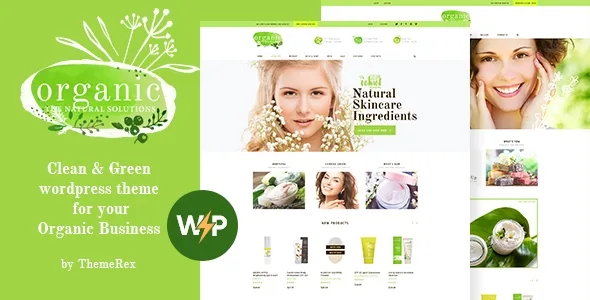
The vendor's layout inventory is specific: 3 premade homepages, 2 WooCommerce shop layouts, 3 gallery styles and 6 blog styles. For a cosmetics store, the meaningful pair is the two shop layouts, because that decides how product grids, filters and category pages look before you touch a single product.
The six blog styles matter more than they might on a pure storefront. A natural-beauty brand usually publishes ingredient explainers, routines and launch posts, and having six presentation options means the article index can be tuned without writing templates. The three gallery styles serve the same instinct — lookbook or ingredient imagery rather than plain product shots.
The vendor positions the theme for organic beauty stores, cosmetic shops, salons, skin-care treatments and adjacent blog territory like eco products. That positioning decides the demo photography and section vocabulary, not who is permitted to use it.
Two sliders, two jobs
The vendor separates its slider tools by placement rather than treating them as duplicates: Revolution Slider is named for the home slider, and Swiper Slider for posts and galleries. That split is practical — the homepage hero gets a heavy timeline-based slider, while listings and image sets get a lighter touch-driven carousel.
If you plan a homepage with a single static hero instead, the split costs you nothing except a plugin you may not use. If you plan a rotating campaign banner, Revolution Slider's layer controls are what you would reach for.
Beyond sliders, the vendor lists an interactive Ajax search mechanism, a set of custom widgets and custom shortcodes, and two icon systems — the Fontello icon set or image icons. Ajax search is the one that changes day-to-day behaviour on a product catalogue: shoppers get results without a page reload.
The GDPR plugin and the images that stay behind
The vendor lists "GDPR Framework WP Plugin included" among key features, and the 2018 changelog entry records adding that plugin along with GDPR-compliant checkboxes to default contact forms. Later notes mention compatibility with The GDPR Framework plugin and, in 2024, the Cookie Information plugin.
That is tooling, and the distinction matters. A consent plugin gives you somewhere to record and manage consent; it does not determine what your shop collects, how long order data is retained, or what your privacy policy promises. If you sell into the EU, those choices still sit with you regardless of which plugin is in the stack.
The other inclusion worth knowing about is a gap. The vendor states that images used in the live preview are copyrighted to their owners and are not included in the template, so the product and lifestyle photography in the demo has to be sourced or shot separately.
What the package contains and what it leaves to WooCommerce
The marketplace file list names PHP, CSS and JavaScript files. There is no layered design file among them, so visual changes mean working in the theme options panel, in WPBakery, or in CSS.
WordPress itself supplies no store logic, a WooCommerce theme inherits all of it: cart, checkout, tax, shipping, payment gateways, product variation. Organic Beauty's job is the styling and layout layered over that, plus the shortcodes and widgets you place. Nothing in the supplied description claims the theme handles bookings, subscriptions or payments itself — those are plugin choices with their own setup.
The same applies to multilingual work. WPML is listed as compatible, which says the theme has been prepared for translation; it does not say your product names, attributes and category descriptions will translate for free. Those need translating whichever tool you use.
Translation tooling aside, if you rely on a custom widget set and Ajax search on a large catalogue, test those two first. They are the theme-specific pieces most likely to need attention when other plugins are added.
Questions & answers
Can I build Organic Beauty pages in the block editor?
The theme's designed layouts are built in WPBakery, and the marketplace marks Gutenberg Optimized as No. Its changelog does record Gutenberg compatibility being added in 2018, so standard posts should not break in the block editor — but the homepage and shop layouts you see in the demo are WPBakery work, not block patterns.
Does the theme include the plugin bundle it references?
The vendor lists PHP, CSS and JavaScript files for the package, and changelog entries repeatedly say plugins were updated to their latest versions. The description does not itemise which plugins ship inside the download as opposed to being listed as compatible, so confirm what your own copy actually contains before you plan around a particular one.
How many shop layouts does it offer?
Two WooCommerce shop layouts, alongside three premade homepages, three gallery styles and six blog styles, according to the vendor's feature list. The two shop layouts are the ones to compare first if product-grid presentation is the deciding factor for your store.