Project thumbnails that move
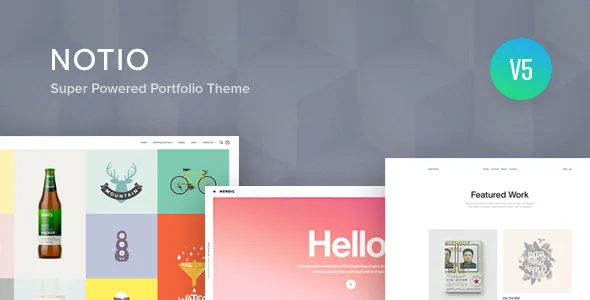
The marketplace description calls Notio "a visually stunning WordPress portfolio theme," which on its own says little. The changelog is more specific about where the design effort has gone. Version 4.1.0 records video hover support for portfolio items, video slider support for portfolio items, and the ability for images to carry video hovers. Version 4.2.5 added video lightbox functionality to portfolio links.
Taken together, those entries describe a portfolio grid in which a still image is only the resting state. A thumbnail can play a clip on hover, a project page can hold a slider of videos, and a project link can open a video overlay instead of navigating away. For photographers, motion designers, film crews and agencies whose work does not sit still in a JPEG, that is a more relevant capability than a long list of homepage demos.
These are vendor changelog claims rather than results you can take as tested on your own install. Video handling is also the first thing to exercise on a staging copy, since file weight and hosting behaviour decide whether the effect helps or hurts a portfolio page.
Masonry layouts you can set per element
Version 4.2.0 added custom layouts for the portfolio masonry element, after version 4.0.0 introduced a new masonry layout and two new masonry hover styles. Read together, those entries suggest the masonry element is configured rather than fixed: column behaviour and hover treatment are part of the element's settings, and they can change between one portfolio listing and another on the same site.
That matters if you publish work of different shapes. A grid of horizontal film stills and a grid of tall poster designs rarely want the same rhythm, and separate element settings spare you from choosing one compromise for the whole site.
The vendor also added three new pagination options for the shop page and additional text animation page builder elements over the same period, so the portfolio and shop listing surfaces have both been revisited rather than left on a single template.
Page chrome for project pages
Version 4.2.4 added a transparent header option for portfolio pages, building on the earlier transparent header support for pages generally. On a project page with a full-bleed opening image, a transparent header lets the artwork run to the top of the viewport instead of sitting under an opaque bar. That is a small setting with a visible effect on how a portfolio opens.
Later entries extend the same page-level control. Version 5.2.0 added row dividers inside row settings, and 5.6.0 added video background support for columns plus a mobile height setting for the spacer element. Each is a decision you make while composing a page rather than a global theme option, so per-project layouts can diverge without touching the rest of the site.
Fuel Studio elements, WPBakery, and where Gutenberg fits
Notio's composition tools sit in the Fuel Studio element set, which the vendor's version 4.0.0 entry describes as updated with over 40 elements. Version 5.6.0 lists three more: a block button, a label element and a highlight type, plus new font settings. WPBakery Page Builder is on the compatible-with list and the current changelog keeps updating it, with 5.6.14 noting WPBakery 9.0.1.
Gutenberg is a separate point and worth reading carefully. The marketplace marks Gutenberg Optimized as Yes, and version 5.4.0 records added Gutenberg support for portfolio metaboxes. That is support for the portfolio data fields in the block editor, not a statement that the demo layouts are assembled from blocks. The feature development described in the changelog is written around WPBakery elements.
Declared integrations and the software range
The marketplace compatibility attributes, observed on 3 November 2026, list WPBakery Page Builder and Visual Composer alongside Contact Form 7, Gravity Forms, Events Calendar, Events Calendar Pro and Foundation 6. WooCommerce is declared across 6.x through 10.x, and WordPress support runs from 5.5.x to 7.0.x in the listed range.
Treat all of that as declared compatibility rather than proof of behaviour on your stack. A portfolio site usually needs less from these integrations than a shop does: a contact form and, on agency sites, an events listing. Notio's own changelog shows annual WooCommerce template refreshes, which is what keeps a shop surface in step with plugin releases, but the theme's centre of gravity remains the portfolio.
Package contents and planning notes
The ThemeForest file list includes PHP, CSS and JS files along with PSD and a layered PSD. For a studio that designs in Photoshop before building, the layered source is the useful inclusion, since comps can be prepared to the theme's grid rather than eyeballed from a live demo.
The vendor's own copyright note says demo images are not licensed for reuse; you need your own licences for anything you publish. Two changelog entries also affect what you can plan for. Version 5.5.0 removed Instagram functionality, so an Instagram feed block is not something to design around. Version 5.2.4 added SVG logo support, and 4.0.1.1 added a GDPR cookie notice bar, which covers a common requirement on European agency sites.
Questions & answers
Can I still add an Instagram feed to Notio?
Version 5.5.0 of the changelog records that Instagram functionalities were removed. That entry describes an older release, so do not plan a build around an Instagram feed element without checking current theme options on a staging install, and consider a dedicated plugin if a feed is a requirement.
Are the demo images included with the theme?
The vendor's copyright disclaimer says that to use the images shown in the demos you need to purchase your own licence or use them at your own risk. Budget for your own photography or licensed stock before building a public site.
Does Gutenberg support mean I can rebuild the demos with blocks?
No. The recorded Gutenberg work is support for portfolio metaboxes in the block editor, and the marketplace marks the theme as Gutenberg Optimized. The element development described in the changelog is built around WPBakery, so the demo layouts are not evidence of a block-based build.