A music site where albums are records, not pages
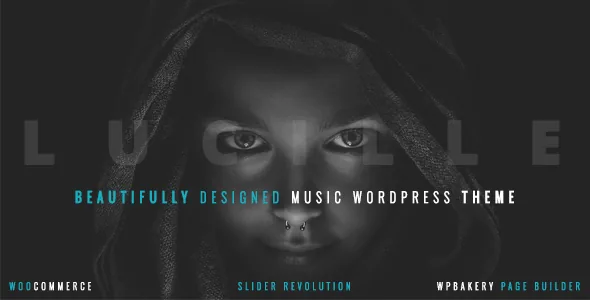
Lucille's centre of gravity is the album. SmartWPress describes a dedicated music album post type with its own taxonomy and fields for artist, release date, label and producer, plus three customisable purchase options. The admin side is made for audio files specifically: media upload, drag-and-drop adding, and drag-and-drop reordering of the tracklist. The album page then renders a music player built for that track order.
That distinction matters if you maintain a discography rather than a landing page. A release becomes an entry you fill in — with the buying links pointing at three destinations you choose — and the theme handles the presentation. You are not rebuilding an album page each time a record comes out, and a tracklist edit is a reorder in the media panel, not a rewrite of page content.
The changelog shows this structure has kept growing. Version 2.9 added performing artists to single templates for events and albums; 2.8.8 added Load More to the discography Elementor widget, and 2.8.1 added navigation to discography category pages. A discography deep enough to need category pages and lazy loading is what the theme has been shaped around.
Events carry logistics, not just a date
The event post type stores what a gig listing actually needs: date, time, venue, a URL for the venue, a tickets link and message, and a link to a Facebook event. Google Maps and YouTube or Vimeo embeds are supported on the event, so a show page can carry directions and promotional footage.
Later releases extended the same record in useful directions. Version 2.8.5 added an option to link events to an external URL from the archive templates and the events list widget, which suits a promoter selling through a third-party box office. Version 2.9.5 added an option to show event featured images in event lists on the special event template pages, and 2.9 added a custom CSS class field for events. Version 2.6 added theme options for the order and style of events on event category pages.
Read together, these are all switches on how existing event data is displayed. The practical consequence is that an events archive can be sorted, styled and linked differently depending on where you place it, without duplicating event entries.
Two lighter content types sharing the same pattern
Photo albums have their own taxonomy and a media upload interface with a preview section where images are sorted by drag and drop. Videos are a separate post type with a custom taxonomy and support for YouTube and Vimeo sources rather than self-hosted files. Both follow the same shape as albums and events: a taxonomy for grouping, a dedicated entry with type-appropriate fields, and theme templates that render the collection.
That consistency is the quiet benefit. Once you have learned one Lucille content type, you can predict the others, and a gallery, a video archive and a discography all live in the same part of the admin rather than across three unrelated plugins.
Templates are where the records meet the design
The vendor lists page templates for photo gallery, videos, music albums, events and blog, plus an empty page for WPBakery Page Builder and a page template with a sidebar. In practice these are the surfaces you assign to a menu item, which is why they matter more than a single homepage demo: an events template can be placed as its own page and carry content of its own, a capability the changelog confirms when version 2.3.7.3 added a content area to the Discography, Events, Videos and Gallery special templates.
Around the templates sits a layer of per-page control. Each page can take its own background image or colour, a full-screen background can be changed, and the menu style is switchable through theme settings — the changelog also records a sticky menu option that shows the menu only when a reader scrolls up. Unlimited colours run through the theme customizer, and the blog page has more than one layout style.
None of this is unusual for a premium theme, but it explains how a music site holds together: individual sections can look different from each other while sharing one set of content records.
Elementor widgets, and what the bundled plugins actually mean
Lucille ships custom Elementor widgets, and the changelog traces them in both directions — additions such as the event single details and promo-link widgets in 2.3.8, and fixes such as a masonry layout correction inside the Elementor editor in 2.8.3. The theme also declares compatibility with WPBakery Page Builder, Elementor Pro, WooCommerce 8.x through 10.x and WPML, and the marketplace attributes mark it Gutenberg optimised and widget ready.
On the plugins, be precise about who is making the claim. The vendor's description says the standard licence bundles WPBakery Page Builder and Slider Revolution, that demos import in one click, and that a child theme is available on request. Those are vendor statements about what comes with a purchase from the marketplace; they are not evidence about any other copy of the theme you might obtain. If a bundled plugin is essential to your plan, treat it as a question to confirm with the source you buy from.
The block editor point deserves the same care. A "yes" on Gutenberg optimisation indicates the theme has been adjusted to work alongside the block editor. It does not mean the album, event and video records are edited as blocks, and the theme's layout work is described through Elementor or WPBakery rather than block patterns.
Upkeep signals in the changelog
The release history is unusually long and mostly about keeping companions current. WPBakery and Slider Revolution updates appear again and again, WooCommerce template files are refreshed regularly, and Font Awesome was moved to version 6.7.2 in 2.8.4.1. The most recent entries follow the same pattern: version 2.9.6.1, dated 18 October 2026 and listed as the latest marketplace version, updates WPBakery Page Builder to 9.0.1.
One entry is worth knowing before you configure fonts. Version 2.3.6 added a plugin to the theme package that hosts Google Fonts locally, described as GDPR-compliant following a 2022 German court decision. If you serve visitors in the EU, that changes a decision you would otherwise have to solve separately. A reCAPTCHA option for the contact page template arrived in 2.8.9, and the contact template itself uses an AJAX form.
The declared compatibility observed on 4 November 2026 spans WordPress 5.3.x through 7.0.x, with PHP, CSS and JS listed as the included file types, a responsive layout at four-plus columns, and browsers including Chrome, Firefox, Safari, Opera and Edge alongside IE10 and IE11. Those are declarations, not test results on your stack — the long browser list in particular reflects the theme's age rather than a recommendation. Your own WordPress, WooCommerce and Elementor versions are the ones that matter, and a staging install is where you find out.
Translation support is listed with .po and .mo files included, and documentation is described as complete. Neither tells you how a translated album archive reads in your language, which is a detail to check with real content if the site is not English-only.
Questions & answers
Do I need a page builder to use Lucille?
Not for the content itself. Albums, events, photo albums and videos are managed as post types with their own fields, and the theme supplies templates for each. Builders matter for custom page design: the vendor provides custom Elementor widgets and lists WPBakery Page Builder among the bundled plugins, so the two paths exist side by side.
Can Lucille sell music directly?
Each album has three customisable purchase options, which can point at whatever store or checkout you use. The theme is also declared compatible with WooCommerce 8.x, 9.x and 10.x, so a shop is a supported combination rather than a built-in feature of the album type.
What happens to event links when tickets are sold elsewhere?
The event record has a tickets link and message, a venue URL and a Facebook event link. Version 2.8.5 added an option to link events to an external URL from the archive templates and the events list widget, so a listing can send readers straight to a promoter's page instead of an internal event page.
Is Lucille suitable for a site that is not in English?
The theme is listed as translation ready with .po and .mo files included, and WPML appears in its compatibility list. How well a translated discography or events archive reads depends on your content and on the theme strings that matter to you, so review those pages with real translated entries rather than relying on the attribute.