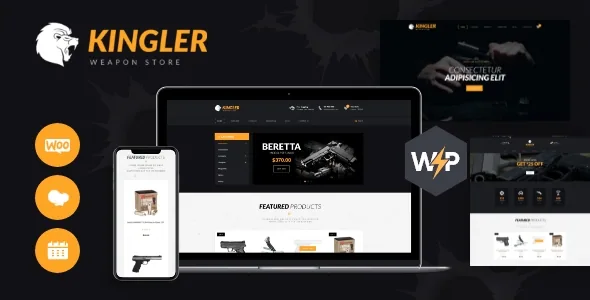
A store and a class schedule in one site
ThemeREX describes Kingler as suitable for an online weapon shop, a shooting school, a gun classes agency, a shooting range or a firearm training company. That list is not padding; it describes two kinds of site with different content models behind them. A shop sells products and needs categories, filters and a checkout. A training business advertises dates, instructors and booking information, and its pages change on a calendar rather than a stock list.
The vendor's own feature list confirms the split, naming both "Events management" and "Gun training classes" alongside store-oriented items such as "Awesome product filters" and custom hover effects. Read together, that means the theme is built for a business that does both: sells firearms, ammunition and accessories while running courses or range sessions you publish as events.
That combination is the thing to evaluate before anything else. If you need only a catalogue, half the theme's design intent is unused. If you need only a class schedule, WooCommerce is the heaviest dependency you will install for a brochure site.
How events and classes fit beside the shop
The events half rests on The Events Calendar, which the marketplace listing names in its compatible-with field. As described, the theme is styled to display upcoming events rather than supplying its own event engine. Event creation, recurrence, venue records and dates come from the plugin; Kingler contributes the presentation of that schedule inside its layouts.
That division matters for planning. You will not find a bespoke class-booking system in the theme's feature list. "Gun training classes" reads as a page and layout concept: a section describing courses, instructors or a booking call to action, with the calendar supplying the dated entries. If you need enrolment, capacity limits or payment per seat, those are questions for whichever booking tool you add, not something the theme's description promises.
A practical consequence: plan your information architecture around two menus. Products belong in WooCommerce categories; classes and events belong wherever The Events Calendar registers its archives. The vendor's mention of user menu and main menu support, plus a main menu slider, is styling and navigation rather than a claim that the two content types merge into one index.
The retail side: filters, hover effects and a fixed grid
The store features the vendor highlights are about browsing rather than checkout. "Awesome product filters" and "Outstanding custom hover effects" both sit before a customer commits, and both are the parts of a gun or tactical gear catalogue that carry the most repetition: ammunition types, calibres, brands, price bands, and product images that reveal a second view on hover.
An interactive Ajax search is also listed, which suits a catalogue where visitors arrive knowing roughly what they want and would rather refine results in place than reload a category page.
Two attributes set the container these sit in. The marketplace records the layout as Fixed and the columns as 4+, and the vendor changelog for version 1.6.1 records fixing the WooCommerce shop layout to four columns. Treat the shop grid as a designed constant: a dense four-across arrangement the theme is tuned for. If you run a small catalogue of high-value items and want two large products per row, expect to work against the theme's default composition rather than with it.
WPBakery as the editing surface, with shortcodes in a companion plugin
Pages are assembled in WPBakery Page Builder, which the vendor names as the builder and which appears in the marketplace compatible-with list. The vendor recommends it directly over Elementor, and describes using it to create "unlimited variants of Homepage Layouts". Gutenberg Optimized is marked No in the attributes, which is a grading of how deeply the theme is built for the block editor, not a statement that the block editor is unusable.
What you edit with is a shortcode inventory: accordion, button, columns, Google Map, tabs, team, testimonials, title, tooltip, toggle and more, plus dedicated Zoom, Content Slider, Video, Skills and eMailer items. The changelog for version 1.7 notes that theme options, widgets and shortcodes were moved into a Themerex Utilities plugin. In practice that means the panel you configure lives in a plugin alongside the theme, so both need to be present and current for the options to appear.
The widget set leans the same way: Popular Posts, Recent Posts, Recent Reviews, Top 10, Advertisement, Logo, Social Icons, Flickr and Twitter. Several of these are shop or content-furniture widgets rather than general-purpose ones, which is consistent with a site whose sidebar is selling rather than publishing.
For a team already working in WPBakery, this is a familiar path. For a team that expects to build templates with block patterns, Kingler will feel like a detour every time a layout changes.
Two sliders, split by placement
The vendor separates its slider tools by where they go rather than treating them as alternatives: Revolution Slider is named for the home slider, and Swiper Slider for posts and galleries. The homepage hero gets the timeline-based tool; listings and image sets get a lighter carousel.
That split is worth noting because it also tells you where the theme expects motion. The homepage is a composed, animated presentation; the archives are quietly functional. If you plan a static homepage hero, the Revolution Slider slot is the part of the demo you can leave empty.
What the update record shows, and what it does not
The changelog begins with 1.0.0 and runs through a long series of compatibility entries: PHP 8 in version 1.7.2, WordPress 6.4.1 in 1.7.7, WordPress 6.7.1 in 1.7.10 and WordPress 6.8.3 in 1.7.12. Each of those releases also refreshes the plugins the theme references and updates the demo data. Two plugins were removed along the way, elegro Crypto Payment in 1.7.9 and the Cookie Information plugin in 1.7.8, so a feature list that still mentions older integrations is not proof they are shipped now.
The version numbers in the supplied material do not agree. The marketplace listing records 1.7.7 as its latest version, while the vendor's changelog describes newer releases and the vendor record was last updated on 1 June 2026. The marketplace attributes declare compatibility from WordPress 4.9.x through 6.9.x. These are declarations of intent, not records of anyone running the theme on a server.
The honest reading: the theme has a long maintenance record and you should confirm which release you are actually working with before relying on any single compatibility claim. That gap is the uncertainty worth resolving first.
Package contents, images and the declared plugin list
The ThemeForest file list names PHP, CSS and JavaScript files. No layered design source is included, so visual changes happen in the theme options, in WPBakery elements, or in CSS.
The vendor is explicit that images used in the live preview are not included in the template and remain copyright of their owners. For a firearms and tactical theme, that is a real production cost: the demo's photography, and the military and range imagery carrying it, has to be licensed or replaced before launch.
Compatibility, as declared rather than tested, covers WooCommerce 6.x.x, The Events Calendar, WPML and WPBakery Page Builder, with Essential Grid, Revolution Slider and Swiper named among the plugin set in the vendor description. WPML's presence hints at a translated shop, but it is a declaration about expected integration; per-language behaviour of the shop and event pages is something to verify on your own build.
Where Kingler stops
Kingler makes sense when you already expect both a WooCommerce catalogue and a dated schedule of classes, and when WPBakery is a workflow you are comfortable in. Its filters, hover treatment and four-column grid suit a browsable armoury; The Events Calendar carries the training side; the shortcode and widget set fills out the pages between them.
It is a poorer match if your team builds in the block editor, if you want the shop grid to reshape per category, or if you need booking logic with seats and payments rather than an events listing. Those are choices the theme's described structure does not make for you.
Questions & answers
Does Kingler include a booking system for training classes?
No booking engine is described. The theme is declared compatible with The Events Calendar, which publishes dated events, and the vendor lists gun training classes as a page concept. Enrolment, capacity and per-seat payment would come from a separate tool you add.
Can I build Kingler pages with the block editor?
The theme is built around WPBakery Page Builder, with its own shortcode and widget set in a companion plugin, and the marketplace marks Gutenberg Optimized as No. The changelog does record a Gutenberg compatibility entry from version 1.7, so the block editor is not declared unusable; it is simply not the editing path the layouts are designed around.
Are the demo photos included with the theme?
No. The vendor states that images used in the live preview are copyright of their respective owners and are not part of the template. You will need to license or supply your own firearms, range and product photography.